A huge congratulations to Ashlin Barry, who won the U23 road race at the 2026 World Championship in Montréal yesterday—on his 19th birthday! On a course that favored smaller climbers on paper, Ashlin rode a smart race, got into the successful break, then dropped his companions to solo the last 30 km (!) to the finish. Well done!
This marks the first time that an American has won gold in the U23 race—Ashlin holds dual American and Canadian citizenships and raced for the U.S. in Montréal. Remarkably, it’s not the first time his family has won the worlds: Ashlin’s mother, Deidre ‘Dede’ Demet-Barry, won the Junior world championship in 1989! Ashlin’s father, Michael Barry Jr., raced in the Great Tours on the U.S. Postal, T-Mobile and Sky teams. And his grandfather, Michael Sr., founded Mariposa Bicycles in Toronto and pioneered cyclotouring bikes in the style of the French constructeurs in North America.
We all know Ashlin from his wins in mountain and gravel races on steel Mariposa bikes, rolling on Rene Herse tires. Sponsorship constraints mean that he’s not racing our tires on the road, but he’s still one of the family. In fact, our friendship goes back a long way: I visited Mike Sr. and Mariposa when I was a college student… and the shop continues to carry our products for customers in Toronto and all over Canada.
Lizards on my doorstep! I’ve tried for two years to get the little guys on camera, but every time I tried to get them into range of my 70mm macro they scurried into the wall. So more working distance was needed. To achieve a long working distance, you need long tele lenses. Sadly there are...
Mike Keating once rode a bicycle 396 miles through flatlands and across mountains from his home in Poquoson, Virginia, back to school at Emory & Henry College near the tip of Tennessee.
Saturday, the 67-year-old Keating will return to his alma mater — now called Emory & Henry University — when the former baseball, football and track-and-field standout will be inducted into the school’s sports hall of fame.
What a long, strange trip it’s been.
For Mike Keating is lucky to be alive.
*****
Mike Keating was a two-year starter at first base for Emory & Henry’s baseball team. Courtesy of Emory & Henry.
Dec. 9, 1986, was a moderate day in the Washington, D.C., area with a high temperature of 56 degrees.
Keating had just completed a workday as the sports editor of the Washington Times and had returned to his town house in nearby Woodbridge.
Still in prime athletic shape at age 27, he changed his clothes and was preparing to go for an evening run. At nearly 6:30 p.m., the sun had set, the air was cooling and a light rain was falling, so he decided to walk across the complex’s parking lot to get a windbreaker out of his leased Mazda RX-7.
As he reached into the back seat, Keating felt something hard pressing against the back of his head.
It was a .38-caliber pistol.
The gun was held by Tony Albert Mackall, a 23-year-old escapee from a halfway house in the D.C. prison system who only moments earlier had killed a woman at a nearby gas station by shooting her in the head while she was hanging Christmas decorations.
Needing a vehicle and intent on carjacking and armed robbery, Mackall ordered Keating back into his apartment at gunpoint.
Within minutes, Mackall fired two bullets into Keating’s skull, leaving the young man for dead.
Fate, blind luck or a higher power had other plans.
Forty years after the shooting, Keating reflected on the incident this week from his home in Houston as he prepared to travel back to his college campus for Saturday’s hall of fame ceremony.
“It was like on TV,” Keating said. “He put me up against the wall. He’s rummaging around looking for stuff, and I tell him, ‘This is all I’ve got in my wallet.’ He took that and tried to get me to find more money, and I said, ‘It’s just not here.’
“He’d had enough of that, and while I was against the wall, he came up and put the gun against the back of my head and fired. Like three seconds later, I didn’t know if he’d shot me or hit me so hard with the butt of the gun. It felt like a baseball bat. I kind of turned around and looked up, and he was kind of startled, like he didn’t finish the job. Then from about two feet away he did it again.
“[The second shot] was right above the left ear. From then I went down and stayed there and said my final prayer and waited. I wanted to make sure he was gone. I went down in the basement and went out the back in case he was out front. It was probably like a minute.”
How slowly can a clock move?
Keating managed to stumble down a staircase into a neighbor’s front door. An ambulance arrived within four minutes.
The emergency medical technicians wanted to airlift their patient to a hospital in Fairfax, but the conditions were too foggy to attempt a helicopter flight.
Keating was taken to a local hospital in Prince William County, which four decades ago was not the vast metropolitan area it is today. Doctors there instructed the EMTs to transport him to Fairfax. Keating’s employer had arranged for a top neurosurgeon to await his arrival.
The doctor would have to wait nearly an hour.
Imagine a 45-minute drive,” Keating said. “You’re in traffic. You’re in an ambulance. You know what’s happened now. You know it’s twice. You know it’s in the head. I mean, what are the chances? Every minute was excruciating, not from the head pain, but from what’s [possibly] next.”
What came next?
Nothing.
Keating recalls a surgeon, Dr. John Monahan, coming into his hospital room with an update on his condition.
“He said, ‘The good news is, we think you’re going to make it. That bad news is, we can’t touch anything in there,’ ” Keating related. “The two bullets were right there next to arteries they can’t even nick.”
He spent five days in intensive care. On the seventh day, Keating was discharged from the hospital with two bullets still in his head. Exactly 30 days later, Keating donned some sweats and completed the run he never got to take, jogging a mile.
“One of the [bullets] came out about a month later,” he said. “The body’s amazing. It wanted to reject [the bullet]. It tried to push it out on a path that was viable to get it. It was like watching a “Law & Order” scene where they take the bullet out and drop it in a little pan. Of course, that was used in the trial as evidence.”
Soon enough, Keating would take part in a real trial.
*****
Mackall was apprehended three days after the shootings. According to court records, he was tried Dec. 18, 1987, on charges of capital murder in the commission of robbery while armed with a deadly weapon and for robbery and the display of a firearm in a threatening manner.
The gunman killed Mary Dahn, 31, whose husband, Stephen Dahn, was the manager of the Riverview Shell Station on Jefferson Davis Highway near Interstate 95. The couple’s daughters, ages 5 and 6, were on the premises when Mackall shot Mary Dahn in the head and robbed the till of $515.
Keating testified during the second phase of Mackall’s trial and provided “evidence of aggravating and mitigating circumstances.”
Prince William County Commonwealth’s Attorney Paul Ebert prosecuted the case.
Ebert, who was born in Roanoke in 1937 and graduated from Virginia Tech, earned some national fame prosecuting trials involving John and Lorena Bobbitt as well as John Allen Muhammad, one of the notorious D.C. snipers.
Ebert also was an aggressive pursuer of the death penalty, which he successfully obtained 13 times in more than five decades in Prince William County as the longest-serving commonwealth’s attorney in Virginia history.
Mackall was convicted on all three charges and sentenced by jury to die by lethal injection. The presiding judge confirmed the sentence. Mackall’s lawyers began a series of appeals in 1988, but they proved unsuccessful, ending with a final rejection from Gov. Jim Gilmore. Mackall was executed on Feb. 10, 1998, more than 10 years following his trial.
“Whatever you believe about the death penalty … if he had killed me, he would not have gotten the death penalty for killing the woman, Mary Dahn,” Keating said.
“That’s the irony, because the state has to prove … at the time the language was ‘malicious and vile’ intent. If he killed me, any good lawyer is going to say, ‘Well, he panicked. That is not “malicious and vile.”‘ But now, when somebody who is [facing] the exact same end but through extraordinary luck or providence can actually describe it … when the women jurors are crying after your testimony, then the prosecutor has a pretty easy job.”
The convicted killer requested forgiveness from Dahn’s family, and he offered an apology to Keating in his final statement at Greensville Correctional Center in Jarratt.
“It was kind of creepy reading that,” Keating said. “He probably didn’t even know my name until that day [if] his lawyer told him. I mean, his own mother didn’t testify. That didn’t help him.”
Keating did not attend the execution.
“I chose not to,” he said. “The family did, and the family mentioned me, and I mentioned the family on the news. I was the subject of a news story that night. That was second-hand, but it was an acknowledgement to each side.”
Keating undergoes occasional medical tests. He said the most recent image of the inside of his head, where one bullet still lies, was five years ago.
“They’re spooky. You see the skull, and you see the trail of the bullet that basically imploded,” he said. “The biggest piece is not that big. It compressed when it hit the skull. It’s probably a half-inch, but there’s a lot of debris. Even now, the MRIs, I have to take the lowest one. They won’t do the most modern one. They’re afraid it will turn it [the bullet] the wrong way.”
Keating said the most physical trouble he had after the shooting was neck pain that restricted his ability to drive a car.
He believes his background as an athlete was a benefit in his recovery.
“All these health experts, whether people have cancer or other health issues, they talk about attitude. An athletic attitude can’t hurt. I wanted to get better as soon as possible. When it came to rehab, I was a madman. I worked harder at that than football practice.
“Obviously there were some mental effects. I’d wake up in a cold sweat. You’re not supposed to die in your dreams, but you can get pretty darn close.”
*****
Mike Keating (left) and Emory & Henry teammate Will Boylan rode bicycles across 400 miles across Virginia before the start of football practice in 1981. Courtesy of Emory & Henry.
Keating graduated from Poquoson High School in 1977, but he did not grow up in the small independent city, which is located on a peninsula adjacent to York County and is known for fishing and boating.
His world was broader than just Bull Island, a nickname Poquoson earned because local farmers once let their cows roam free in the salt marshes.
Keating was an Air Force brat, attending elementary school in Spain and living in Taiwan until the early 1970s. His father, John Keating, was an F-4 fighter pilot, participating in 217 missions during the Vietnam War before being stationed at Langley Air Force Base in Hampton.
John and Joanne Keating had seven children, and their second eldest showed up in Tidewater Virginia with a love of sports and the realization that Poquoson was not like Taiwan.
“In Poquoson, there were the locals, and then there were the outsiders like I was,” he said. “When I arrived in 1974, there were very few people other than the fishermen, the locals, who lived there. But then there’s Langley Air Force Base. All those [military] people started coming to Poquoson, and we were not well-received.
“They didn’t even like me. They tolerated me. They tolerated all the outsiders.”
Keating was a freshman starter on Poquoson’s baseball team. He did not play football until he was a junior, helping the team to a 1976 VHSL Group A state semifinal, where the Islanders lost to Madison County.
He attended nearby Old Dominion University as a walk-on with the baseball program, but his career ended with a shoulder injury caused when a car slammed into his vehicle at a stoplight. He eventually transferred from Old Dominion to Old Dominion Athletic Conference member Emory & Henry.
Keating followed former high school teammate and friend Will Boylan to Emory. Keating says Boylan sold him on the move. Boylan’s version is slightly different.
“I think it was more or less he saw me doing well in football and [thought], ‘If Boylan is doing well, then I can do well,’ ” he said. “He was like Michael Jordan, very competitive.”
Keating had an outstanding career in three sports.
He was a first-team All-ODAC football selection as a 6-foot, 170-pound free safety in 1981 and was an ODAC first-team pick in baseball as a first baseman, leading E&H in five offensive categories in 1980 and 1981. He also earned ODAC honors in track and field in the 100, 200 and triple jump.
Former E&H football coach and athletic director Larry Bales said Keating excelled despite leg trouble that curtailed his speed.
“Mike as an athlete was held back [because] he had calcium deposits in both quadriceps. He was a whole lot faster before,” said Bales, who still lives in Abingdon. “But you didn’t have to be too awful smart to see that he was a superior athlete. Coaches aren’t supposed to have favorites. Mike was one of mine.”
Bales’ favorite memory of Keating has nothing to do with football, baseball or track and field. It was the day Keating and Boylan rolled into Emory for the start of football practice in August 1981 on bicycles they pedaled 396 miles from Poquoson.
“Mike was an odd combination of a nut, but under control, very purposeful, very smart,” said Boylan, an Army brat himself who also starred in football and track and field. “He’s one of the smartest people I’ve ever met. He came up with this idea, ‘Let’s ride across Virginia.’ Of course, I’m crazy enough, I’ll do it.”
Keating’s father helped him map out a route across southern Virginia. The trek took the better part of four days, including a memorable overnight stop at the RJ Ranch near Hillsville where the locals greeted the two voyagers with food and festivities.
It might have been a warm reception, but the night air in the mountains was anything but comfortable.
“All we had on us was an extra pair of underwear, extra socks, extra shirt,” said Boylan, who is a business owner in Roanoke. “Mike had a bedsheet, and I had one of those military nylon blankets. That’s all we had. It’s in August. We’re near Hillsville. It gets cold, like in the 40s. We’re dying. We’re cuddled up togther. We got one sheet on the ground, one blanket on top of us. I got my underwear on my head and socks on my hands.
“We get up at 4 o’clock, and we’re dying. We go in the bathhouse. We turn the showerheads on. We move the benches over to the showerheads. And we sat in the shower until all the hot water ran out. We get on our bikes and 5 in the morning.”
When the pair arrived on campus with football practice scheduled to begin the following day, they were out of gas and just about everything else.
“They got to Emory, and of course they had spent all their money,” Bales said. [The football program] didn’t have any money. We had five thousand dollars for the entire season. My entire recruiting budget was five hundred.
“Mike and Will came to me and said, ‘Coach, you got any money hidden back so we can have dinner tonight? Of course, we didn’t. I think I had 25 dollars in my pocket, and that’s how much they had to eat on that night.”
*****
Mike Keating (right) in 2019 with his father, John Sr., and his brother, John, during a golf trip to Ireland. Courtesy of Keating.
Keating graduated from E&H with an English degree and began working as a sportswriter at the Daily Press in Newport News, where he had worked part time.
He quickly moved to the Washington Times, which was founded by Unification Church leader Sun Myung Moon in 1982. At age 25 in 1984, Keating became sports editor.
“It was kind of a startup. They were offering like, twice the salary,” he said. “I said, ‘You know, I’ll give this a try.’ “
Keating stayed on board for a decade until he founded a magazine called “Washington Golf Monthly,” eventually buying the publication, which later became known as “Golfstyles.”
Just to prove he knew the subject matter, Keating attempted to qualify for the Virginia State Golf Association’s Senior Championship in 2017. At age 58, Keating not only qualified, he was the medalist with rounds of 5-under-par 67 and 74 at the Pete Dye Full Cry course at Keswick Golf Club in Charlottesville.
Keating, no longer married, has five children and five grandchildren. He and his father and brother used to make annual golf pilgrimages to Ireland. He has walked the 175-mile version of The Camino Way in Spain and plans to do the entire distance in 2027.
His old buddy, Boylan, is not surprised.
“He’s just gutsy. I mean, look what he’s done,” he said. “He rides across the state of Virginia on a bike, not having trained. He navigated us. No problem. Then he gets shot. No problem.”
Keating was curious how much a reporter wanted to know about the day he took two bullets to the head 40 years ago.
“It’s a good cocktail party story,” he said. “It gets rapt attention for about 15 minutes. People just shake their head and go, ‘ ‘Holy s—.’ “
Because the ending could have been much different. Instead, Keating will be the oldest of six 2026 inductees into his college’s sports hall of fame.
“I guess I can take my posthumous speech out of the will,” he said, “so nobody has to deliver that.”
Pete Hegseth and Trump got a dubious win today: a 2-1 panel of the DC Circuit found that the designation of Anthropic as a supply chain risk was not unlawful. It dismissed Anthropic’s challenge despite (1) a different court having found the exact opposite not that long ago; (2) being predicated on a statutory interpretation of “supply chain risk” that would effectively deem most AI models, and potentially all software, a supply chain risk; (3) having made this designation selectively and punitively; and (4) it resulting in Anthropic being disqualified from selling its model to any government agency, including those without same concern the DC Circuit credited the military with having.
To some extent the difference in the two decisions can be explained by the two different statutes at issue. Hegseth claimed the authority to make “supply chain risk” designations under two separate ones, 10 U.S.C. § 3252, which was at issue in the California challenge, and 41 U.S.C. § 4713, which was at issue in this case. Congress is also partly to blame for this mess, because in writing the statutory definition for “supply chain risk” in the 4713 statute it created more space for dubious interpretations like this one (“Whatever paradigmatic examples individual members of Congress may have had in mind, the statutory definition is not limited to “adversar[ies],” 10 U.S.C. § 3252(d)(4), and instead covers “any person,” which cannot refer only to foreign entities, 41 U.S.C. § 4713(k)(6).”). The statute also constrained how such designations could be challenged, sending them all directly to the DC Circuit, rather than a district court, which is why Anthropic’s challenge of the Hegseth action ended up in two separate cases.
But a bizarre situation has still resulted where one court has said that Anthropic’s First Amendment and due process rights had been violated, and another has now said they weren’t, even though the same action was involved with both. Anthropic argued that the California district court’s earlier decision should have been controlling, but the DC Circuit disagreed:
Anthropic contends that the Northern District’s decision is preclusive as well as persuasive. But because the Department’s designation authority is much broader under section 4713 than it is under section 3252, the issues flagged by Anthropic are not the same in both cases. So, for example, the Northern District’s determination that the section 3252 designation was arbitrary does not control our determination whether the section 4713 designation was arbitrary. Likewise, the Northern District’s determination of exigency under section 3252 does not control our determination of exigency under section 4713. In any event, Congress gave this Court exclusive jurisdiction to review procurement actions taken pursuant to section 4713 designations, see 41 U.S.C. § 1327(b)(1), and it specifically barred other courts from reviewing any other “action taken under” section 4713, see id. § 1327(a). That strict “allocation of jurisdiction” to this Court makes it inappropriate to constrain our review based on the Northern District’s judgment. Restatement (Second) of Judgments § 28 (1982); see Shaw v. State of Cal. Dep’t of Alcoholic Beverage Control, 788 F.2d 600, 607–09 (9th Cir. 1986); Lyons v. Westinghouse Elec. Corp., 222 F.2d 184, 188–89 (2d Cir. 1955) (L. Hand, J.).
Instead, because the DC Circuit read the statutory authority Hegseth drew from differently, apparently given its textual differences, it found Hegseth entitled to take the action that he did. But it is a dubious reading that would have broad implications the court did not address. In short, because Anthropic would still have control over its model, the court found that it could be considered to have the power to “manipulate” it, even after being deployed in government, and that made it a supply chain risk.
The Secretary reasonably concluded that removing Anthropic from the Department’s supply chain was necessary to protect national security by reducing supply chain risk to the Department’s information systems. Specifically, the Secretary credited a joint recommendation from two senior Department officials that Claude might be “subject to manipulation” by Anthropic “in such a manner as to inhibit the DoW’s use thereof.” App. 178. Likewise, he credited Under Secretary Michael’s conclusion that Anthropic might “manipulat[e]” the “design, integrity, and operation” of the Department’s Claude models, potentially causing “critical defense system[s] failing to engage” as intended by the Department. Id. at 182.
The record in this case amply supports the Secretary’s conclusion. To begin, it is undisputed that Anthropic can and does control how Claude responds—or fails to respond—to user prompts. Anthropic’s Chief Science Officer explained how the company “seek[s] to embed safety considerations directly into the model itself.” App. 8. Its CEO explained how such training gives the model an “identity, character, values, and personality” of its own, tethered to a “constitution” developed to impose “high-level principles and values” on Claude itself. Id. at 93–94. And the head of its public-sector business explained: “Model training is the primary mechanism through which Anthropic can influence the behavior of models used by the Department.” Id. at 276. Anthropic disclaims any ability to access or alter a model that has already been delivered to the Department, see id., despite the “technical measures” that it uses to police compliance with usage restrictions by private customers, id. at 8. Nonetheless, extant models reflect Claude’s “[c]onstitutional” training. Id. at 274–75. Moreover, Anthropic may encode additional restrictions each time it delivers any “new version of the model” to Department contractors. Id. at 276. Finally, it is undisputed that such model restrictions are vitally important to Anthropic, which describes them as lying “at the core of [its] mission.” Id. at 2.
The record also indicates that Anthropic’s model training is effective in enforcing usage restrictions and that, as a result, Claude has refused to answer legitimate queries from government users. Anthropic itself explained how early, commercially available versions of Claude frustrated Department and intelligence-community users by refusing prompts to evaluate classified materials. App. 255. Likewise, as Under Secretary Michael explained, the Department learned in 2025 that Claude had refused to process CDC prompts to support research to prevent the spread of infectious diseases. Id. at 212. Anthropic responds that these glitches reflected safety features appropriately built into models sold to private companies and were resolved after Anthropic engineers worked with the relevant government stakeholders. Id. at 255–56, 261–62. Perhaps so, but the point here is not that these model or usage restrictions were arbitrary; instead, it is that Anthropic’s model training does effectively enforce contractual usage restrictions.
Finally, the record reveals a recent, serious dispute about the scope of the contractual prohibitions on lethal autonomous warfare and mass domestic surveillance. Under Secretary Michael describes the incident in general but striking terms: [O]ne of Anthropic’s executives questioned the propriety of the potential use of their software for a sensitive military operation abroad despite that use being permitted under the existing Terms of Service. This led to alarm by the DoW and the prime contractor who provides Anthropic software, and raised material doubts as to whether they would cause their software to stop working or cause some other disastrous action that would put our warfighters[’] lives in danger. App. 181. Anthropic does not say much about this incident, except to suggest that it reflected a misunderstanding. Id. at 236–37. But regardless, Anthropic has made clear that it views the contractual prohibition on mass domestic surveillance as urgent to support “democratic values,” id. at 146, and the contractual prohibition on lethal autonomous warfare as urgent to avoid “put[ting] America’s warfighters and civilians at risk” of a catastrophic AI mistake, id. at 147. For its part, the Department has made clear that it views an “any lawful use” authorization to be critical to its “AI-first” strategic plan. Id. at 202, 206. With such diametrically opposed positions and with contractual limitations that are hardly self-defining, the prospect for disputes is apparent.
In sum, the Department reasonably feared that Anthropic might manipulate Claude’s design to prevent it from performing national-security functions that the Department deems contractually authorized and necessary.
The nightmare hypo that the court credited was what if the military had some sensitive plans that depended on Claude’s use, which Anthropic then changed on the fly, which jeopardized the mission. But there are multiple problems with the court’s acceptance of the government’s argument here.
For one, if the court’s statutory interpretation about the power to affect the operation of delivered software were correct, then pretty much any software product, at least those still subject to vendor-supplied updates, could be considered supply chain risks, given that any update could make substantive changes. In any case, it would seem to mean that any AI model would be too risky for the government to use, because there is nothing unusual about Anthropic’s model-control architecture—to the extent Anthropic could still control its model, so could any other AI vendor potentially control theirs. Whether they would or not would depend on the contract restraining them, and the only thing potentially different about Anthropic is that it did not want to be contractually obligated to allow certain functions that Hegseth really wanted—functions that were ethically dubious at best and monstrously dangerous at worst.
But because that contractual reluctance upset Trump and Hegseth, they singled Anthropic out, alone, for negative treatment, turning their pique that “we can’t agree with Anthropic on how the software would need to be designed for us to be able to buy it” into “and because we can’t agree then NO ONE ELSE IN THE GOVERNMENT CAN EVER USE IT.” Per the DC Circuit, such an overbroad measure—after all, not every agency had the same concerns about changeability that the military might, yet Hegseth was deciding for them, too, whether they could use Claude, even when its architecture created no particular risk to them—and clearly punitive measure was perfectly fine because it implicated the implicit “national security” exception to the First Amendment the Founders apparently wrote into it in invisible ink.
To succeed on such a First Amendment retaliation claim, the plaintiff or petitioner must prove that (1) it engaged in protected speech, (2) the government took materially adverse action against it, and (3) the speech caused the materially adverse action. See Houston Cmty. Coll. Sys. v. Wilson, 595 U.S. 468, 477–79 (2022); Aref v. Lynch, 833 F.3d 242, 258 (D.C. Cir. 2016). Anthropic has satisfied the first and second prongs of this test, but not the third. The First Amendment squarely protects Anthropic’s advocacy regarding the safe and appropriate use of AI products. Moreover, the Department’s exclusion of Claude from its supply chain plainly qualifies as a materially adverse action. However, we can discern no causal connection between the two. Instead, the record makes clear that the Department removed Anthropic from its supply chain not because of its advocacy, but because Anthropic refused to agree to a contract term the Department deemed essential to national security.
Because Anthropic wouldn’t do the deal Hegseth wanted to do, he was therefore entitled to declare it too risky for anyone in the government to use, without it being seen as punishing Anthropic for its disinclination.
Anthropic points to various pungent statements in the Secretary’s February 27 social media post. Among other things, the Secretary denounced Anthropic’s “sanctimonious rhetoric,” “virtue-signaling,” and “Silicon Valley ideology.” App. 77. Such rhetoric seldom provides a sound basis for judging the lawfulness of federal executive action. See, e.g., Mullin v. Doe, 146 S. Ct. 2121, 2139 (2026); Trump v. Hawaii, 585 U.S. at 700–02. In any event, for all its flourishes, the Secretary’s social media post squarely addresses Anthropic’s refusal to provide the “all lawful uses” contractual authorization. He described Anthropic’s behavior as a “textbook case of how not to do business” with the Pentagon. App. 77 (emphasis added). He reiterated the Department’s demand for “full, unrestricted access to Anthropic’s models for every lawful purpose in defense of the Republic.” Id. (cleaned up). And he characterized Anthropic’s refusal to provide that access as imposing an unacceptable “veto power over the operational decisions of the United States military.” Id. The nub of this dispute was contractual, and the First Amendment did not require the Department to continue a contractual relationship that it viewed as creating a national-security risk.
Per the DC Circuit panel, the First Amendment takes a backseat to the President and his Secretary’s determination that a technology can ever be used by the government, no matter what.
This case raises profoundly difficult questions about the appropriate military uses of an almost unimaginably powerful new technology. The Secretary raises the deeply sobering prospect of overly constrained AI models shutting down unexpectedly and thus causing important military operations to fail. Anthropic raises the deeply sobering prospect of unconstrained AI models hallucinating inappropriate targets for lethal military force. Both possibilities present obvious national-security concerns. But in our Republic, it is the President and the Secretary of War who must determine how best to balance the competing risks. In doing so here, the Secretary did not transgress any limits on his authority under the Supply Chain Security Act or the Constitution. Accordingly, we deny the petitions for review.
Which cannot possibly be right if the Bill of Rights is to have any meaning in limiting government power, and especially not on a record like this. Yet here we are.
The Metric Is Not the Mission is a ten-part examination of how Big Tech moved from building and expanding the open internet to increasingly shaping it around its own metrics, incentives and assumptions. Across the series, the argument follows the evolution of the platform economy—from the optimism of the early internet to the growing tensions around power, prediction, geopolitics, accountability and the future of digital life.
The series will be published in two parts each week over five weeks, with each installment building on the one before it. At the end of the series, the complete essay will be brought together in a single PDF edition, providing the full argument in one place.
Part II — When They Still Understood Us
Part I looked at the slow transformation taking place beneath the daily controversies surrounding Big Tech. This second part goes back to the beginning, asking what these companies originally understood about people and how the metrics that once measured their success gradually became the definition of it.
It has become fashionable to tell the story of Big Tech as though it were always destined to end here. In retrospect, it is easy to portray the rise of the major platforms as the inescapable march of surveillance capitalism, monopolistic ambition, and unchecked technological power. That narrative is emotionally satisfying because it offers clear villains and a comforting sense of inevitability. It also happens to be incomplete.
Cory Doctorow has given this deterioration a memorable name: “enshittification.” His argument is that platforms initially serve users well, then, once users and business customers are locked in, progressively shift value away from both toward shareholders, degrading the service in the process. It is a powerful account of how platforms become extractive. But it is not quite the argument here. The deeper problem is not simply that Big Tech has learned to extract more from us but that it has become increasingly convinced that because it can measure and predict our behavior, it understands us and, by extension, the societies it has come to mediate. The failure is therefore not only economic; it is also epistemic. The metric has become a substitute for the mission.
One cannot understand why these companies now appear increasingly disconnected from the societies they helped shape without first acknowledging that, for a remarkably long time, they understood those societies exceptionally well.
Technology succeeds when it solves technical problems. It changes the world when it solves human ones.
That was the genius of the first generation of internet platforms. Their founders did not invent friendship, curiosity, creativity or community. They simply recognized that the internet had reached a stage where these deeply human instincts required new forms of expression. The web of the late 1990s was exhilarating, but it was also fragmented, uneven and, for many people, intimidating. Finding information often required patience. Discovering interesting websites depended on chance as much as design. Publishing demanded a degree of technical literacy that excluded far more people than it empowered. The internet was open, but openness alone does not necessarily produce accessibility.
The great platforms emerged not because they sought to replace the internet but because they made it intelligible. Google transformed an expanding wilderness of information into something navigable. Wikipedia demonstrated that knowledge could be organized through collaboration rather than hierarchy. YouTube lowered the barriers to publishing so dramatically that expertise escaped universities, broadcasters and production studios. Facebook addressed an even more fundamental challenge. It recognized that the internet was no longer simply about information; it had become about people. Until then, maintaining relationships online had been surprisingly cumbersome. Email was too formal, instant messaging too ephemeral, personal websites too static. Facebook reduced social interaction to something almost frictionless. Its success lay not in technological sophistication but in psychological intuition.
This is easy to forget because the platforms that dominate our lives today bear only a partial resemblance to the ones that first captured our imagination. Facebook did not begin as an endless stream of algorithmically selected content. It was, in essence, a digital address book enriched by photographs, conversations, and the ordinary rituals of everyday life. It became valuable because it mirrored existing relationships rather than attempting to manufacture new ones. There was comfort in discovering former classmates, following the lives of distant relatives, or organizing gatherings that would otherwise have required dozens of emails and phone calls. The platform expanded social life without yet attempting to redefine it.
YouTube offered a similarly modest promise. It was not originally designed to maximize engagement or optimize watch time. It functioned more like an immense public archive whose value derived from its unpredictability. One could arrive searching for a lecture on astronomy and leave having discovered a forgotten jazz performance, a documentary on Greek history, or a repair manual for a washing machine. Recommendation existed, but it remained subordinate to curiosity. Users still felt as though they were exploring rather than being guided.
Even Twitter (now X), before it became a battleground for politics, culture wars, and performative outrage, captured something important about the changing nature of public conversation. It collapsed distance between journalists, academics, politicians, and ordinary citizens in ways that would have seemed extraordinary only a few years earlier. For all its imperfections, it suggested that expertise and authority might become more accessible rather than less.
Looking back, what united these companies was not simply technological innovation but a particular philosophy of the internet. They assumed that openness generated value. The more people connected, the richer the network became. Every new participant increased the possibilities for everyone else. Economists describe this as a network effect, but the phrase barely captures its cultural significance. Participation itself became the source of optimism. The internet appeared to be validating one of the oldest liberal ideas: that societies flourish when individuals are free to exchange ideas, collaborate voluntarily, and build institutions from the bottom up.
It is difficult to overstate how persuasive this vision became. Most governments celebrated the digital economy as an engine of innovation. Investors poured unprecedented sums into technology because the opportunities seemed limitless. Civil society organizations embraced online platforms as tools for democratic participation and global advocacy. Even critics of globalization often regarded the internet as an exception, a domain where openness appeared to distribute power rather than concentrate it.
For a brief historical moment, these interests aligned. What was good for technology companies often appeared to be good for users, for markets, and, in many respects, for the internet itself. The incentives reinforced one another. Companies grew by making the network more useful. Users benefited from larger communities. Developers built new services on open standards. The web expanded because success depended on drawing people further into its richness rather than confining them within a single destination.
History, however, has an inconvenient habit of changing the problems that institutions are asked to solve. The sociologist Robert K. Merton once observed that organizations often become prisoners of their own success. Practices that were rational under one set of conditions gradually harden into routines, and routines into orthodoxies. Institutions continue refining the solutions that once made them indispensable even as the environment around them evolves. Success breeds confidence; confidence breeds certainty; certainty eventually makes adaptation more difficult than persistence.
There is no reason to believe technology companies are exempt from this pattern. If anything, their extraordinary success may have accelerated it.
The platforms that once competed to help users navigate an open internet eventually found themselves managing ecosystems of unprecedented scale. Their priorities changed almost imperceptibly. The models they developed during the internet’s age of expansion proved astonishingly effective at connecting people, organizing information, and lowering the costs of participation. The metrics through which they evaluated success, such as growth, engagement, scale, and network effects, were not arbitrary inventions of venture capital. They reflected a period during which connecting more people genuinely created more value for everyone involved. The problem is that the world changed while the metrics remained stable. A measure that once indicated success gradually became the definition of success itself.
There is an obvious parallel here with Goodhart’s Law: when a measure becomes a target, it ceases to be a good measure. The principle, first articulated by economist Charles Goodhart in the context of monetary policy, describes what happens when an indicator that works as a proxy for an underlying objective is turned into the objective itself. But the problem here is slightly different. The issue is not simply that platforms began gaming their metrics, or that users learned to optimize for them. It is that the metrics gradually became so deeply embedded in the companies’ understanding of success that the distinction between the measure and the mission was lost. The metric did not merely distort the objective; it quietly became the objective.
None of this happened because a group of executives gathered in a boardroom and decided to undermine the open internet. Institutional change is rarely so theatrical. More often, it emerges from countless rational decisions made in pursuit of perfectly reasonable objectives: improve the user experience, reduce friction, personalize recommendations, increase safety, remove inconvenience. Each adjustment appears modest in isolation but collectively they alter the character of the system itself.
This is where history becomes quietly ironic. The companies that had once understood the internet better than anyone else slowly began to forget what had made the internet exceptional in the first place. They continued to believe they were connecting the world, even as they increasingly replaced the world with carefully curated representations of it. They accumulated unprecedented quantities of information about human behavior while becoming progressively less attentive to the human condition.
The distinction is subtle, but it may prove to be the defining story of this technological era. To observe behavior is not the same as understanding experience. A platform can know how long we hesitate before clicking a link, which videos hold our attention for an extra seven seconds, or what sequence of images is most likely to keep us scrolling late into the night. It can infer preferences with astonishing accuracy. It can predict patterns that would have been unimaginable a generation ago. Yet prediction, however sophisticated, remains an impoverished form of understanding. It reveals what people do. It says far less about why they do it, what they fear, what they hope for, or what kind of society they are trying to build together.
That difference, almost invisible at first, is where the story begins to change.
Konstantinos Komaitis, PhD, is a veteran of developing and analysing Internet policy to ensure an open and global Internet.
Yesterday, I received this email as a response to You Can't Vibe Code Love. It's such a remarkable and powerful statement that I asked permission to share it here, in its entirety, with personal information redacted:
Hey Jeff,
Hope you and your family are doing well.
Just jogging your memory; I reached out to you (and John Carmack) about how difficult interviewing had become despite me being a stellar engineer at my work. You offered some words of wisdom, wrote me a postcard, which I still have, and stickers (which my kids loved).
I took a leadership coordination role in Tokyo, and it freed me from the interview process I hated, and I'm still programming. Through the public school here my family found our way into a community, which brings me to why I'm writing.
I've been thinking about Stack Overflow drying up and honestly; I feel profoundly sad.
2013 I was active duty in the Air Force. Simultaneously I was also going to college full time remotely. I was deployed in Zamboanga Philippines. The Zamboanga Siege happens. Over 100 people killed, 120,000 civilians displaced. It was warfare in a populated city where nobody should have every been caught up in that to begin with. For 3 weeks this went on.
I was still doing college. I still had homework, tests, projects. All of that needed to be done.
With everything happening around me, missing my projects and homework became a huge risk. Everyday was a fight to do my job and help these people, and do my school. I would cry a lot looking at my textbooks not sleeping. The smoke from the burning city would come in the cracks of the buildings I worked and lived in.
I had a Microsoft Surface because it was perfect for someone who was flying around with equipment on vehicles that vibrated all the time. I swapped the plate out from my vest and slid in my Surface so that I could still do my homework if we had to leave. That's how important this was to me.
Sometimes I would get stuck, and I needed someone to just nudge me in the right direction.
I actually come from a family with a few software engineers. I have friends who were software engineers. I reached out for help. The standard response from everyone fell between ignoring me or telling me I need to "do it myself".
You know who did help me? Random strangers on Stack Overflow. People who had nothing to gain from helping me other than just trying to help someone in need.
That meant so much to me. I felt a connection to people through a community.
And it meant the world.
An LLM would have done exactly what I wanted back then. But would it have given me what I needed?
At the time, I needed to know somebody cared enough to help me.
You, your colleagues, and random strangers in the Stack Overflow Community, really helped me. It was more than answering my questions. You gave me your time. That made me feel like I mattered. The fact my questions could help other people in my predicament made me feel like I was part of something.
An LLM can't do that.
So when I watch communities hollow out, replaced by something that gives answers but doesn't give me a single thought... I get depressed. Because we're losing something that was always there but I didn't notice. It's like losing gravity.
Thanks for everything. If you ever find yourself in [city] I'd love to say thank you personally.
Hope all is well, D
Perhaps the LLMs are a reminder that we should make an extra effort to cultivate relationships with each other and form communities online – communities that belong to us, not some billionaire. Communities where we regularly stop to help each other, because that's how we learn too. And if we do not stop to help each other... what do we become?
Yesterday, I received this email as a response to You Can't Vibe Code Love. It's such a remarkable and powerful statement that I asked permission to share it here, in its entirety, with personal information redacted:
Hey Jeff,
Hope you and your family are doing well.
Just jogging your memory; I reached out to you (and John Carmack) about how difficult interviewing had become despite me being a stellar engineer at my work. You offered some words of wisdom, wrote me a postcard, which I still have, and stickers (which my kids loved).
I took a leadership coordination role in Tokyo, and it freed me from the interview process I hated, and I'm still programming. Through the public school here my family found our way into a community, which brings me to why I'm writing.
I've been thinking about Stack Overflow drying up and honestly; I feel profoundly sad.
2013 I was active duty in the Air Force. Simultaneously I was also going to college full time remotely. I was deployed in Zamboanga Philippines. The Zamboanga Siege happens. Over 100 people killed, 120,000 civilians displaced. It was warfare in a populated city where nobody should have every been caught up in that to begin with. For 3 weeks this went on.
I was still doing college. I still had homework, tests, projects. All of that needed to be done.
With everything happening around me, missing my projects and homework became a huge risk. Everyday was a fight to do my job and help these people, and do my school. I would cry a lot looking at my textbooks not sleeping. The smoke from the burning city would come in the cracks of the buildings I worked and lived in.
I had a Microsoft Surface because it was perfect for someone who was flying around with equipment on vehicles that vibrated all the time. I swapped the plate out from my vest and slid in my Surface so that I could still do my homework if we had to leave. That's how important this was to me.
Sometimes I would get stuck, and I needed someone to just nudge me in the right direction.
I actually come from a family with a few software engineers. I have friends who were software engineers. I reached out for help. The standard response from everyone fell between ignoring me or telling me I need to "do it myself".
You know who did help me? Random strangers on Stack Overflow. People who had nothing to gain from helping me other than just trying to help someone in need.
That meant so much to me. I felt a connection to people through a community.
And it meant the world.
An LLM would have done exactly what I wanted back then. But would it have given me what I needed?
At the time, I needed to know somebody cared enough to help me.
You, your colleagues, and random strangers in the Stack Overflow Community, really helped me. It was more than answering my questions. You gave me your time. That made me feel like I mattered. The fact my questions could help other people in my predicament made me feel like I was part of something.
An LLM can't do that.
So when I watch communities hollow out, replaced by something that gives answers but doesn't give me a single thought... I get depressed. Because we're losing something that was always there but I didn't notice. It's like losing gravity.
Thanks for everything. If you ever find yourself in [city] I'd love to say thank you personally.
Hope all is well, D
Perhaps the LLMs are a reminder that we should make an extra effort to cultivate relationships with each other and form communities online – communities that belong to us, not some billionaire. Communities where we regularly stop to help each other, because that's how we learn too. And if we do not stop to help each other... what do we become?
Our fun links this week include Jev, the super fast new AI classifier, and Persodex, the context layer for your Contacts (PS. hit Ben up if you’re in New York in mid-October).
Researchers say they recently found Google ads delivering a sophisticated tech support scam that freezes the screens of both Windows and Mac devices and displays messages urgently instructing them to phone a bogus call center.
The ads were displayed all over the web, including on high-traffic maps, weather, real-estate, document-hosting, and sports sites. Users who called the number were then urged to pay hefty fees, grant remote access to their devices, or divulge personal information. From August 31 to September 14, security firm Netskope observed users from 619 customer organizations click on the malicious ads, although none of them were actually scammed because Netskope blocked the content.
Roughly 62 percent of the organizations were based in the US, with Japan and Australia accounting for the Nos. 2 and 3 spots. Since the firm has visibility into only a tiny sliver of Internet activity, the number of people exposed to the ads—including those who fell victim to it—is likely much higher. Netskope tracked more than 250 Google Ads campaign IDs across at least 284 legitimate publisher sites.
Bella Cook grinned back at herself across Danville’s Memorial Drive on a sunny morning Friday.
It’s not weird to see her face, airbrushed in paint, on the side of the concrete wall. Actually, “it’s pretty cool,” said the 14-year-old.
A new mural, called “The River’s Radiance,” depicts Bella with her arm stretched out, reaching toward dragonflies and river reeds, with a blue heron flying behind her.
Bella and her family joined artist Jon Murrill on a trip from Roanoke, where they live, to Danville for a dedication ceremony introducing the mural, the newest piece of public art in the city.
“The River’s Radiance” was painted by Roanoke artist Jon Murrill, with help from community members. Photo by Grace Mamon.
Public art may seem less important than other city responsibilities, but it plays a big role in economic development and growth, said Lee Rainboth, Danville’s arts and culture director.
Conversations about a new mural first began about a year ago, and when the city put out a call for artists, Rainboth said some residents questioned the value of the artwork.
“People in this community might see art and think, ‘Why are you putting money into that when my utility bills are so high, and when we have so many people struggling with homelessness?’ Things like that,” he said.
But as the Danville area grows, quality of life and arts and culture have become increasing priorities.
The city researched peer localities and found that investing in public art helps business growth, education and other sectors by bringing residents and visitors alike to the downtown area, Rainboth said.
Previous public art, like the Danville Art Trail, a temporary exhibition of sculptures along the city’s Riverwalk, and the JTI fountain in the River District, have been well received by existing residents and new visitors, according to a 2024 master plan for the Danville parks and recreation department.
“We have to walk and chew gum,” Rainboth said. “Hopefully the art does help bring a sense of life and vitality that creates those ripple effects to improve some of the other areas that the community is struggling with.”
Questions about the mural investment have subsided during later stages in the project, he said.
“Now that it’s done and people have seen it, we’ve had positive responses across the board,” Rainboth said.
Murrill, who was one of 29 artists that applied for the project, also said that the response to the mural has been overwhelmingly positive — even during the painting process.
Community members were invited to help Murrill with the art, using roller brushes, paint brushes and airbrush cans to bring the formerly plain concrete wall to life.
“It makes a big difference when you can share ownership with the people that actually walk by and see and interact with the piece on a daily basis,” Murrill said in an interview after the ceremony.
Ashlyn Wheeler, one of the residents who helped paint the mural, said she heard about the opportunity online and was eager to participate.
“He taught us different techniques and tips to use the airbrush cans,” Wheeler said. “I did the wings over on the left side, and my brother and his wife got to do some of the grass and greenery. It was really enjoyable, and it also helped him [Murrill] with the labor aspect.”
The city didn’t dictate any specific imagery when it began searching for artists, Rainboth said. The request for proposals suggested that the mural be related to the river and a “welcoming gateway” into the River District, but otherwise it was open-ended, he said.
“Naturally, a lot of the artists gravitated toward the same inspiration of the heron, the water, the dragonflies, the nature that is associated with the river,” Rainboth said. “But the selection committee really liked the ones that involved people, too, because we wanted this to be a mural that would reflect the people of the community, as well as the nature, and how people can interact with nature and find joy in the beautiful natural resources that we have.”
That’s what the mural is all about, Murrill said. He wanted the piece to stand apart from other murals in the River District by including a portrait alongside river imagery, he said.
Bella said Murrill is friends with her dad and that he’s done her portrait before.
“I wanted to bring something fresh and new, something that represented youth and the relationship to nature,” Murrill said. “Representing Bella, who is a young girl from our region, was a great choice because it brings conversations back to what’s really important, which is youth being outside and this love of nature.”
The mural was sponsored by the Riverview Rotary club, which covered the $30,000 cost, including artist fees, equipment and materials, and preparation of the wall, Rainboth said.
Rainboth said he hopes the positive reception of the mural inspires more such projects.
“This is sort of a starting point for us, but we’re hoping to do much more in the community, seeing how positive the response was,” he said. “I’ve got a long list of other locations where I’d like to see public art, and it’s just a matter of securing the right support from all the different stakeholders, whether it be the owners of the buildings or other outside funders to help support it.”
Bella Cook grinned back at herself across Danville’s Memorial Drive on a sunny morning Friday.
It’s not weird to see her face, airbrushed in paint, on the side of the concrete wall. Actually, “it’s pretty cool,” said the 14-year-old.
A new mural, called “The River’s Radiance,” depicts Bella with her arm stretched out, reaching toward dragonflies and river reeds, with a blue heron flying behind her.
Bella and her family joined artist Jon Murrill on a trip from Roanoke, where they live, to Danville for a dedication ceremony introducing the mural, the newest piece of public art in the city.
“The River’s Radiance” was painted by Roanoke artist Jon Murrill, with help from community members. Photo by Grace Mamon.
Public art may seem less important than other city responsibilities, but it plays a big role in economic development and growth, said Lee Rainboth, Danville’s arts and culture director.
Conversations about a new mural first began about a year ago, and when the city put out a call for artists, Rainboth said some residents questioned the value of the artwork.
“People in this community might see art and think, ‘Why are you putting money into that when my utility bills are so high, and when we have so many people struggling with homelessness?’ Things like that,” he said.
But as the Danville area grows, quality of life and arts and culture have become increasing priorities.
The city researched peer localities and found that investing in public art helps business growth, education and other sectors by bringing residents and visitors alike to the downtown area, Rainboth said.
Previous public art, like the Danville Art Trail, a temporary exhibition of sculptures along the city’s Riverwalk, and the JTI fountain in the River District, have been well received by existing residents and new visitors, according to a 2024 master plan for the Danville parks and recreation department.
“We have to walk and chew gum,” Rainboth said. “Hopefully the art does help bring a sense of life and vitality that creates those ripple effects to improve some of the other areas that the community is struggling with.”
Questions about the mural investment have subsided now that the work is done, he said.
“Now that it’s done and people have seen it, we’ve had positive responses across the board,” Rainboth said.
Murrill, who was one of 29 artists that applied for the project, also said that the response to the mural has been overwhelmingly positive — even during the painting process.
Community members were invited to help Murrill with the art, using roller brushes, paint brushes, and air brush cans to bring the formerly plain concrete wall to life.
“It makes a big difference when you can share ownership with the people that actually walk by and see and interact with the piece on a daily basis,” Murrill said in an interview after the ceremony.
Ashlyn Wheeler, one of the residents who helped paint the mural, said she heard about the opportunity online and was eager to participate.
“He taught us different techniques and tips to use the airbrush cans,” Wheeler said. “I did the wings over on the left side, and my brother and his wife got to do some of the grass and greenery. It was really enjoyable, and it also helped him [Murrill] with the labor aspect.”
The city didn’t dictate any specific imagery when it began searching for artists, Rainboth said. The request for proposals suggested that the mural be related to the river somehow, and be a “welcoming gateway” into the River District, but otherwise it was open-ended, he said.
“Naturally, a lot of the artists gravitated toward the same inspiration of the heron, the water, the dragonflies, the nature that is associated with the river,” Rainboth said. “But the selection committee really liked the ones that involved people too, because we wanted this to be a mural that would reflect the people of the community, as well as the nature, and how people can interact with nature and find joy in the beautiful natural resources that we have.”
That’s what the mural is all about, Murrill said. He wanted the piece to stand apart from other murals in the River District by including a portrait alongside river imagery, he said.
Bella said Murrill is friends with her dad, and that he’s done her portrait before.
“I wanted to bring something fresh and new, something that represented youth and the relationship to nature,” Murrill said. “Representing Bella, who is a young girl from our region, was a great choice because it brings conversations back to what’s really important, which is youth being outside and this love of nature.”
The mural was sponsored by the Riverview Rotary club, which covered the $30,000 cost, including artist fees, equipment and materials and preparation of the wall, Rainboth said.
Rainboth said he hopes the positive reception of the mural inspires more such projects.
“This is sort of a starting point for us, but we’re hoping to do much more in the community, seeing how positive the response was,” he said. “I’ve got a long list of other locations where I’d like to see public art, and it’s just a matter of securing the right support from all the different stakeholders, whether it be the owners of the buildings or other outside funders to help support it.”
Bella Cook grinned back at herself across Danville’s Memorial Drive on a sunny morning Friday.
It’s not weird to see her face, airbrushed in paint, on the side of the concrete wall. Actually, “it’s pretty cool,” said the 14-year-old.
A new mural, called “The River’s Radiance,” depicts Bella with her arm stretched out, reaching toward dragonflies and river reeds, with a blue heron flying behind her.
Bella and her family joined artist Jon Murrill on a trip from Roanoke, where they live, to Danville for a dedication ceremony introducing the mural, the newest piece of public art in the city.
“The River’s Radiance” was painted by Roanoke artist Jon Murrill, with help from community members. Photo by Grace Mamon.
Public art may seem less important than other city responsibilities, but it plays a big role in economic development and growth, said Lee Rainboth, Danville’s arts and culture director.
Conversations about a new mural first began about a year ago, and when the city put out a call for artists, Rainboth said some residents questioned the value of the artwork.
“People in this community might see art and think, ‘Why are you putting money into that when my utility bills are so high, and when we have so many people struggling with homelessness?’ Things like that,” he said.
But as the Danville area grows, quality of life and arts and culture have become increasing priorities.
The city researched peer localities and found that investing in public art helps business growth, education and other sectors by bringing residents and visitors alike to the downtown area, Rainboth said.
Previous public art, like the Danville Art Trail, a temporary exhibition of sculptures along the city’s Riverwalk, and the JTI fountain in the River District, have been well received by existing residents and new visitors, according to a 2024 master plan for the Danville parks and recreation department.
“We have to walk and chew gum,” Rainboth said. “Hopefully the art does help bring a sense of life and vitality that creates those ripple effects to improve some of the other areas that the community is struggling with.”
Questions about the mural investment have subsided during later stages in the project, he said.
“Now that it’s done and people have seen it, we’ve had positive responses across the board,” Rainboth said.
Murrill, who was one of 29 artists that applied for the project, also said that the response to the mural has been overwhelmingly positive — even during the painting process.
Community members were invited to help Murrill with the art, using roller brushes, paint brushes and airbrush cans to bring the formerly plain concrete wall to life.
“It makes a big difference when you can share ownership with the people that actually walk by and see and interact with the piece on a daily basis,” Murrill said in an interview after the ceremony.
Ashlyn Wheeler, one of the residents who helped paint the mural, said she heard about the opportunity online and was eager to participate.
“He taught us different techniques and tips to use the airbrush cans,” Wheeler said. “I did the wings over on the left side, and my brother and his wife got to do some of the grass and greenery. It was really enjoyable, and it also helped him [Murrill] with the labor aspect.”
The city didn’t dictate any specific imagery when it began searching for artists, Rainboth said. The request for proposals suggested that the mural be related to the river and be a “welcoming gateway” into the River District, but otherwise it was open-ended, he said.
“Naturally, a lot of the artists gravitated toward the same inspiration of the heron, the water, the dragonflies, the nature that is associated with the river,” Rainboth said. “But the selection committee really liked the ones that involved people, too, because we wanted this to be a mural that would reflect the people of the community, as well as the nature, and how people can interact with nature and find joy in the beautiful natural resources that we have.”
That’s what the mural is all about, Murrill said. He wanted the piece to stand apart from other murals in the River District by including a portrait alongside river imagery, he said.
Bella said Murrill is friends with her dad and that he’s done her portrait before.
“I wanted to bring something fresh and new, something that represented youth and the relationship to nature,” Murrill said. “Representing Bella, who is a young girl from our region, was a great choice because it brings conversations back to what’s really important, which is youth being outside and this love of nature.”
The mural was sponsored by the Riverview Rotary club, which covered the $30,000 cost, including artist fees, equipment and materials and preparation of the wall, Rainboth said.
Rainboth said he hopes the positive reception of the mural inspires more such projects.
“This is sort of a starting point for us, but we’re hoping to do much more in the community, seeing how positive the response was,” he said. “I’ve got a long list of other locations where I’d like to see public art, and it’s just a matter of securing the right support from all the different stakeholders, whether it be the owners of the buildings or other outside funders to help support it.”
Bella Cook grinned back at herself across Danville’s Memorial Drive on a sunny morning Friday.
It’s not weird to see her face, airbrushed in paint, on the side of the concrete wall. Actually, “it’s pretty cool,” said the 14-year-old.
A new mural, called “The River’s Radiance,” depicts Bella with her arm stretched out, reaching toward dragonflies and river reeds, with a blue heron flying behind her.
Bella and her family joined artist Jon Murrill on a trip from Roanoke, where they live, to Danville for a dedication ceremony introducing the mural, the newest piece of public art in the city.
“The River’s Radiance” was painted by Roanoke artist Jon Murrill, with help from community members. Photo by Grace Mamon.
Public art may seem less important than other city responsibilities, but it plays a big role in economic development and growth, said Lee Rainboth, Danville’s arts and culture director.
Conversations about a new mural first began about a year ago, and when the city put out a call for artists, Rainboth said some residents questioned the value of the artwork.
“People in this community might see art and think, ‘Why are you putting money into that when my utility bills are so high, and when we have so many people struggling with homelessness?’ Things like that,” he said.
But as the Danville area grows, quality of life and arts and culture have become increasing priorities.
The city researched peer localities and found that investing in public art helps business growth, education and other sectors by bringing residents and visitors alike to the downtown area, Rainboth said.
Previous public art, like the Danville Art Trail, a temporary exhibition of sculptures along the city’s Riverwalk, and the JTI fountain in the River District, have been well received by existing residents and new visitors, according to a 2024 master plan for the Danville parks and recreation department.
“We have to walk and chew gum,” Rainboth said. “Hopefully the art does help bring a sense of life and vitality that creates those ripple effects to improve some of the other areas that the community is struggling with.”
Questions about the mural investment have subsided during later stages in the project, he said.
“Now that it’s done and people have seen it, we’ve had positive responses across the board,” Rainboth said.
Murrill, who was one of 29 artists that applied for the project, also said that the response to the mural has been overwhelmingly positive — even during the painting process.
Community members were invited to help Murrill with the art, using roller brushes, paint brushes and airbrush cans to bring the formerly plain concrete wall to life.
“It makes a big difference when you can share ownership with the people that actually walk by and see and interact with the piece on a daily basis,” Murrill said in an interview after the ceremony.
Ashlyn Wheeler, one of the residents who helped paint the mural, said she heard about the opportunity online and was eager to participate.
“He taught us different techniques and tips to use the airbrush cans,” Wheeler said. “I did the wings over on the left side, and my brother and his wife got to do some of the grass and greenery. It was really enjoyable, and it also helped him [Murrill] with the labor aspect.”
The city didn’t dictate any specific imagery when it began searching for artists, Rainboth said. The request for proposals suggested that the mural be related to the river and a “welcoming gateway” into the River District, but otherwise it was open-ended, he said.
“Naturally, a lot of the artists gravitated toward the same inspiration of the heron, the water, the dragonflies, the nature that is associated with the river,” Rainboth said. “But the selection committee really liked the ones that involved people, too, because we wanted this to be a mural that would reflect the people of the community, as well as the nature, and how people can interact with nature and find joy in the beautiful natural resources that we have.”
That’s what the mural is all about, Murrill said. He wanted the piece to stand apart from other murals in the River District by including a portrait alongside river imagery, he said.
Bella said Murrill is friends with her dad and that he’s done her portrait before.
“I wanted to bring something fresh and new, something that represented youth and the relationship to nature,” Murrill said. “Representing Bella, who is a young girl from our region, was a great choice because it brings conversations back to what’s really important, which is youth being outside and this love of nature.”
The mural was sponsored by the Riverview Rotary club, which covered the $30,000 cost, including artist fees, equipment and materials, and preparation of the wall, Rainboth said.
Rainboth said he hopes the positive reception of the mural inspires more such projects.
“This is sort of a starting point for us, but we’re hoping to do much more in the community, seeing how positive the response was,” he said. “I’ve got a long list of other locations where I’d like to see public art, and it’s just a matter of securing the right support from all the different stakeholders, whether it be the owners of the buildings or other outside funders to help support it.”
A ton of attention was paid recently to some offhand statements from OpenAI and Microsoft employees that surfaced in filings in the NY Times’ ongoing case against OpenAI, which has been consolidated into a much larger class action lawsuit. As I argued earlier, that struck me as something of a nothingburger of a story, because it should have no impact on the actual legal questions regarding copyright infringement and fair use. However, on Wednesday evening, OpenAI and Microsoft filed something far more stunning, accusing Susman Godfrey (which represents the plaintiffs in the consolidated case) of effectively end-running basic rules of discovery and evidence by (1) paying for research to supply evidence its clients lacked, (2) hiding from the defendants that it had paid for that research, and (3) sneaking the paid-for research into the case outside the normal expert process.
This filing should be seen as the massive bombshell (if not fraud on the court) that people tried to make out that earlier filing to be. Professor Ed Lee, who runs ChatGPT is Eating the World (which tracks all of the various AI lawsuits), has called this an “explosive motion.” But it’s a little bit complex to understand why, which is why it will not get nearly as much attention as some offhand comments by a Microsoft employee.
To understand why this is such a big deal, we need to take a few steps back to explain. There are a bunch of different cases going on in the US regarding whether or not AI training is “fair use” and therefore not a copyright infringement. There were two important rulings in California last year, one after the other, where one judge (William Alsup) found training to be somewhat obviously fair use, while the other judge (Vince Chhabria) found it to be somewhat obviously not fair use.
As often happens in fair use cases, a lot of time is spent on the “effect on the market” argument, and part of that is whether or not the new works “dilute” the market for earlier works. In the Anthropic case, Alsup didn’t buy the claims of dilution, which is maybe not surprising, since he found training to be fair use. But perhaps more interesting is that in the Meta case, Chhabria — even as he found against fair use — wasn’t persuaded about the “dilution” argument:
As for the potentially winning argument—that Meta has copied their works to create a product that will likely flood the market with similar works, causing market dilution—the plaintiffs barely give this issue lip service, and they present no evidence about how the current or expected outputs from Meta’s models would dilute the market for their own works.
That was a federal judge signalling to potential plaintiffs, if you’re bringing infringement cases like this, maybe find some evidence of dilution?
And… that happened. Earlier this year, a preprint came out on Arxiv seemingly providing evidence on that specific point, claiming that “Generative AI floods and dilutes the market for books” written by four researchers, most notably Jane Ginsburg, who is one of the most famous copyright scholars around (though is also well known as one of the most extreme copyright maximalists, not to mention a general hater on a broad interpretation of fair use). But the lead name on the paper is Tuhin Chakrabarty, a recent PhD. (2024) grad who is now a computer science professor at SUNY Stony Brook. Chakrabarty received his PhD. from Columbia University, where Ginsburg teaches.
A friend had sent me that report when it came out and I found the analysis… perplexing. I had put it on my list of things to write about, but never got to it. Thankfully, Thad McIlroy, who runs “The Future of Publishing” and has been a long term contributing editor at Publishers Weekly, took it upon himself to examine the paper and found it deeply problematic, mainly because they relied on Kindle Unlimited to get copies of the books that they used for the analysis. But as McIlroy points out, that’s distortionary for many reasons regarding how KU works, and suggests that many of the underlying assumptions in the paper simply don’t hold up to scrutiny:
But the author earns income on KU solely on the number of actual pages of their book that are read by a subscriber. Just getting downloaded provides no income. The complex formula is well-described here. There is no method available to estimate the page reads for a book, nor the KU income. Chakrabarty writes, “We measure Kindle Unlimited as whether a title is available on the service, not as how much of it readers actually read. The panel does not tell us whether a given unit is a Kindle Unlimited borrow, a page read allocation, or an ordinary purchase.”
An interesting aspect of KU is that a book’s income there may relate far more closely to quality than it does under royalty systems. If a reader downloads a low-quality AI-generated book on KU, starts to read it, and recognizes the low quality, they will stop reading and move onto another book. The author will earn an insignificant amount of money. On the other hand, if a reader buys the same book, the author receives their full royalty (unless the reader goes to the trouble of returning the book and seeking a refund).
An AI-generated book on KU will only earn significant page revenue if readers find it to be of quality sufficient to match the genre books they are used to reading on the platform.
With these factors in mind, the prevalence of Kindle Unlimited titles in this study appears to be a distorting influence. First, AI-generated books are more likely to appear on Kindle Unlimited than they are more broadly on the Amazon Kindle platform. Second, there is no clear method available to estimate a book’s actual KU income.
Even more bizarre, when McIlroy shared a copy of his critique with Chakrabarty, he was dismissed on moral grounds, because McIlroy has argued for ethical ways to use AI in publishing, which Chakrabarty claims is “morally not okay with me.” That alone should raise some serious red flags about the objectiveness of Chakrabarty in this research. He did not come to this with an open mind. He came bearing a grudge.
A few months earlier, Chakrabarty and Ginsburg (along with Xinyue Liu, who was also an author of the paper above, and who appears to be a first or second year PhD. student working for Charkrabarty) put out another paper called “Alignment Whack-A-Mole: Finetuning Activates Verbatim Recall of Copyrighted Books in Large Language Models.” That piece claimed there was evidence that AI models “store copies of copyrighted works” and even pointed out that this “undermine[s] a key premise of recent fair use rulings.” Indeed, it calls out the Alsup and Chhabria rulings in the paper itself, and effectively notes that they’re responding to the judge’s concerns regarding the effect on the market.
In short, Chakrabarty, Liu, and Ginsburg have been publishing research that attempts to fill in the gaps that multiple judges had called out, and to help plaintiffs argue that training is not fair use. This was especially important because if such evidence was widely available, other plaintiffs would have brought it up. But they have not. Likely because it doesn’t really exist unless you stretch your methodology to its breaking point.
Of course, my biases are known: I’m quite convinced that training AI on copyrighted works is fair use, and I find the argument that slop books “dilute” non-slop books to be beyond nonsensical. Similarly, knowing a little bit (just enough to be dangerous) about how LLM training works, makes it difficult for me to believe that models are, in fact, holding full copies of works they are trained on. That’s just not how they work. But you don’t have to take my word for it. A. Feder Cooper, a well-known computer science professor at Yale who has (somewhat famously) done research on getting LLM’s to spit out “memorized books,” or other full works, had some pretty blunt criticisms of the “whack-a-mole” paper:
As will become clear soon, I think the paper has significant methodological and presentation problems. I’ve spent considerable time reviewing and re-reviewing the paper, and have consulted with two trusted senior colleagues who are experts on memorization to gut-check my reading. And, in brief, I’m confident that Alignment Whack-a-Mole’s headline claims are incorrect. These results rest on aspecific memorization metric and elicitation methodologythat I don’t think hold up to scrutiny, anddon’t support the broad claimsthe paper makes. At best, I think the claims are seriously overstated; at worst, the large majority are wrong. I can’t tell which because the paper doesn’t report enough detail to distinguish the two.
That alone should be concerning, but the media — including the NY Times — really loved to report on these studies, even as their methodology seemed questionable to some experts, and despite the clear potential conflict of interest.
Now, that takes us to the claims in the OpenAI filing from earlier this week: it’s that the plaintiffs’ lawyers at Susman Godfrey secretly paid at least Chakrabarty to do these studies, hid that fact, and then took further steps to launder the studies as non-biased expertise. It appears this wasn’t just a conflict of interest at work, it was a conflict piled upon a conflict, and then potential fraud on the court.
Unable to muster any evidence of harm after years of discovery, Class Plaintiffs’ counsel Susman Godfrey L.L.P. (“Class Counsel” or “Susman”) paid Stony Brook University professor Dr. Tuhin Chakrabarty to research “[h]ow AI generated books dilute the market for human authors.” Declaration of Victor Chiu ISO Motion to Strike (“Chiu Decl.”), Ex. A. Dr. Chakrabarty then coauthored a working, non-peer-reviewed paper purporting to show exactly that (the “Chakrabarty Paper”). The paper was initially self-published on July 22, 2026. Susman had disclosed Dr. Chakrabarty and one of his co-authors as retained experts months earlier—but the resumes Susman provided omitted that Susman had funded Dr. Chakrabarty’s research. Neither Dr. Chakrabarty nor the other disclosed expert ever served an expert report in this case. And after Defendants specifically objected that Dr. Chakrabarty’s resume was incomplete, Susman provided what it represented was an “updated resume” that still omitted Susman’s own funding of his market-dilution research.
Now, some people will point out that it’s not uncommon for companies to pay for research and then use that research elsewhere in ways that are beneficial to them. That’s absolutely true. The problem here isn’t who paid for the research, but the lengths the plaintiffs’ lawyers went to in hiding who paid for it from the court (and from OpenAI and Microsoft)… and how the evidence was laundered into the case long past the normal deadline where it could have been challenged.
Normally, if you bring expert witnesses into a case, the other side gets to challenge their expertise and any research findings that they’re providing. But here, the class plaintiffs’ lawyers took a bunch of steps that at least suggest they deliberately sought to make that effectively impossible with this bit of research. They had named Chakrabarty as a potential witness, providing an incomplete resume for him, but then didn’t use him as such. Instead, they did a kind of evidence two step to get it into the case in a way that would make it harder to challenge:
On July 22, 2026—after the deadlines for all expert reports had passed—Dr. Chakrabarty, Dr. Dhillon, Xinyue Liu, and Professor Jane Ginsburg uploaded to the internet a working paper titled “Generative AI floods and dilutes the market for books.”… They then uploaded two subsequent versions of the paper on July 26, 2026 and August 3, 2026, respectively…. The paper remains identified as a “Working Paper Under Review.” …
The Chakrabarty Paper purports to “measure[] how generative AI” impacts “a real book market once its output reache[s] the catalog and compete[s] for sales.” … Its abstract asserts that the research “bear[s] directly on the market-effect question at the center of the fair use defense to copyright infringement.” … The July 22 and July 26 versions of the Chakrabarty Paper did not disclose that it was funded by Susman and did not make any of its underlying data available. … The August 3 version of the Chakrabarty Paper again did not disclose its funding source. …
[…..]
On Sunday, August 2, 2026, the afternoon before Mr. Lasinski’s deposition, Class Plaintiffs served a supplemental report devoted entirely to the Chakrabarty Paper and which cited the July 26, 2026 version. … At his deposition the next day, Mr. Lasinski testified that he did not analyze any of the data underlying the Chakrabarty Paper…. Mr. Lasinski also testified that he had never spoken with Dr. Chakrabarty or any of his co-authors “about this paper or any other matters related to this litigation.” … When Mr. Lasinski was asked whether he understood that Dr. Chakrabarty and Dr. Dhillon “were retained as experts by Plaintiffs in this matter,” counsel from Susman objected: “I’m not sure why this is appropriate to ask Mr. Lasinski about.” … Mr. Lasinski ultimately testified that he did not “know that this means that [Dr. Chakrabarty and Dr. Dhillon] were retained.”
Mr. Lasinski likewise did not know who had funded the research he was relying upon. When asked whether “the study was funded by Plaintiffs in this case or the Susman Godfrey firm,” Mr. Lasinski testified: “I don’t know the funding sources,” but “to be clear . . . funding something like this would be inconsistent with what I’ve known the Susman Godfrey firm to do.” … Counsel from Susman, who was defending the deposition, did not correct the record or comment on the issue of funding.
Got that? After the deadlines for expert reports were past, the Susman lawyers filed a “supplemental report” from a different expert, Lasinski, which was all about this report that Chakrabarty et al had only just published, effectively getting it into evidence after the deadline passed, and through a non-author of the paper, who had little actual knowledge of the paper’s methodology or data. And, yes, it’s notable that Lasinski said it would be “inconsistent” with what he knew of Susman Godfrey for the firm to fund something like this. Meanwhile, the Susman lawyers in the room objected to questions about whether the paper’s authors were retained experts, and then said nothing at all when Lasinski vouched that the firm wouldn’t fund such research. How… interesting.
There’s also the bit about how the lawyers for OpenAI and Microsoft figure this out:
After Mr. Lasinski’s deposition, OpenAI independently located a substantially similar version of Dr. Chakrabarty’s resume on his website…. Unlike the “updated” resume Susman provided in February, however, the version OpenAI found contains a section specifying $100,000 in “Funding” from Susman in December 2025:
The resume identifies the $100,000 as an “Unrestricted Gift for sponsored research” on “How AI generated books dilutes the market for human authors?”—the same subject covered in the Chakrabarty Paper and in Mr. Lasinski’s supplemental report….
Thus, according to Dr. Chakrabarty’s own resume, Susman’s funding had begun approximately two months before Susman provided Defendants with his supposedly “updated” resume, and the stated subject of that funding was the same market-dilution issue addressed by the Chakrabarty Paper and Mr. Lasinski’s supplemental report. Neither of the resumes Class Plaintiffs provided in February disclosed that the research was sponsored or the source of funding...
That looks bad! This looks worse:
Two days later, on August 27, 2026, Dr. Chakrabarty changed the resume on his public-facing website and removed the reference to Susman’s $100,000 gift. Chiu Decl. ¶ 15, Ex. M. The revised resume now states, in fine print and barely legible font, that “[a] previous version of [Dr. Chakrabarty’s] resume stated that [he] received an unrestricted gift for sponsored research from Susman Godfrey LLP in the amount of $100,000. This was incorrect as the research was done for In re Mosaic LLM litigation for which [his] institution was compensated in a lesser amount:”
Even taken at face value, the revised resume does not deny that Susman funding facilitated the research presented in the Chakrabarty Paper. Whether the money was nominally earmarked for this MDL or the In re Mosaic LLM Litigation case, it supported the same researcher investigating the same market dilution question that is the subject of the Chakrabarty Paper, which in turn is the subject of Mr. Lasinski’s supplemental report.
OpenAI and Microsoft have asked the court to toss the paper entirely, and it’s the plaintiffs’ key evidence on dilution, the exact thing Chhabria said was missing in the Meta case. But also, they point out that this appears to be an attempted fraud on the court.
The Lasinski Supplement is not just late; it instead appears to be a deliberate effort to gain an advantage by evading Rule 26. “It is troublesome, to say the least, for a party to engage a consulting, non-testifying expert; pay for that individual to conduct and publish a study, or otherwise affect or influence the study; engage a testifying expert who relies upon the study; and then cloak the details of the arrangement with the consulting expert . . . in order to conceal it from a party opponent and the Court.” … To make matters worse, Susman appears to have concealed its funding of the Chakrabarty Paper from Class Plaintiffs’ own expert, Mr. Lasinski, despite asking him to rely on it. Dr. Chakrabarty himself was also apparently ignorant of the fact that the tens of thousands of dollars Susman was funneling his way to conduct market-dilution research and publish papers was tied to a specific litigation, much less which one. And Class Plaintiffs have now completed the maneuver: their summary judgment submissions rely extensively on the Chakrabarty Paper and describe it to the Court simply as an “academic stud[y],” without disclosing that their own counsel funded the underlying research.
This maneuver deprived Defendants of the opportunity to fully analyze and rebut the Chakrabarty Paper—and the Court of the ability to properly assess its reliability. Had Class Plaintiffs properly disclosed the Chakrabarty Paper and underlying data and materials, Defendants would have evaluated the data on which the study is based, deposed Dr. Chakrabarty and his co-authors, and tested the study’s methodology and conclusions through the ordinary discovery process. Instead, Defendants were only able to depose Mr. Lasinski, who knew nothing about Dr. Chakrabarty’s underlying data and who mistook the Chakrabarty Paper to reflect neutral, independent research.
Courts recognize that it is “fundamentally unfair” for a party “to supplement the record with reports of alleged ‘consulting experts’”—like Dr. Chakrabarty here—“whose identity and opinions have been shielded [from disclosure].”
The Court also has the inherent authority to preclude the Lasinski Supplement and Chakrabarty Paper to “prevent [Class Plaintiffs] from perpetrating a fraud on the court,” Yukos Capital S.A.R.L. v. Feldman, 977 F.3d 216, 235 (2d Cir. 2020), or interfering with the judicial system’s ability to impartially adjudicate this action. Such interference includes concealing counsel’s role in creating purportedly neutral scientific evidence. See Hazel-Atlas Glass Co. v. Hartford-Empire Co., 322 U.S. 238, 251 (1944) (vacating judgment obtained using an article ghostwritten by counsel but presented as the work of a disinterested expert).
That is what Susman did here. When disclosing Dr. Chakrabarty as an expert, Susman omitted that it funded the research subject of the Chakrabarty Paper, continued to omit that funding even after providing what it represented was an “updated resume,” and allowed Mr. Lasinski to testify at his deposition that Susman would not provide such funding. And even since its funding of the research has come to light, Susman has refused to answer straightforward questions about the nature of its relationship with Dr. Chakrabarty and his co-authors. As Mr. Lasinski himself acknowledges, it would be “inconsistent” for a law firm to fund a study for litigation and then present it through an expert as neutral academic literature.
Once again, the issue isn’t even that the research is sketchy (although… it is). Nor is it that the research was paid for by an interested party (though… it was). The main issue is that the funding appears to have been deliberately hidden from the defendants, and then the sketchy, paid-for research was laundered into the case through a different expert after the deadline for expert reports had passed.
Literally everything about this bit of research — which is a key plank in the anti-fair use argument — comes out of this as suspect.
This Smart & Interactive Self-Rotating Cat Toy Ball is a USB-rechargeable toy featuring 360-degree rolling movements, obstacle avoidance, and changing LED lights to help keep cats entertained. It’s built out of scratch-resistant and bite-resistant materials, the ball is tough enough to withstand rough play from high-energy kittens and adult cats alike. It’s on sale for $20.
Note: The Techdirt Deals Store is powered and curated by StackSocial. A portion of all sales from Techdirt Deals helps support Techdirt. The products featured do not reflect endorsements by our editorial team.
The program delivers a book each month to children under 5 years old. Kids begin receiving books from the time they are born until they start kindergarten, which means by age 5 they will have received 60 free books.
More than 31,000 children across Southwest and Southside Virginia are currently enrolled in the program, according to data from the Imagination Library’s website.
“Dolly Parton believed that every child should grow up surrounded by books, and she wanted to inspire every child to read,” Gov. Abigail Spanberger said in a video statement released Friday morning.
“Putting a book in a child’s hand is only the first step. The real magic happens when we open those books and when we read them together. … Reading helps children hear new words, it builds their vocabulary and strengthens early literacy skills. And most importantly, it helps them develop a love of reading that can last a lifetime.”
Parton started the program in 1995 in east Tennessee, dedicating it to her father, who never learned to read or write.
Since then, it has expanded to five countries and delivered more than 300 million books.
Through an initiative spearheaded by the Junior League of the Roanoke Valley, in partnership with Roanoke City Public Schools and Vinton Baptist Church, the organization aimed to enroll 1,000 local children over the next three years.
It surpassed its goal by August, WDBJ-TV reported, with more than 2,000 children already enrolled in the program.
Local partner agencies including libraries, civic clubs, nonprofit groups and chambers of commerce help cover some of the costs of mailing free books to families. As of this month, there are 100 active program partners in Virginia, with more than 102,000 children enrolled statewide.
She’s worked with lawmakers, advocating for dedicated state funding for the program, which the General Assembly approved first in 2022 and again in 2024, according to E3: Elevate Early Education, the statewide advocate and partner for the Imagination Library of Virginia.
This month, Harrill celebrated the launch of additional programs in Northern Virginia and is working on new programs for Arlington and King George counties, areas of need identified in 2025, according to a news release.
“The map looks a little different than it did when we first started advocating for the Imagination Library. Dolly would be pleased with our progress. We’re working ever so hard in Virginia to secure her legacy,” Harrill said in the news release. “Early childhood literacy is everybody’s business and every child’s birthright.”
But, she added, there are still “more blanks to fill in on Dolly’s map.”
The program delivers a book each month to children under 5 years old. Kids begin receiving books from the time they are born until they start kindergarten, which means by age 5 they will have received 60 free books.
More than 31,000 children across Southwest and Southside Virginia are currently enrolled in the program, according to data from the Imagination Library’s website.
“Dolly Parton believed that every child should grow up surrounded by books, and she wanted to inspire every child to read,” Gov. Abigail Spanberger said in a video statement released Friday morning.
“Putting a book in a child’s hand is only the first step. The real magic happens when we open those books and when we read them together. … Reading helps children hear new words, it builds their vocabulary and strengthens early literacy skills. And most importantly, it helps them develop a love of reading that can last a lifetime.”
Parton started the program in 1995 in East Tennessee, dedicating it to her father, who never learned to read or write.
Since then, it has expanded to five countries and delivered more than 300 million books.
Through an initiative spearheaded by the Junior League of the Roanoke Valley, in partnership with Roanoke City Public Schools and Vinton Baptist Church, the organization aimed to enroll 1,000 local children over the next three years.
It surpassed its goal by August, WDBJ-TV reported, with more than 2,000 children already enrolled in the program.
Local partner agencies, including libraries, civic clubs, nonprofit groups and chambers of commerce, help cover some of the costs of mailing free books to families. As of this month, there are 100 active program partners in Virginia, with more than 102,000 children enrolled statewide.
She’s worked with lawmakers, advocating for dedicated state funding for the program, which the General Assembly approved first in 2022 and again in 2024, according to E3: Elevate Early Education, the statewide advocate and partner for the Imagination Library of Virginia.
This month, Harrill celebrated the launch of additional programs in Northern Virginia and is working on new programs for Arlington and King George counties, areas of need identified in 2025, according to a news release.
“The map looks a little different than it did when we first started advocating for the Imagination Library. Dolly would be pleased with our progress. We’re working ever so hard in Virginia to secure her legacy,” Harrill said in the news release. “Early childhood literacy is everybody’s business and every child’s birthright.”
But, she added, there are still “more blanks to fill in on Dolly’s map.”
On Monday we wrote about Donald Trump’s direct attack on the First Amendment and the free press by banning reporters from the White House. As we expected, a judge on Thursday morning issued a Temporary Restraining Order, blocking the White House from continuing this unconstitutional action, though (as happened the last time Trump tried this) the court relied on Fifth Amendment due process rather than reaching the First Amendment question.
Plaintiffs are also likely to succeed in showing that their hard passes were revoked without constitutionally adequate due process. The “general rule” is that “individuals must receive notice and an opportunity to be heard before the Government deprives them” of a constitutionally protected interest…. Indeed, the Supreme Court has “described the root requirement of the Due Process Clause as being that an individual be given an opportunity for a hearing before he is deprived of any significant property interest.” Cleveland Bd. of Educ. v. Loudermill, 470 U.S. 532, 542 (1985) (citation omitted). Karem also holds that, because of the substantial interests at stake, before the Government can revoke the White House-issued hard pass of a reporter it must promulgate rules or standards governing the conduct that would lead to such revocation. See 960 F.3d at 665. And the reporter must “receive fair notice not only of the conduct that would subject him to punishment, but also of the magnitude of the sanction that the White House might impose.”
Still, on this record, Defendants offer little to back up their asserted national security interest to justify revocation of Plaintiffs’ hard passes. So this interest does not tilt these factors in their favor, especially given that Plaintiffs have shown a likelihood of success on the merits.
For one thing, nothing in the record that predates this suit suggests that the revocation of Plaintiffs’ hard passes was motivated by national security concerns. Certainly, that is not what President Trump said when he announced that he was “banning” Plaintiffs from the White House—instead, he focused on the alleged lack of truthfulness and negativity of Plaintiffs’ reporting.3 And even the justifications provided to Plaintiffs after this case was filed are ambiguous about the true purpose of the revocations: while Defendants’ letters to Plaintiffs mention national security concerns, they purport to identify reporting that “threatened national security and/or spread falsehoods,” leaving open the possibility that all the stories fall into the later bucket, rather than the former.
Of course, it wouldn’t be the Trump presidency if his White House didn’t start out by ignoring the TRO. According to Politico (one of the banned outlets):
A POLITICO reporter was denied access to the White House Thursday and his press credentials confiscatedafter a judge orderedthe Trump administration overnight to immediately restore access for news organizations that President Donald Trump banned from the complex last week.
MS NOW and CNN said their reporters were also denied entry. The three outlets have been barred from the White House since Saturday, following an order from Trump to do so “as a result of their constant ‘reporting’ FAKE NEWS!”
And so, the news orgs rushed back to court to point out that the White House was violating the TRO, which judges generally don’t take kindly to:
Early this morning the Court issued a Temporary Restraining Order directing “that Defendants (except for President Trump) and their agents, representatives, and all persons or entities acting in concert with them shall immediately return, reinstate, and restore the White House ‘hard pass’ press credentials held by employees of CNN, MS NOW, and POLITICO that were revoked on or about September 18, 2026.” Dkt. 24 (the “Order”). This morning journalists from each of CNN, MS NOW, and POLITICO attempted to enter the White House and were turned away. A Secret Service agent confiscated the hard pass of journalists from all three organizations. And when Plaintiff Betsy Klein, whose hard pass was confiscated on Saturday, September 19, requested to have her hard pass returned, her request was denied and she was refused access to the White House complex.
The judge ordered the White House to respond to the non-compliance notice by 12:30pm, and quickly received a declaration from Micah Stopperich, the Director of White House Press Operations, that the passes had been restored as of 9:07am, and that previously confiscated badges had been dropped at the entry gate to return to the journalists they had been taken from. Yet reporters say they were still being turned away until around noon, well after that supposed 9:07am restoration. They eventually regained some access to the White House.
But hours later, journalists from two of the same outlets were turned away from the arrival ceremony for Trump’s state dinner with Xi Jinping. As MS NOW itself reported:
Hours after regaining access, MS NOW White House reporter Laura Barrón-López was denied entry Thursday evening to the arrival ceremony on the portico ahead of the White House state dinner for Chinese President Xi Jinping. MS NOW had requested credentials for the event but never received a response. A CNN producer and correspondent were also denied access. When Barrón-López asked why she was being turned away, a White House staffer told her to “talk to Steven,” seemingly referring to White House communications director Steven Cheung.
According to CNN, the White House told them that CNN could not send a reporter to cover Xi’s arrival, only a photojournalist and an audio technician. The White House will surely argue that credentials for a specific event aren’t the same as the hard passes covered by the TRO. But blocking the reporters while allowing only CNN’s camera crew (a restriction not imposed on any other network) is exactly the kind of petty gamesmanship that the pending preliminary injunction briefing will have to deal with.
It’s unclear how the White House thinks any of this helps. It’s unconstitutional, and it makes the administration look petty: An administration that insists it’s the champion of free speech can’t even manage to let reporters in the door after a judge orders it to.
Instead of ordering another run of Speedbombs, Stooge Cycles in the UK dreamed up another klunker-inspired rigid mountain bike, and the MK-Moto was born. Learn more and find out how to get your hands on one here...
In a surprise move, Tailfin has officially announced its sale to MVC Group. Although core members will stay on to continue the mission, the sale raises questions about the company's future. To better understand why Tailfin sold to MVC, Neil spoke with CEO Nick Broadbent. Find his full interview below…
This week’s Debrief features the Unforget Rack, a Misfits-themed Surly Preamble, new 32" tires from Schwalbe, a teal Jones SWB, the perfect cruiser bar, several events to follow live, and much more. Find it all here…
Over the spring, Tobias Renggli embarked on an ambitious expedition from Alaska to Patagonia, aiming to climb the highest mountain in each of the 35 countries along the way. Learn more about Tobias's human-powered adventure and watch the first episode documenting his ride from Deadhorse to Denali here...
I’ve written a lot this year about how Republicans hijacked the $42.5 billion Broadband, Equity, Access, and Deployment (BEAD) program (created by the 2021 infrastructure bill) and immediately set about weakening oversight standards, eliminating enforcement of stuff like broadband affordability, speed, and equitable deployment, and making it a priority to heavily subsidize Elon Musk for LEO satellite broadband networks he had already planned to deploy anyway.
All of the chaos and changes have resulted in endless delays, and a lot of promising providers backing out of the BEAD program entirely. That includes electric cooperatives, many of which have been pushing affordable fiber optics into their existing, very rural electrical footprints.
The Trump NTIA process has been so filled with cronyism, delays, changes, new pointless regulations and chaos, a third or more of U.S. cooperatives say they’ll no longer participate:
“63 electric cooperatives across 27 states received provisional BEAD awards to offer reliable high-speed broadband to some of the most challenging eligible locations in the country. But delayed implementation and shifting guidance have created a program defined by uncertainty and confusion. Instead of accelerating deployment, continual revisions to the program have discouraged participation,” said Matheson.
“To date, 20 of the 63 electric cooperatives originally slated to participate in BEAD have withdrawn from the program. Many others are considering withdrawal, citing concerns over the application of extra-statutory pole attachment requirements as a condition of participation,” he added.”
Cooperatives are annoyed, in part, about new pole-attachment regulations the NTIA applied that make installations much more time-consuming and complex. The Communications Act explicitly exempted electric cooperatives and municipal utilities from federal pole regulation because such providers serve the public interest and are often the only ones willing to connect rural Americans.
Many incumbent telecoms control local poles, and make pole fiber attachment extra annoying to forestall competition. I’d suspect the new restrictions — from an administration that generally demonizes corporate oversight and regulation — are at the direct request of companies like AT&T, worried that popular cooperatives might gobble up market share in markets they theoretically could serve in the future.
It’s worth reminding you: Republicans spent the entirety of the last few years insisting that BEAD was a giant government boondoggle, and that once in office they’d fix it. This claim was routinely propped up by the likes of Ezra Klein at the New York Times, who hasn’t had a single solitary thing to say about U.S. broadband access policy in the two-years since Trumpism retook control of the program.
Congress originally set aside $42.5 billion to improve U.S. broadband. The Trump administration effectively tried to cut the program in half, insisting that Elon Musk’s expensive, congested satellite service would be “good enough” for a lot of these locations. The Trump administration then very clearly tried to wander off with the remaining money, and continues to be very murky about when states will receive it.
Fixing U.S. broadband requires a coordinated array of solutions. Some communities are helped by municipally-owned broadband. Some are helped by the local electrical cooperative getting into fiber and expanding cheap fiber access to rural communities. Others are best served by public-private partnerships between local governments and private providers.
The Trump administration’s BEAD changes have worked tirelessly to redirect a lot of money away from these popular, highly localized solutions, and funnel as much money as possible into the back pocket of incumbent monopolies like AT&T and Comcast, or billionaires like Elon Musk.
Other smaller and mid-sized providers are increasingly backing away from participating in the program entirely, either because of new restrictions and delays, or because the cost of deployment is skyrocketing due to wars, tariffs, and other Trump bumbling. As more BEAD bidders back away from participation or existing awards, more and more money will be funneled to Musk for substandard service so Trump Republicans can pretend the problem of U.S. broadband access has been “fixed.”
In states like California, Trump officials are insisting that California won’t receive any of its already-scheduled $1.86 billion BEAD grant award if they do literally anything telecom monopolies don’t like, whether that’s holding big telecom affordable for high prices, or enforcing the state’s net neutrality law.
It’s a cronyistic mess that’s starting to see growing bipartisan anger even in states like Texas, and it’s poised to get much, much louder as the long-delayed money to states truly begins to flow next year. Right now, a lot of people in state broadband policy are hesitant to publicly comment because they’re worried the Trump administration will sever their grant awards entirely.
In this feature edition of Reader’s Rig, we meet UK-based framebuilder Pete Skelton of Medusa Cycles and learn the story of how a rugged 2018 tour across Europe and Asia planted the seed for what would eventually become the Kangal concept build. Find photos and a detailed description of what Pete considers the “ultimate bikepacking rig” here…
Being interested in both the mountains and photography, I am frequently on the lookout for small, light and affordable equipment. In the digital realm, I find that micro four thirds (m43) satisfies my needs (I rarely print above A3 size) and generally exceeds my abilities and shot discipline. Some of the smallest interchangeable-lens digital cameras...
As a young, single mother, Kira Lowe had struggled to find childcare for the first of her three daughters.
She was in her early 20s when she had her first child, Keri, and Lowe relied on her grandmother for childcare so that she could work to support her daughter. But after her grandmother was diagnosed with cancer, Lowe had to seek help elsewhere. She had a difficult time finding care for Keri because the little girl was not yet potty trained.
Then she learned about Head Start, a free program that provides childcare and other services for low-income families. That program was crucial for Lowe in her ability to support Keri, now 8, and her second daughter, Brooklyn, now 5.
“It was a big help,” said Lowe, who lives in Martinsville. “Once I was able to get them in, I was able to work, and I was able to provide for my kids, so it turned out great.”
The Head Start program was funded to serve 715,873 children and pregnant women in centers, family homes and family childcare homes across the country — including 12,384 in Virginia — in fiscal year 2024, according to the federal Head Start office. The total cost of the program that year was roughly $12.2 billion.
The administration says that the August proposal would open up 236,000 Head Start slots and free up $2.2 billion per year in federal funds by 2031 by easing regulations.
Advocates for the program say those regulatory cuts would lead to lower-quality services. According to the administration, states will have the final say on regulatory changes that concern the advocates. But Virginia officials aren’t saying how they would shape the program if given that leeway.
Elected officials and others weigh in on the proposed changes
Head Start provides free early childhood education and childcare for low-income families. The federal program, which started 61 years ago under President Lyndon B. Johnson, also provides school day services for children, developmental screenings of the child’s physical and mental health and early intervention for children who may have been identified with a learning disability, among other services.
Proposed changes to Head Start would alter the federal standards for the program while giving more control to parents and states. Advocates say the cutback of those federal standards could lead to a reduction in the quality of health and wellness programs for pregnant women and young children.
Read more about Head Start and other childcare initiatives in Virginia
The proposal would also decrease the amount that the program is allowed to spend on administrative costs from a 15% cap to 5%. That change is expected to save $2.2 billion, which the government plans to reinvest in the program to create more slots, Alex Adams, the U.S. Department of Health and Human Services’ assistant secretary for family support, told National Public Radio in August.
“The appropriate amount of each Head Start grant that should be allocated to administrative overhead is debatable,” said Rep. Morgan Griffith, R-Salem, when asked about the rule changes.
“The Department of Health and Human Services has determined that 15% of the total money going to Head Start agencies for administrative overhead and not for education of children is too high,” he added.
The federal government’s proposal would also shift decisions about several standards — such as student-teacher ratios, education requirements, background checks and transportation practices — to the states, according to NPR.
“This proposal does not come with one more dollar, and the things they are trying to eliminate are things that are vital to the quality of success, like teacher credentialing and having regulations for class sizes and ratios,” Dawn Ault, executive director of Virginia Head Start Association, an advocacy group for the program, said in a Zoom interview.
“What it’s doing is stripping away the quality of the program,” she added.
U.S. Sen. Mark Warner, D-Va., said that the Trump administration has “continually undermined Head Start and the programs that support America’s children and families.” The administration’s actions have included withholding and delaying funds, cutting staff and funding.
“I am deeply concerned our young children will lose a critical lifeline in early childhood education and comprehensive health and social services,” Warner said via email.
Sen. Tim Kaine, D-Va., said he shares the concerns that the Trump administration’s proposed changes to Head Start could severely harm the program and its ability to provide services.
“I’m committed to doing everything I can to prevent the administration from making changes like these that would hurt our families and our overall economy,” Kaine said in a statement.
Once the proposed rules are final, Congress can challenge them through a Congressional Review Act resolution.
Over the past three years, the Head Start program has received minimal funding increases. In fiscal years 2024 and 2025, it saw an appropriation of $12.2 billion, and in fiscal year 2026, it saw a 0.7% increase in funding to $12.3 billion.
If approved, the proposal would lead to fewer teachers or other staff, an increase in the number of students per teacher, fewer hours of service and less time spent on parental coaching, home visiting, health and mental health supports, among other items, Ault added.
The federal Administration for Children and Families, which manages Head Start, pushed back against that characterization.
“Flexibility is permission, not a mandate. Any Head Start program that likes its current performance standards is welcome to maintain those same standards,” a spokesperson for the federal Head Start office said via email this week, when asked about the change in standards.
The spokesperson, who did not provide their name, added that the proposed rule would remove “prescriptive federal formulas to allow local programs to align staffing ratios and group sizes with applicable state and local law, rather than a single federally mandated standard.”
The person added that components of Head Start that are required by statute would remain in place and will continue to be enforced through federal monitoring and oversight. Those components include health and mental health supports, family services, disability services and school readiness preparation.
Republican Congressman John McGuire of Goochland County had a different view of the proposed rule changes, which he said “aim to unlock more resources for children and families that use the program.”
“By reducing the current red tape in place, and creating more flexibility, the program will be able to serve more folks in need,” he said in a statement provided by his office.
Rep. Ben Cline, R-Botetourt County, did not respond to a request for comment on the rule changes.
Head Start’s footprint in Southwest and Southside Virginia
Head Start programs are administered by the federal Office of Head Start, which falls under the Administration for Children and Families and the U.S. Department of Health and Human Services. The Office of Head Start awards nearly all federal funds directly to public agencies, private nonprofit and for-profit organizations, tribal governments and school systems to operate Head Start programs in local communities.
Virginia received $184.4 million from the federal government for Head Start in fiscal year 2024.
Alyssa Schwenk, spokesperson for the Virginia Department of Education, said Wednesday by email that the department is monitoring the federal rule process and will “continue to provide support and coordination to Virginia Head Start grantees and program leaders in responding to any future changes to program guidelines or requirements.”
Asked if Virginia plans to maintain the current regulations if the federal rule change is finalized, Schwenk reiterated her previous comment and said that she cannot comment on hypotheticals.
Del. Sam Rasoul, D-Roanoke and chair of the House of Delegates Education Committee, said during a phone call on Thursday that federal changes to the Head Start program would be a challenge for the state to manage, even though the General Assembly invested a record amount of money in early childhood development in the last few years. He added that the General Assembly is analyzing the local impacts of the proposed federal rule changes.
“However, with the level of poverty in many of the jurisdictions in Southwest Virginia, any cuts to Head Start could potentially be pretty devastating,” he said. “We would be committed to doing our best to fill some of the slots, but it would potentially have a big impact here in Virginia.”
He said that there’s already a waitlist of more than 10,000 children across Virginia for a slot in an early childhood education program and that federal changes to Head Start could lead to childcare deserts.
Virginia had a funded Head Start enrollment of 10,893 in fiscal year 2025. That enrollment included children in center-based programs, home-based programs and family childcare, and services for pregnant women. There were 149 Head Start sites that received federal funding in fiscal year 2025 across Southside, western and Southwest Virginia, according to data provided by Ault.
Roughly 3,300 children are served at Head Start locations across Southside and Southwest Virginia, according to data provided by the federal Head Start office.
“In rural communities, there are a lot of childcare deserts, and sometimes Head Start is the only option for families,” Ault said.
“I believe there will be a lot of resignations, a lot of quality teachers and leadership. We’re not retaining this workforce,” she added, if proposed changes to the program are approved.
Ault expressed concern regarding possible cuts to transportation services for the program in rural areas and how cuts to home-based programs could affect young families and single parents.
“How are some of these families going to get their child to a Head Start center?” she said.
There are two models for Head Start: center-based and home-based. A lot of rural areas have home-based Head Start options, which involve a teacher coming to a child’s home once a week to work with the family on early childhood development and group socialization.
“A lot of our parents are young — they’re teen moms,” she said. “If home-based is no longer going to exist, how are these parents going to get education about parenting?”
What are the next steps regarding the federal proposal?
The proposal was released in early August. After a 60-day public comment period, the federal agency will determine what stays and what is removed from the proposal; then it will become a final rule, likely in January, with an effective date. New requirements could become effective in a staggered rollout.
“This does not require Congress, this is from the administration, from the agency, Health and Human Services,” Ault said.
Keri, Kira Lowe’s eldest daughter, in her Head Start classroom when she was younger. She’s now 8. Courtesy of Kira Lowe
Until the proposal becomes a final rule with an effective date, nothing has changed for the Head Start program.
“Head Start is still open. Everything is status quo for right now. Nothing has changed. All of the regulations that we currently have are in effect until we hear about a final rule,” Ault said.
Now 30, Lowe has three young daughters, and she has begun volunteering at the Refuge Temple Head Start program in Martinsville. Refuge Temple has 69 Head Start slots.
“It’s a great opportunity for kids to learn and grow — just to get in to learn the fundamentals so they’ll be ready to start real school. I think it’s a big help, and I think the program should continue. It helps a lot of parents, single parents or parents who struggle,” she said.
A recent graduate of a medical assistant and phlebotomy program, Lowe is hoping to find work as a phlebotomist and to return to school to get training as a nurse. Her two oldest daughters attended the Head Start program and are now in K-12 schools where they were placed in advanced classes. Lowe plans to send her youngest, 2-year-old Syla, to Head Start once she is old enough.
Update 12:05 p.m. Sept. 25: The office of Rep. Ben Cline, R-Botetourt County, responded to a request for comment Friday morning, after this story had published. Cline’s comments have been added to the story.
______________________________
As a young, single mother, Kira Lowe had struggled to find childcare for the first of her three daughters.
She was in her early 20s when she had her first child, Keri, and Lowe relied on her grandmother for childcare so that she could work to support her daughter. But after her grandmother was diagnosed with cancer, Lowe had to seek help elsewhere. She had a difficult time finding care for Keri because the little girl was not yet potty trained.
Then she learned about Head Start, a free program that provides childcare and other services for low-income families. That program was crucial for Lowe in her ability to support Keri, now 8, and her second daughter, Brooklyn, now 5.
“It was a big help,” said Lowe, who lives in Martinsville. “Once I was able to get them in, I was able to work, and I was able to provide for my kids, so it turned out great.”
The Head Start program was funded to serve 715,873 children and pregnant women in centers, family homes and family childcare homes across the country — including 12,384 in Virginia — in fiscal year 2024, according to the federal Head Start office. The total cost of the program that year was roughly $12.2 billion.
The administration says that the August proposal would open up 236,000 Head Start slots and free up $2.2 billion per year in federal funds by 2031 by easing regulations.
Advocates for the program say those regulatory cuts would lead to lower-quality services. According to the administration, states will have the final say on regulatory changes that concern the advocates. But Virginia officials aren’t saying how they would shape the program if given that leeway.
Elected officials and others weigh in on the proposed changes
Head Start provides free early childhood education and childcare for low-income families. The federal program, which started 61 years ago under President Lyndon B. Johnson, also provides school day services for children, developmental screenings of the child’s physical and mental health and early intervention for children who may have been identified with a learning disability, among other services.
Proposed changes to Head Start would alter the federal standards for the program while giving more control to parents and states. Advocates say the cutback of those federal standards could lead to a reduction in the quality of health and wellness programs for pregnant women and young children.
Read more about Head Start and other childcare initiatives in Virginia
The proposal would also decrease the amount that the program is allowed to spend on administrative costs from a 15% cap to 5%. That change is expected to save $2.2 billion, which the government plans to reinvest in the program to create more slots, Alex Adams, the U.S. Department of Health and Human Services’ assistant secretary for family support, told National Public Radio in August.
“The appropriate amount of each Head Start grant that should be allocated to administrative overhead is debatable,” said Rep. Morgan Griffith, R-Salem, when asked about the rule changes.
“The Department of Health and Human Services has determined that 15% of the total money going to Head Start agencies for administrative overhead and not for education of children is too high,” he added.
The federal government’s proposal would also shift decisions about several standards — such as student-teacher ratios, education requirements, background checks and transportation practices — to the states, according to NPR.
“This proposal does not come with one more dollar, and the things they are trying to eliminate are things that are vital to the quality of success, like teacher credentialing and having regulations for class sizes and ratios,” Dawn Ault, executive director of Virginia Head Start Association, an advocacy group for the program, said in a Zoom interview.
“What it’s doing is stripping away the quality of the program,” she added.
U.S. Sen. Mark Warner, D-Va., said that the Trump administration has “continually undermined Head Start and the programs that support America’s children and families.” The administration’s actions have included withholding and delaying funds, cutting staff and funding.
“I am deeply concerned our young children will lose a critical lifeline in early childhood education and comprehensive health and social services,” Warner said via email.
Sen. Tim Kaine, D-Va., said he shares the concerns that the Trump administration’s proposed changes to Head Start could severely harm the program and its ability to provide services.
“I’m committed to doing everything I can to prevent the administration from making changes like these that would hurt our families and our overall economy,” Kaine said in a statement.
Once the proposed rules are final, Congress can challenge them through a Congressional Review Act resolution.
Over the past three years, the Head Start program has received minimal funding increases. In fiscal years 2024 and 2025, it saw an appropriation of $12.2 billion, and in fiscal year 2026, it saw a 0.7% increase in funding to $12.3 billion.
If approved, the proposal would lead to fewer teachers or other staff, an increase in the number of students per teacher, fewer hours of service and less time spent on parental coaching, home visiting, health and mental health supports, among other items, Ault added.
The federal Administration for Children and Families, which manages Head Start, pushed back against that characterization.
“Flexibility is permission, not a mandate. Any Head Start program that likes its current performance standards is welcome to maintain those same standards,” a spokesperson for the federal Head Start office said via email this week, when asked about the change in standards.
The spokesperson, who did not provide their name, added that the proposed rule would remove “prescriptive federal formulas to allow local programs to align staffing ratios and group sizes with applicable state and local law, rather than a single federally mandated standard.”
The person added that components of Head Start that are required by statute would remain in place and will continue to be enforced through federal monitoring and oversight. Those components include health and mental health supports, family services, disability services and school readiness preparation.
Republican Congressman John McGuire of Goochland County had a different view of the proposed rule changes, which he said “aim to unlock more resources for children and families that use the program.”
“By reducing the current red tape in place, and creating more flexibility, the program will be able to serve more folks in need,” he said in a statement provided by his office.
Rep. Ben Cline, R-Botetourt County, said Friday that he supported the Trump administration’s effort to change the federal rules.
“The administration is putting education back where it belongs: into the hands of parents and states,” Cline said via text message from a staffer. “By cutting red tape and administrative costs, billions of dollars and hundreds of thousands of slots are being freed up so more American children in need can participate in the program.”
Head Start’s footprint in Southwest and Southside Virginia
Head Start programs are administered by the federal Office of Head Start, which falls under the Administration for Children and Families and the U.S. Department of Health and Human Services. The Office of Head Start awards nearly all federal funds directly to public agencies, private nonprofit and for-profit organizations, tribal governments and school systems to operate Head Start programs in local communities.
Virginia received $184.4 million from the federal government for Head Start in fiscal year 2024.
Alyssa Schwenk, spokesperson for the Virginia Department of Education, said Wednesday by email that the department is monitoring the federal rule process and will “continue to provide support and coordination to Virginia Head Start grantees and program leaders in responding to any future changes to program guidelines or requirements.”
Asked if Virginia plans to maintain the current regulations if the federal rule change is finalized, Schwenk reiterated her previous comment and said that she cannot comment on hypotheticals.
Del. Sam Rasoul, D-Roanoke and chair of the House of Delegates Education Committee, said during a phone call on Thursday that federal changes to the Head Start program would be a challenge for the state to manage, even though the General Assembly invested a record amount of money in early childhood development in the last few years. He added that the General Assembly is analyzing the local impacts of the proposed federal rule changes.
“However, with the level of poverty in many of the jurisdictions in Southwest Virginia, any cuts to Head Start could potentially be pretty devastating,” he said. “We would be committed to doing our best to fill some of the slots, but it would potentially have a big impact here in Virginia.”
He said that there’s already a waitlist of more than 10,000 children across Virginia for a slot in an early childhood education program and that federal changes to Head Start could lead to childcare deserts.
Virginia had a funded Head Start enrollment of 10,893 in fiscal year 2025. That enrollment included children in center-based programs, home-based programs and family childcare, and services for pregnant women. There were 149 Head Start sites that received federal funding in fiscal year 2025 across Southside, western and Southwest Virginia, according to data provided by Ault.
Roughly 3,300 children are served at Head Start locations across Southside and Southwest Virginia, according to data provided by the federal Head Start office.
“In rural communities, there are a lot of childcare deserts, and sometimes Head Start is the only option for families,” Ault said.
“I believe there will be a lot of resignations, a lot of quality teachers and leadership. We’re not retaining this workforce,” she added, if proposed changes to the program are approved.
Ault expressed concern regarding possible cuts to transportation services for the program in rural areas and how cuts to home-based programs could affect young families and single parents.
“How are some of these families going to get their child to a Head Start center?” she said.
There are two models for Head Start: center-based and home-based. A lot of rural areas have home-based Head Start options, which involve a teacher coming to a child’s home once a week to work with the family on early childhood development and group socialization.
“A lot of our parents are young — they’re teen moms,” she said. “If home-based is no longer going to exist, how are these parents going to get education about parenting?”
What are the next steps regarding the federal proposal?
The proposal was released in early August. After a 60-day public comment period, the federal agency will determine what stays and what is removed from the proposal; then it will become a final rule, likely in January, with an effective date. New requirements could become effective in a staggered rollout.
“This does not require Congress, this is from the administration, from the agency, Health and Human Services,” Ault said.
Keri, Kira Lowe’s eldest daughter, in her Head Start classroom when she was younger. She’s now 8. Courtesy of Kira Lowe
Until the proposal becomes a final rule with an effective date, nothing has changed for the Head Start program.
“Head Start is still open. Everything is status quo for right now. Nothing has changed. All of the regulations that we currently have are in effect until we hear about a final rule,” Ault said.
Now 30, Lowe has three young daughters, and she has begun volunteering at the Refuge Temple Head Start program in Martinsville. Refuge Temple has 69 Head Start slots.
“It’s a great opportunity for kids to learn and grow — just to get in to learn the fundamentals so they’ll be ready to start real school. I think it’s a big help, and I think the program should continue. It helps a lot of parents, single parents or parents who struggle,” she said.
A recent graduate of a medical assistant and phlebotomy program, Lowe is hoping to find work as a phlebotomist and to return to school to get training as a nurse. Her two oldest daughters attended the Head Start program and are now in K-12 schools where they were placed in advanced classes. Lowe plans to send her youngest, 2-year-old Syla, to Head Start once she is old enough.
Update 12:05 p.m. Sept. 25: The office of Rep. Ben Cline, R-Botetourt County, responded to a request for comment Friday morning, after this story had published. Cline’s comments have been added to the story.
______________________________
As a young, single mother, Kira Lowe had struggled to find childcare for the first of her three daughters.
She was in her early 20s when she had her first child, Keri, and Lowe relied on her grandmother for childcare so that she could work to support her daughter. But after her grandmother was diagnosed with cancer, Lowe had to seek help elsewhere. She had a difficult time finding care for Keri because the little girl was not yet potty trained.
Then she learned about Head Start, a free program that provides childcare and other services for low-income families. That program was crucial for Lowe in her ability to support Keri, now 8, and her second daughter, Brooklyn, now 5.
“It was a big help,” said Lowe, who lives in Martinsville. “Once I was able to get them in, I was able to work, and I was able to provide for my kids, so it turned out great.”
The Head Start program was funded to serve 715,873 children and pregnant women in centers, family homes and family childcare homes across the country — including 12,384 in Virginia — in fiscal year 2024, according to the federal Head Start office. The total cost of the program that year was roughly $12.2 billion.
The administration says that the August proposal would open up 236,000 Head Start slots and free up $2.2 billion per year in federal funds by 2031 by easing regulations.
Advocates for the program say those regulatory cuts would lead to lower-quality services. According to the administration, states will have the final say on regulatory changes that concern the advocates. But Virginia officials aren’t saying how they would shape the program if given that leeway.
Elected officials and others weigh in on the proposed changes
Head Start provides free early childhood education and childcare for low-income families. The federal program, which started 61 years ago under President Lyndon B. Johnson, also provides school day services for children, developmental screenings of the child’s physical and mental health and early intervention for children who may have been identified with a learning disability, among other services.
Proposed changes to Head Start would alter the federal standards for the program while giving more control to parents and states. Advocates say the cutback of those federal standards could lead to a reduction in the quality of health and wellness programs for pregnant women and young children.
Read more about Head Start and other childcare initiatives in Virginia
The proposal would also decrease the amount that the program is allowed to spend on administrative costs from a 15% cap to 5%. That change is expected to save $2.2 billion, which the government plans to reinvest in the program to create more slots, Alex Adams, the U.S. Department of Health and Human Services’ assistant secretary for family support, told National Public Radio in August.
“The appropriate amount of each Head Start grant that should be allocated to administrative overhead is debatable,” said Rep. Morgan Griffith, R-Salem, when asked about the rule changes.
“The Department of Health and Human Services has determined that 15% of the total money going to Head Start agencies for administrative overhead and not for education of children is too high,” he added.
The federal government’s proposal would also shift decisions about several standards — such as student-teacher ratios, education requirements, background checks and transportation practices — to the states, according to NPR.
“This proposal does not come with one more dollar, and the things they are trying to eliminate are things that are vital to the quality of success, like teacher credentialing and having regulations for class sizes and ratios,” Dawn Ault, executive director of Virginia Head Start Association, an advocacy group for the program, said in a Zoom interview.
“What it’s doing is stripping away the quality of the program,” she added.
U.S. Sen. Mark Warner, D-Va., said that the Trump administration has “continually undermined Head Start and the programs that support America’s children and families.” The administration’s actions have included withholding and delaying funds, cutting staff and funding.
“I am deeply concerned our young children will lose a critical lifeline in early childhood education and comprehensive health and social services,” Warner said via email.
Sen. Tim Kaine, D-Va., said he shares the concerns that the Trump administration’s proposed changes to Head Start could severely harm the program and its ability to provide services.
“I’m committed to doing everything I can to prevent the administration from making changes like these that would hurt our families and our overall economy,” Kaine said in a statement.
Once the proposed rules are final, Congress can challenge them through a Congressional Review Act resolution.
Over the past three years, the Head Start program has received minimal funding increases. In fiscal years 2024 and 2025, it saw an appropriation of $12.2 billion, and in fiscal year 2026, it saw a 0.7% increase in funding to $12.3 billion.
If approved, the proposal would lead to fewer teachers or other staff, an increase in the number of students per teacher, fewer hours of service and less time spent on parental coaching, home visiting, health and mental health supports, among other items, Ault added.
The federal Administration for Children and Families, which manages Head Start, pushed back against that characterization.
“Flexibility is permission, not a mandate. Any Head Start program that likes its current performance standards is welcome to maintain those same standards,” a spokesperson for the federal Head Start office said via email this week, when asked about the change in standards.
The spokesperson, who did not provide their name, added that the proposed rule would remove “prescriptive federal formulas to allow local programs to align staffing ratios and group sizes with applicable state and local law, rather than a single federally mandated standard.”
The person added that components of Head Start that are required by statute would remain in place and will continue to be enforced through federal monitoring and oversight. Those components include health and mental health supports, family services, disability services and school readiness preparation.
Republican Congressman John McGuire of Goochland County had a different view of the proposed rule changes, which he said “aim to unlock more resources for children and families that use the program.”
“By reducing the current red tape in place, and creating more flexibility, the program will be able to serve more folks in need,” he said in a statement provided by his office.
Rep. Ben Cline, R-Botetourt County, said Friday that he supported the Trump administration’s effort to change the federal rules.
“The administration is putting education back where it belongs: into the hands of parents and states,” Cline said via text message from a staffer. “By cutting red tape and administrative costs, billions of dollars and hundreds of thousands of slots are being freed up so more American children in need can participate in the program.”
Head Start’s footprint in Southwest and Southside Virginia
Head Start programs are administered by the federal Office of Head Start, which falls under the Administration for Children and Families and the U.S. Department of Health and Human Services. The Office of Head Start awards nearly all federal funds directly to public agencies, private nonprofit and for-profit organizations, tribal governments and school systems to operate Head Start programs in local communities.
Virginia received $184.4 million from the federal government for Head Start in fiscal year 2024.
Alyssa Schwenk, spokesperson for the Virginia Department of Education, said Wednesday by email that the department is monitoring the federal rule process and will “continue to provide support and coordination to Virginia Head Start grantees and program leaders in responding to any future changes to program guidelines or requirements.”
Asked if Virginia plans to maintain the current regulations if the federal rule change is finalized, Schwenk reiterated her previous comment and said that she cannot comment on hypotheticals.
Del. Sam Rasoul, D-Roanoke and chair of the House of Delegates Education Committee, said during a phone call on Thursday that federal changes to the Head Start program would be a challenge for the state to manage, even though the General Assembly invested a record amount of money in early childhood development in the last few years. He added that the General Assembly is analyzing the local impacts of the proposed federal rule changes.
“However, with the level of poverty in many of the jurisdictions in Southwest Virginia, any cuts to Head Start could potentially be pretty devastating,” he said. “We would be committed to doing our best to fill some of the slots, but it would potentially have a big impact here in Virginia.”
He said that there’s already a waitlist of more than 10,000 children across Virginia for a slot in an early childhood education program and that federal changes to Head Start could lead to childcare deserts.
Virginia had a funded Head Start enrollment of 10,893 in fiscal year 2025. That enrollment included children in center-based programs, home-based programs and family childcare, and services for pregnant women. There were 149 Head Start sites that received federal funding in fiscal year 2025 across Southside, western and Southwest Virginia, according to data provided by Ault.
Roughly 3,300 children are served at Head Start locations across Southside and Southwest Virginia, according to data provided by the federal Head Start office.
“In rural communities, there are a lot of childcare deserts, and sometimes Head Start is the only option for families,” Ault said.
“I believe there will be a lot of resignations, a lot of quality teachers and leadership. We’re not retaining this workforce,” she added, if proposed changes to the program are approved.
Ault expressed concern regarding possible cuts to transportation services for the program in rural areas and how cuts to home-based programs could affect young families and single parents.
“How are some of these families going to get their child to a Head Start center?” she said.
There are two models for Head Start: center-based and home-based. A lot of rural areas have home-based Head Start options, which involve a teacher coming to a child’s home once a week to work with the family on early childhood development and group socialization.
“A lot of our parents are young — they’re teen moms,” she said. “If home-based is no longer going to exist, how are these parents going to get education about parenting?”
What are the next steps regarding the federal proposal?
The proposal was released in early August. After a 60-day public comment period, the federal agency will determine what stays and what is removed from the proposal; then it will become a final rule, likely in January, with an effective date. New requirements could become effective in a staggered rollout.
“This does not require Congress, this is from the administration, from the agency, Health and Human Services,” Ault said.
Keri, Kira Lowe’s eldest daughter, in her Head Start classroom when she was younger. She’s now 8. Courtesy of Kira Lowe
Until the proposal becomes a final rule with an effective date, nothing has changed for the Head Start program.
“Head Start is still open. Everything is status quo for right now. Nothing has changed. All of the regulations that we currently have are in effect until we hear about a final rule,” Ault said.
Now 30, Lowe has three young daughters, and she has begun volunteering at the Refuge Temple Head Start program in Martinsville. Refuge Temple has 69 Head Start slots.
“It’s a great opportunity for kids to learn and grow — just to get in to learn the fundamentals so they’ll be ready to start real school. I think it’s a big help, and I think the program should continue. It helps a lot of parents, single parents or parents who struggle,” she said.
A recent graduate of a medical assistant and phlebotomy program, Lowe is hoping to find work as a phlebotomist and to return to school to get training as a nurse. Her two oldest daughters attended the Head Start program and are now in K-12 schools where they were placed in advanced classes. Lowe plans to send her youngest, 2-year-old Syla, to Head Start once she is old enough.
If a student entered James Madison University in 2022 and graduated on time in 2026, that student would have paid $11,689 in mandatory student fees to pay for the school’s intercollegiate athletics programs.
Some see this as just a routine part of the college experience; others (and I count myself in this camp) see this as students being squeezed to pay for what is increasingly a professionalized sports program.
That means more than one-third of JMU’s student body is going into debt partly to pay for the sports program.
Now, maybe 36% of JMU’s student body would have to take out loans no matter whether those fees existed or not, but the point is that about 5,826 students (36% of the school’s total enrollment) is having to incur some debt so that 549 of their fellow students can play an intercollegiate sport at a high level — and some of those 549 are now getting paid to do so. We don’t know exactly how much, but The Athletic has estimated that JMU’s football roster costs $1 million, a relatively small sum in today’s college football world. At Ohio State, The Athletic estimates the roster payroll adds up to somewhere between $49 million and $54 million. At Virginia Tech, it’s estimated to be between $25 million and $30 million. At the University of Virginia, $20 million to $24 million. In other words, some students are incurring debt to help subsidize the activities of other students who are getting paid, some likely at a six-figure level or more.
Is this fair? People see fairness in different ways, so maybe that’s not the right question. This might be a better one: Is this good public policy?
By default, it’s the policy we have, whether it’s good or not. The public aspect of it comes in multiple ways: JMU is a state school. The cost of what it takes to educate students — our future workforce — is very much a public concern. The levels of debt that those students incur is a public concern, too, because that has implications for years to come: Money that people are using to pay off student loans is not being used on other things, from buying houses to buying cars to affording children.
So I ask again: Is it good public policy to have students going into any debt to pay for intercollegiate sports programs that now increasingly function as minor league teams?
The time will come when Virginia legislators will have to wrestle with this question. Or, more accurately, they will have the opportunity to wrestle with this question. Humans — politicians included — often are quite skillful at avoiding difficult questions. Nonetheless, this year’s General Assembly (in the form of some language in the state budget) has set in motion a study by the Joint Legislative Audit and Review Commission about the economics of college sports in Virginia. All I’m doing here is asking some questions that the commission staff will eventually need to ask. I single out JMU — my alma mater — because it collects more in mandatory student fees than any other school in Virginia. In 2025, that amounted to $58.14 million. By contrast, the University of Virginia collected $17.34 million in mandatory student fees for intercollegiate athletics, Virginia Tech $15.66 million.
Why the difference? As I’ve noted in previous columns, JMU is trying to run a high-level sports program without two things that Virginia and Virginia Tech have: a lot of deep-pocketed donors and a lot of broadcast money. JMU relies on those mandatory student fees to cover 74% of its athletic budget. At the University of Virginia, those student fees account for just 11% of the athletic budget; at Tech, 10%.
Those of you who have read my previous columns on the economics of college sports have seen all this before and are probably wondering: What’s new? What’s new is this question: How can we fix this and still have intercollegiate sports? The reality is that many colleges are trying to play at a level that the marketplace doesn’t support. When ticket sales and broadcast revenues don’t pay all the bills, they have to turn to donors — or mandatory student fees. Or sometimes their own funds.
That’s been the trend. Ten years ago, the four state schools in Virginia playing football at the highest level — Virginia, Virginia Tech, James Madison and Old Dominion — needed just $650,000 of “institutional support” combined. Virtually all that was at JMU. Today those four schools spend $31.04 million in “institutional support” for intercollegiate athletics. There’s another public policy angle.
Between them, the mandatory student fees at those four schools have risen from $93.39 million in 2015 to $125.05 million in 2025. (All these figures, by the way, come from the Knight Newhouse College Athletics Database, run jointly by the Knight Commission on Intercollegiate Athletics and Syracuse University’s Newhouse School of Public Communications.)
Between institutional support and mandatory student fees, that’s $156.9 million last year that came from someplace other than the free market to make sure the state’s four top football schools had sports programs. I’ve been limiting this data to just those four schools because a) they have the most professionalized programs and b) the database doesn’t include figures for some of Virginia’s smaller state schools. However, if we added in the other schools that the database does have information from — George Mason University, Longwood University, Norfolk State University, Radford University, Virginia Commonwealth University, Virginia Military Institute and the College of William & Mary — then we find that those schools collected $233.85 million from students in mandatory student fees for athletics and added $65 million of institutional support. (That doesn’t necessarily mean these are tax dollars; institutions have lots of nonstate money under their control.)
In all, that’s $298.85 million that comes from someplace other than the marketplace.
There’s a word for this, one that I learned when I was studying political science and economics at JMU: This is socialism. At least the mandatory student fee part of it is.
This isn’t normally how we think of socialism, but that’s exactly what this is. The government — in the form of state-supported schools — is subsidizing college sports that otherwise couldn’t cut it in the marketplace. Instead of using tax dollars, these schools are essentially taxing students. True, these students could choose to go somewhere else if they found these fees too onerous. But it’s also true that anyone who doesn’t like the “car tax” could simply use bicycles instead. Both are somewhat impractical.
There are basically three options here.
One, we can just accept this — and many do.
Two, we could say schools couldn’t charge students these fees or use their own funds to support intercollegiate support. If we did that, we’d have no intercollegiate sports at many schools. That’s not really a realistic option, either.
Three, we could try capitalism.
There’s a tentative trend in college sports for private equity firms to move in to partner with schools and try to figure out how to make some money for everybody. This may not be a good idea. In fact, it may be a terrible idea. But it is an idea that’s taking root. Virginia legislators may want to ponder what rules — if any — they want to govern such deals before they’re presented as a fait accompli somewhere. Here’s one suggestion: If any school were to do this, part of the deal should be that the school can’t charge mandatory student fees, so students aren’t paying to support something that venture capitalists are making money off of.
Here’s another: Right now, students get nothing for these fees, other than being able to have a team to cheer for. Is that enough? Some think so. But what if these fees counted as some sort of equity stake in the sports program? If so, what if students were the ones making money off the deal, in the form of dividends? Or even the ability to sell their stake to some outside investor?
Perhaps some professor teaching a business or economics class at my alma mater will assign this question as a homework assignment. What would be the implications — good, bad, otherwise? Let’s find out.
Early voting is now underway. You can see who’s on the ballot and where they stand on our Voter Guide. In this week’s edition of West of the Capital, our weekly political newsletter, I’ll take a look at the trends from the first week of early voting. Sign up here:
If a student entered James Madison University in 2022 and graduated on time in 2026, that student would have paid $11,689 in mandatory student fees to pay for the school’s intercollegiate athletics programs.
Some see this as just a routine part of the college experience; others (and I count myself in this camp) see this as students being squeezed to pay for what is increasingly a professionalized sports program.
That means more than one-third of JMU’s student body is going into debt partly to pay for the sports program.
Now, maybe 36% of JMU’s student body would have to take out loans no matter whether those fees existed or not, but the point is that about 5,826 students (36% of the school’s total enrollment) is having to incur some debt so that 549 of their fellow students can play an intercollegiate sport at a high level — and some of those 549 are now getting paid to do so. We don’t know exactly how much, but The Athletic has estimated that JMU’s football roster costs $1 million, a relatively small sum in today’s college football world. At Ohio State, The Athletic estimates the roster payroll adds up to somewhere between $49 million and $54 million. At Virginia Tech, it’s estimated to be between $25 million and $30 million. At the University of Virginia, $20 million to $24 million. In other words, some students are incurring debt to help subsidize the activities of other students who are getting paid, some likely at a six-figure level or more.
Is this fair? People see fairness in different ways, so maybe that’s not the right question. This might be a better one: Is this good public policy?
By default, it’s the policy we have, whether it’s good or not. The public aspect of it comes in multiple ways: JMU is a state school. The cost of what it takes to educate students — our future workforce — is very much a public concern. The levels of debt that those students incur is a public concern, too, because that has implications for years to come: Money that people are using to pay off student loans is not being used on other things, from buying houses to buying cars to affording children.
So I ask again: Is it good public policy to have students going into any debt to pay for intercollegiate sports programs that now increasingly function as minor league teams?
The time will come when Virginia legislators will have to wrestle with this question. Or, more accurately, they will have the opportunity to wrestle with this question. Humans — politicians included — often are quite skillful at avoiding difficult questions. Nonetheless, this year’s General Assembly (in the form of some language in the state budget) has set in motion a study by the Joint Legislative Audit and Review Commission about the economics of college sports in Virginia. All I’m doing here is asking some questions that the commission staff will eventually need to ask. I single out JMU — my alma mater — because it collects more in mandatory student fees than any other school in Virginia. In 2025, that amounted to $58.14 million. By contrast, the University of Virginia collected $17.34 million in mandatory student fees for intercollegiate athletics, Virginia Tech $15.66 million.
Why the difference? As I’ve noted in previous columns, JMU is trying to run a high-level sports program without two things that Virginia and Virginia Tech have: a lot of deep-pocketed donors and a lot of broadcast money. JMU relies on those mandatory student fees to cover 74% of its athletic budget. At the University of Virginia, those student fees account for just 11% of the athletic budget; at Tech, 10%.
Those of you who have read my previous columns on the economics of college sports have seen all this before and are probably wondering: What’s new? What’s new is this question: How can we fix this and still have intercollegiate sports? The reality is that many colleges are trying to play at a level that the marketplace doesn’t support. When ticket sales and broadcast revenues don’t pay all the bills, they have to turn to donors — or mandatory student fees. Or sometimes their own funds.
That’s been the trend. Ten years ago, the four state schools in Virginia playing football at the highest level — Virginia, Virginia Tech, James Madison and Old Dominion — needed just $650,000 of “institutional support” combined. Virtually all that was at JMU. Today those four schools spend $31.04 million in “institutional support” for intercollegiate athletics. There’s another public policy angle.
Between them, the mandatory student fees at those four schools have risen from $93.39 million in 2015 to $125.05 million in 2025. (All these figures, by the way, come from the Knight Newhouse College Athletics Database, run jointly by the Knight Commission on Intercollegiate Athletics and Syracuse University’s Newhouse School of Public Communications.)
Between institutional support and mandatory student fees, that’s $156.9 million last year that came from someplace other than the free market to make sure the state’s four top football schools had sports programs. I’ve been limiting this data to just those four schools because a) they have the most professionalized programs and b) the database doesn’t include figures for some of Virginia’s smaller state schools. However, if we added in the other schools that the database does have information from — George Mason University, Longwood University, Norfolk State University, Radford University, Virginia Commonwealth University, Virginia Military Institute and the College of William & Mary — then we find that those schools collected $233.85 million from students in mandatory student fees for athletics and added $65 million of institutional support. (That doesn’t necessarily mean these are tax dollars; institutions have lots of nonstate money under their control.)
In all, that’s $298.85 million that comes from someplace other than the marketplace.
There’s a word for this, one that I learned when I was studying political science and economics at JMU: This is socialism. At least the mandatory student fee part of it is.
This isn’t normally how we think of socialism, but that’s exactly what this is. The government — in the form of state-supported schools — is subsidizing college sports that otherwise couldn’t cut it in the marketplace. Instead of using tax dollars, these schools are essentially taxing students. True, these students could choose to go somewhere else if they found these fees too onerous. But it’s also true that anyone who doesn’t like the “car tax” could simply use bicycles instead. Both are somewhat impractical.
There are basically three options here.
One, we can just accept this — and many do.
Two, we could say schools couldn’t charge students these fees or use their own funds to support intercollegiate support. If we did that, we’d have no intercollegiate sports at many schools. That’s not really a realistic option, either.
Three, we could try capitalism.
There’s a tentative trend in college sports for private equity firms to move in to partner with schools and try to figure out how to make some money for everybody. This may not be a good idea. In fact, it may be a terrible idea. But it is an idea that’s taking root. Virginia legislators may want to ponder what rules — if any — they want to govern such deals before they’re presented as a fait accompli somewhere. Here’s one suggestion: If any school were to do this, part of the deal should be that the school can’t charge mandatory student fees, so students aren’t paying to support something that venture capitalists are making money off of.
Here’s another: Right now, students get nothing for these fees, other than being able to have a team to cheer for. Is that enough? Some think so. But what if these fees counted as some sort of equity stake in the sports program? If so, what if students were the ones making money off the deal, in the form of dividends? Or even the ability to sell their stake to some outside investor?
Perhaps some professor teaching a business or economics class at my alma mater will assign this question as a homework assignment. What would be the implications — good, bad, otherwise? Let’s find out.
Early voting is now underway. You can see who’s on the ballot and where they stand on our Voter Guide. In this week’s edition of West of the Capital, our weekly political newsletter, I’ll take a look at the trends from the first week of early voting. Sign up here:
If a student entered James Madison University in 2022 and graduated on time in 2026, that student would have paid $11,689 in mandatory student fees to pay for the school’s intercollegiate athletics programs.
Some see this as just a routine part of the college experience; others (and I count myself in this camp) see this as students being squeezed to pay for what is increasingly a professionalized sports program.
That means more than one-third of JMU’s student body is going into debt partly to pay for the sports program.
Now, maybe 36% of JMU’s student body would have to take out loans no matter whether those fees existed or not, but the point is that about 5,826 students (36% of the school’s total enrollment) is having to incur some debt so that 549 of their fellow students can play an intercollegiate sport at a high level — and some of those 549 are now getting paid to do so. We don’t know exactly how much, but The Athletic has estimated that JMU’s football roster costs $1 million, a relatively small sum in today’s college football world. At Ohio State, The Athletic estimates the roster payroll adds up to somewhere between $49 million and $54 million. At Virginia Tech, it’s estimated to be between $25 million and $30 million. At the University of Virginia, $20 million to $24 million. In other words, some students are incurring debt to help subsidize the activities of other students who are getting paid, some likely at a six-figure level or more.
Is this fair? People see fairness in different ways, so maybe that’s not the right question. This might be a better one: Is this good public policy?
By default, it’s the policy we have, whether it’s good or not. The public aspect of it comes in multiple ways: JMU is a state school. The cost of what it takes to educate students — our future workforce — is very much a public concern. The levels of debt that those students incur is a public concern, too, because that has implications for years to come: Money that people are using to pay off student loans is not being used on other things, from buying houses to buying cars to affording children.
So I ask again: Is it good public policy to have students going into any debt to pay for intercollegiate sports programs that now increasingly function as minor league teams?
The time will come when Virginia legislators will have to wrestle with this question. Or, more accurately, they will have the opportunity to wrestle with this question. Humans — politicians included — often are quite skillful at avoiding difficult questions. Nonetheless, this year’s General Assembly (in the form of some language in the state budget) has set in motion a study by the Joint Legislative Audit and Review Commission about the economics of college sports in Virginia. All I’m doing here is asking some questions that the commission staff will eventually need to ask. I single out JMU — my alma mater — because it collects more in mandatory student fees than any other school in Virginia. In 2025, that amounted to $58.14 million. By contrast, the University of Virginia collected $17.34 million in mandatory student fees for intercollegiate athletics, Virginia Tech $15.66 million.
Why the difference? As I’ve noted in previous columns, JMU is trying to run a high-level sports program without two things that Virginia and Virginia Tech have: a lot of deep-pocketed donors and a lot of broadcast money. JMU relies on those mandatory student fees to cover 74% of its athletic budget. At the University of Virginia, those student fees account for just 11% of the athletic budget; at Tech, 10%.
Those of you who have read my previous columns on the economics of college sports have seen all this before and are probably wondering: What’s new? What’s new is this question: How can we fix this and still have intercollegiate sports? The reality is that many colleges are trying to play at a level that the marketplace doesn’t support. When ticket sales and broadcast revenues don’t pay all the bills, they have to turn to donors — or mandatory student fees. Or sometimes their own funds.
That’s been the trend. Ten years ago, the four state schools in Virginia playing football at the highest level — Virginia, Virginia Tech, James Madison and Old Dominion — needed just $650,000 of “institutional support” combined. Virtually all that was at JMU. Today those four schools spend $31.04 million in “institutional support” for intercollegiate athletics. There’s another public policy angle.
Between them, the mandatory student fees at those four schools have risen from $93.39 million in 2015 to $125.05 million in 2025. (All these figures, by the way, come from the Knight Newhouse College Athletics Database, run jointly by the Knight Commission on Intercollegiate Athletics and Syracuse University’s Newhouse School of Public Communications.)
Between institutional support and mandatory student fees, that’s $156.9 million last year that came from someplace other than the free market to make sure the state’s four top football schools had sports programs. I’ve been limiting this data to just those four schools because a) they have the most professionalized programs and b) the database doesn’t include figures for some of Virginia’s smaller state schools. However, if we added in the other schools that the database does have information from — George Mason University, Longwood University, Norfolk State University, Radford University, Virginia Commonwealth University, Virginia Military Institute and the College of William & Mary — then we find that those schools collected $233.85 million from students in mandatory student fees for athletics and added $65 million of institutional support. (That doesn’t necessarily mean these are tax dollars; institutions have lots of nonstate money under their control.)
In all, that’s $298.85 million that comes from someplace other than the marketplace.
There’s a word for this, one that I learned when I was studying political science and economics at JMU: This is socialism. At least the mandatory student fee part of it is.
This isn’t normally how we think of socialism, but that’s exactly what this is. The government — in the form of state-supported schools — is subsidizing college sports that otherwise couldn’t cut it in the marketplace. Instead of using tax dollars, these schools are essentially taxing students. True, these students could choose to go somewhere else if they found these fees too onerous. But it’s also true that anyone who doesn’t like the “car tax” could simply use bicycles instead. Both are somewhat impractical.
There are basically three options here.
One, we can just accept this — and many do.
Two, we could say schools couldn’t charge students these fees or use their own funds to support intercollegiate support. If we did that, we’d have no intercollegiate sports at many schools. That’s not really a realistic option, either.
Three, we could try capitalism.
There’s a tentative trend in college sports for private equity firms to move in to partner with schools and try to figure out how to make some money for everybody. This may not be a good idea. In fact, it may be a terrible idea. But it is an idea that’s taking root. Virginia legislators may want to ponder what rules — if any — they want to govern such deals before they’re presented as a fait accompli somewhere. Here’s one suggestion: If any school were to do this, part of the deal should be that the school can’t charge mandatory student fees, so students aren’t paying to support something that venture capitalists are making money off of.
Here’s another: Right now, students get nothing for these fees, other than being able to have a team to cheer for. Is that enough? Some think so. But what if these fees counted as some sort of equity stake in the sports program? If so, what if students were the ones making money off the deal, in the form of dividends? Or even the ability to sell their stake to some outside investor?
Perhaps some professor teaching a business or economics class at my alma mater will assign this question as a homework assignment. What would be the implications — good, bad, otherwise? Let’s find out.
Early voting is now underway. You can see who’s on the ballot and where they stand on our Voter Guide. In this week’s edition of West of the Capital, our weekly political newsletter, I’ll take a look at the trends from the first week of early voting. Sign up here:
If a student entered James Madison University in 2022 and graduated on time in 2026, that student would have paid $11,689 in mandatory student fees to pay for the school’s intercollegiate athletics programs.
Some see this as just a routine part of the college experience; others (and I count myself in this camp) see this as students being squeezed to pay for what is increasingly a professionalized sports program.
That means more than one-third of JMU’s student body is going into debt partly to pay for the sports program.
Now, maybe 36% of JMU’s student body would have to take out loans no matter whether those fees existed or not, but the point is that about 5,826 students (36% of the school’s total enrollment) is having to incur some debt so that 549 of their fellow students can play an intercollegiate sport at a high level — and some of those 549 are now getting paid to do so. We don’t know exactly how much, but The Athletic has estimated that JMU’s football roster costs $1 million, a relatively small sum in today’s college football world. At Ohio State, The Athletic estimates the roster payroll adds up to somewhere between $49 million and $54 million. At Virginia Tech, it’s estimated to be between $25 million and $30 million. At the University of Virginia, $20 million to $24 million. In other words, some students are incurring debt to help subsidize the activities of other students who are getting paid, some likely at a six-figure level or more.
Is this fair? People see fairness in different ways, so maybe that’s not the right question. This might be a better one: Is this good public policy?
By default, it’s the policy we have, whether it’s good or not. The public aspect of it comes in multiple ways: JMU is a state school. The cost of what it takes to educate students — our future workforce — is very much a public concern. The levels of debt that those students incur is a public concern, too, because that has implications for years to come: Money that people are using to pay off student loans is not being used on other things, from buying houses to buying cars to affording children.
So I ask again: Is it good public policy to have students going into any debt to pay for intercollegiate sports programs that now increasingly function as minor league teams?
The time will come when Virginia legislators will have to wrestle with this question. Or, more accurately, they will have the opportunity to wrestle with this question. Humans — politicians included — often are quite skillful at avoiding difficult questions. Nonetheless, this year’s General Assembly (in the form of some language in the state budget) has set in motion a study by the Joint Legislative Audit and Review Commission about the economics of college sports in Virginia. All I’m doing here is asking some questions that the commission staff will eventually need to ask. I single out JMU — my alma mater — because it collects more in mandatory student fees than any other school in Virginia. In 2025, that amounted to $58.14 million. By contrast, the University of Virginia collected $17.34 million in mandatory student fees for intercollegiate athletics, Virginia Tech $15.66 million.
Why the difference? As I’ve noted in previous columns, JMU is trying to run a high-level sports program without two things that Virginia and Virginia Tech have: a lot of deep-pocketed donors and a lot of broadcast money. JMU relies on those mandatory student fees to cover 74% of its athletic budget. At the University of Virginia, those student fees account for just 11% of the athletic budget; at Tech, 10%.
Those of you who have read my previous columns on the economics of college sports have seen all this before and are probably wondering: What’s new? What’s new is this question: How can we fix this and still have intercollegiate sports? The reality is that many colleges are trying to play at a level that the marketplace doesn’t support. When ticket sales and broadcast revenues don’t pay all the bills, they have to turn to donors — or mandatory student fees. Or sometimes their own funds.
That’s been the trend. Ten years ago, the four state schools in Virginia playing football at the highest level — Virginia, Virginia Tech, James Madison and Old Dominion — needed just $650,000 of “institutional support” combined. Virtually all that was at JMU. Today those four schools spend $31.04 million in “institutional support” for intercollegiate athletics. There’s another public policy angle.
Between them, the mandatory student fees at those four schools have risen from $93.39 million in 2015 to $125.05 million in 2025. (All these figures, by the way, come from the Knight Newhouse College Athletics Database, run jointly by the Knight Commission on Intercollegiate Athletics and Syracuse University’s Newhouse School of Public Communications.)
Between institutional support and mandatory student fees, that’s $156.9 million last year that came from someplace other than the free market to make sure the state’s four top football schools had sports programs. I’ve been limiting this data to just those four schools because a) they have the most professionalized programs and b) the database doesn’t include figures for some of Virginia’s smaller state schools. However, if we added in the other schools that the database does have information from — George Mason University, Longwood University, Norfolk State University, Radford University, Virginia Commonwealth University, Virginia Military Institute and the College of William & Mary — then we find that those schools collected $233.85 million from students in mandatory student fees for athletics and added $65 million of institutional support. (That doesn’t necessarily mean these are tax dollars; institutions have lots of nonstate money under their control.)
In all, that’s $298.85 million that comes from someplace other than the marketplace.
There’s a word for this, one that I learned when I was studying political science and economics at JMU: This is socialism. At least the mandatory student fee part of it is.
This isn’t normally how we think of socialism, but that’s exactly what this is. The government — in the form of state-supported schools — is subsidizing college sports that otherwise couldn’t cut it in the marketplace. Instead of using tax dollars, these schools are essentially taxing students. True, these students could choose to go somewhere else if they found these fees too onerous. But it’s also true that anyone who doesn’t like the “car tax” could simply use bicycles instead. Both are somewhat impractical.
There are basically three options here.
One, we can just accept this — and many do.
Two, we could say schools couldn’t charge students these fees or use their own funds to support intercollegiate support. If we did that, we’d have no intercollegiate sports at many schools. That’s not really a realistic option, either.
Three, we could try capitalism.
There’s a tentative trend in college sports for private equity firms to move in to partner with schools and try to figure out how to make some money for everybody. This may not be a good idea. In fact, it may be a terrible idea. But it is an idea that’s taking root. Virginia legislators may want to ponder what rules — if any — they want to govern such deals before they’re presented as a fait accompli somewhere. Here’s one suggestion: If any school were to do this, part of the deal should be that the school can’t charge mandatory student fees, so students aren’t paying to support something that venture capitalists are making money off of.
Here’s another: Right now, students get nothing for these fees, other than being able to have a team to cheer for. Is that enough? Some think so. But what if these fees counted as some sort of equity stake in the sports program? If so, what if students were the ones making money off the deal, in the form of dividends? Or even the ability to sell their stake to some outside investor?
Perhaps some professor teaching a business or economics class at my alma mater will assign this question as a homework assignment. What would be the implications — good, bad, otherwise? Let’s find out.
Early voting is now underway. You can see who’s on the ballot and where they stand on our Voter Guide. In this week’s edition of West of the Capital, our weekly political newsletter, I’ll take a look at the trends from the first week of early voting. Sign up here:
If a student entered James Madison University in 2022 and graduated on time in 2026, that student would have paid $11,689 in mandatory student fees to pay for the school’s intercollegiate athletics programs.
Some see this as just a routine part of the college experience; others (and I count myself in this camp) see this as students being squeezed to pay for what is increasingly a professionalized sports program.
That means more than one-third of JMU’s student body is going into debt partly to pay for the sports program.
Now, maybe 36% of JMU’s student body would have to take out loans no matter whether those fees existed or not, but the point is that about 5,826 students (36% of the school’s total enrollment) is having to incur some debt so that 549 of their fellow students can play an intercollegiate sport at a high level — and some of those 549 are now getting paid to do so. We don’t know exactly how much, but The Athletic has estimated that JMU’s football roster costs $1 million, a relatively small sum in today’s college football world. At Ohio State, The Athletic estimates the roster payroll adds up to somewhere between $49 million and $54 million. At Virginia Tech, it’s estimated to be between $25 million and $30 million. At the University of Virginia, $20 million to $24 million. In other words, some students are incurring debt to help subsidize the activities of other students who are getting paid, some likely at a six-figure level or more.
Is this fair? People see fairness in different ways, so maybe that’s not the right question. This might be a better one: Is this good public policy?
By default, it’s the policy we have, whether it’s good or not. The public aspect of it comes in multiple ways: JMU is a state school. The cost of what it takes to educate students — our future workforce — is very much a public concern. The levels of debt that those students incur is a public concern, too, because that has implications for years to come: Money that people are using to pay off student loans is not being used on other things, from buying houses to buying cars to affording children.
So I ask again: Is it good public policy to have students going into any debt to pay for intercollegiate sports programs that now increasingly function as minor league teams?
The time will come when Virginia legislators will have to wrestle with this question. Or, more accurately, they will have the opportunity to wrestle with this question. Humans — politicians included — often are quite skillful at avoiding difficult questions. Nonetheless, this year’s General Assembly (in the form of some language in the state budget) has set in motion a study by the Joint Legislative Audit and Review Commission about the economics of college sports in Virginia. All I’m doing here is asking some questions that the commission staff will eventually need to ask. I single out JMU — my alma mater — because it collects more in mandatory student fees than any other school in Virginia. In 2025, that amounted to $58.14 million. By contrast, the University of Virginia collected $17.34 million in mandatory student fees for intercollegiate athletics, Virginia Tech $15.66 million.
Why the difference? As I’ve noted in previous columns, JMU is trying to run a high-level sports program without two things that Virginia and Virginia Tech have: a lot of deep-pocketed donors and a lot of broadcast money. JMU relies on those mandatory student fees to cover 74% of its athletic budget. At the University of Virginia, those student fees account for just 11% of the athletic budget; at Tech, 10%.
Those of you who have read my previous columns on the economics of college sports have seen all this before and are probably wondering: What’s new? What’s new is this question: How can we fix this and still have intercollegiate sports? The reality is that many colleges are trying to play at a level that the marketplace doesn’t support. When ticket sales and broadcast revenues don’t pay all the bills, they have to turn to donors — or mandatory student fees. Or sometimes their own funds.
That’s been the trend. Ten years ago, the four state schools in Virginia playing football at the highest level — Virginia, Virginia Tech, James Madison and Old Dominion — needed just $650,000 of “institutional support” combined. Virtually all that was at JMU. Today those four schools spend $31.04 million in “institutional support” for intercollegiate athletics. There’s another public policy angle.
Between them, the mandatory student fees at those four schools have risen from $93.39 million in 2015 to $125.05 million in 2025. (All these figures, by the way, come from the Knight Newhouse College Athletics Database, run jointly by the Knight Commission on Intercollegiate Athletics and Syracuse University’s Newhouse School of Public Communications.)
Between institutional support and mandatory student fees, that’s $156.9 million last year that came from someplace other than the free market to make sure the state’s four top football schools had sports programs. I’ve been limiting this data to just those four schools because a) they have the most professionalized programs and b) the database doesn’t include figures for some of Virginia’s smaller state schools. However, if we added in the other schools that the database does have information from — George Mason University, Longwood University, Norfolk State University, Radford University, Virginia Commonwealth University, Virginia Military Institute and the College of William & Mary — then we find that those schools collected $233.85 million from students in mandatory student fees for athletics and added $65 million of institutional support. (That doesn’t necessarily mean these are tax dollars; institutions have lots of nonstate money under their control.)
In all, that’s $298.85 million that comes from someplace other than the marketplace.
There’s a word for this, one that I learned when I was studying political science and economics at JMU: This is socialism. At least the mandatory student fee part of it is.
This isn’t normally how we think of socialism, but that’s exactly what this is. The government — in the form of state-supported schools — is subsidizing college sports that otherwise couldn’t cut it in the marketplace. Instead of using tax dollars, these schools are essentially taxing students. True, these students could choose to go somewhere else if they found these fees too onerous. But it’s also true that anyone who doesn’t like the “car tax” could simply use bicycles instead. Both are somewhat impractical.
There are basically three options here.
One, we can just accept this — and many do.
Two, we could say schools couldn’t charge students these fees or use their own funds to support intercollegiate support. If we did that, we’d have no intercollegiate sports at many schools. That’s not really a realistic option, either.
Three, we could try capitalism.
There’s a tentative trend in college sports for private equity firms to move in to partner with schools and try to figure out how to make some money for everybody. This may not be a good idea. In fact, it may be a terrible idea. But it is an idea that’s taking root. Virginia legislators may want to ponder what rules — if any — they want to govern such deals before they’re presented as a fait accompli somewhere. Here’s one suggestion: If any school were to do this, part of the deal should be that the school can’t charge mandatory student fees, so students aren’t paying to support something that venture capitalists are making money off of.
Here’s another: Right now, students get nothing for these fees, other than being able to have a team to cheer for. Is that enough? Some think so. But what if these fees counted as some sort of equity stake in the sports program? If so, what if students were the ones making money off the deal, in the form of dividends? Or even the ability to sell their stake to some outside investor?
Perhaps some professor teaching a business or economics class at my alma mater will assign this question as a homework assignment. What would be the implications — good, bad, otherwise? Let’s find out.
Early voting is now underway. You can see who’s on the ballot and where they stand on our Voter Guide. In this week’s edition of West of the Capital, our weekly political newsletter, I’ll take a look at the trends from the first week of early voting. Sign up here:
If a student entered James Madison University in 2022 and graduated on time in 2026, that student would have paid $11,689 in mandatory student fees to pay for the school’s intercollegiate athletics programs.
Some see this as just a routine part of the college experience; others (and I count myself in this camp) see this as students being squeezed to pay for what is increasingly a professionalized sports program.
That means more than one-third of JMU’s student body is going into debt partly to pay for the sports program.
Now, maybe 36% of JMU’s student body would have to take out loans no matter whether those fees existed or not, but the point is that about 5,826 students (36% of the school’s total enrollment) is having to incur some debt so that 549 of their fellow students can play an intercollegiate sport at a high level — and some of those 549 are now getting paid to do so. We don’t know exactly how much, but The Athletic has estimated that JMU’s football roster costs $1 million, a relatively small sum in today’s college football world. At Ohio State, The Athletic estimates the roster payroll adds up to somewhere between $49 million and $54 million. At Virginia Tech, it’s estimated to be between $25 million and $30 million. At the University of Virginia, $20 million to $24 million. In other words, some students are incurring debt to help subsidize the activities of other students who are getting paid, some likely at a six-figure level or more.
Is this fair? People see fairness in different ways, so maybe that’s not the right question. This might be a better one: Is this good public policy?
By default, it’s the policy we have, whether it’s good or not. The public aspect of it comes in multiple ways: JMU is a state school. The cost of what it takes to educate students — our future workforce — is very much a public concern. The levels of debt that those students incur is a public concern, too, because that has implications for years to come: Money that people are using to pay off student loans is not being used on other things, from buying houses to buying cars to affording children.
So I ask again: Is it good public policy to have students going into any debt to pay for intercollegiate sports programs that now increasingly function as minor league teams?
The time will come when Virginia legislators will have to wrestle with this question. Or, more accurately, they will have the opportunity to wrestle with this question. Humans — politicians included — often are quite skillful at avoiding difficult questions. Nonetheless, this year’s General Assembly (in the form of some language in the state budget) has set in motion a study by the Joint Legislative Audit and Review Commission about the economics of college sports in Virginia. All I’m doing here is asking some questions that the commission staff will eventually need to ask. I single out JMU — my alma mater — because it collects more in mandatory student fees than any other school in Virginia. In 2025, that amounted to $58.14 million. By contrast, the University of Virginia collected $17.34 million in mandatory student fees for intercollegiate athletics, Virginia Tech $15.66 million.
Why the difference? As I’ve noted in previous columns, JMU is trying to run a high-level sports program without two things that Virginia and Virginia Tech have: a lot of deep-pocketed donors and a lot of broadcast money. JMU relies on those mandatory student fees to cover 74% of its athletic budget. At the University of Virginia, those student fees account for just 11% of the athletic budget; at Tech, 10%.
Those of you who have read my previous columns on the economics of college sports have seen all this before and are probably wondering: What’s new? What’s new is this question: How can we fix this and still have intercollegiate sports? The reality is that many colleges are trying to play at a level that the marketplace doesn’t support. When ticket sales and broadcast revenues don’t pay all the bills, they have to turn to donors — or mandatory student fees. Or sometimes their own funds.
That’s been the trend. Ten years ago, the four state schools in Virginia playing football at the highest level — Virginia, Virginia Tech, James Madison and Old Dominion — needed just $650,000 of “institutional support” combined. Virtually all that was at JMU. Today those four schools spend $31.04 million in “institutional support” for intercollegiate athletics. There’s another public policy angle.
Between them, the mandatory student fees at those four schools have risen from $93.39 million in 2015 to $125.05 million in 2025. (All these figures, by the way, come from the Knight Newhouse College Athletics Database, run jointly by the Knight Commission on Intercollegiate Athletics and Syracuse University’s Newhouse School of Public Communications.)
Between institutional support and mandatory student fees, that’s $156.9 million last year that came from someplace other than the free market to make sure the state’s four top football schools had sports programs. I’ve been limiting this data to just those four schools because a) they have the most professionalized programs and b) the database doesn’t include figures for some of Virginia’s smaller state schools. However, if we added in the other schools that the database does have information from — George Mason University, Longwood University, Norfolk State University, Radford University, Virginia Commonwealth University, Virginia Military Institute and the College of William & Mary — then we find that those schools collected $233.85 million from students in mandatory student fees for athletics and added $65 million of institutional support. (That doesn’t necessarily mean these are tax dollars; institutions have lots of nonstate money under their control.)
In all, that’s $298.85 million that comes from someplace other than the marketplace.
There’s a word for this, one that I learned when I was studying political science and economics at JMU: This is socialism. At least the mandatory student fee part of it is.
This isn’t normally how we think of socialism, but that’s exactly what this is. The government — in the form of state-supported schools — is subsidizing college sports that otherwise couldn’t cut it in the marketplace. Instead of using tax dollars, these schools are essentially taxing students. True, these students could choose to go somewhere else if they found these fees too onerous. But it’s also true that anyone who doesn’t like the “car tax” could simply use bicycles instead. Both are somewhat impractical.
There are basically three options here.
One, we can just accept this — and many do.
Two, we could say schools couldn’t charge students these fees or use their own funds to support intercollegiate support. If we did that, we’d have no intercollegiate sports at many schools. That’s not really a realistic option, either.
Three, we could try capitalism.
There’s a tentative trend in college sports for private equity firms to move in to partner with schools and try to figure out how to make some money for everybody. This may not be a good idea. In fact, it may be a terrible idea. But it is an idea that’s taking root. Virginia legislators may want to ponder what rules — if any — they want to govern such deals before they’re presented as a fait accompli somewhere. Here’s one suggestion: If any school were to do this, part of the deal should be that the school can’t charge mandatory student fees, so students aren’t paying to support something that venture capitalists are making money off of.
Here’s another: Right now, students get nothing for these fees, other than being able to have a team to cheer for. Is that enough? Some think so. But what if these fees counted as some sort of equity stake in the sports program? If so, what if students were the ones making money off the deal, in the form of dividends? Or even the ability to sell their stake to some outside investor?
Perhaps some professor teaching a business or economics class at my alma mater will assign this question as a homework assignment. What would be the implications — good, bad, otherwise? Let’s find out.
Early voting is now underway. You can see who’s on the ballot and where they stand on our Voter Guide. In this week’s edition of West of the Capital, our weekly political newsletter, I’ll take a look at the trends from the first week of early voting. Sign up here:
An energy-industry megamerger, concerns about regional data center development and rising electric bills took center stage Thursday as Lt. Gov. Ghazala Hashmi brought her multicity “Energy Costs Listening Tour” to Roanoke.
Hashmi’s series was sparked by the proposed merger of electric utility giants Dominion Energy, based in Richmond, and NextEra Energy, based in Florida, and what the deal could mean “for utility bills, grid reliability and communities across the commonwealth,” according to the listening tour’s website.
The $67 billion deal would create the largest regulated electric utility business in the world. State regulators are scheduled to hold hearings on the proposal in October and November.
[Disclosure: Dominion is one of our donors, but donors have no say in news decisions;see our policy.]
“This is a big money takeover for Virginia. That’s it,” the Rev. David Denham, pastor of Roanoke’s Tree of Life church, said on Thursday.
Denham was one of nearly two dozen audience members who stepped up to speak during the hour-and-a-half event at Roanoke’s Harrison Museum of African American Culture.
Audience questions followed comments from the stage by Hashmi; Roanoke Mayor Joe Cobb; Del. Lily Franklin, D-Montgomery County; Del. Sam Rasoul, D-Roanoke; Botetourt County resident Kathryn Hatam, who was introduced by Hashmi as representing “community voices;” and Victoria Higgins, Virginia director of the Chesapeake Climate Action Network.
Dominion and NextEra say their combination would bring greater operational efficiency, faster development of solar power and battery storage, hundreds of new jobs and millions of dollars invested in Virginia’s workforce and supply chain.
It would mean four years of $10 average monthly bill credits for residents, two years of bill credits for businesses other than large data centers and hundreds of new jobs, the companies say.
The deal would create “a stronger Dominion Energy Virginia, still local, still regulated in Virginia, with the scale, low-cost platform and capabilities of NextEra Energy behind it,” NextEra President, Chairman and CEO John Ketchum said in a recent news release.
Critics are concerned about electric bills continuing to rise despite the credits, potential job losses once the companies’ five-year commitment to maintain their employee headcount in Virginia expires and a larger company wielding greater influence in politics.
“I worry that with an out-of-state power company, quite possibly the largest in the country, that will take away any sort of negotiating power that we have when we are mistreated by our power generators and distributors,” said Alex Smith of Roanoke, who described having billing difficulties as a previous Dominion customer in Richmond.
More than 70 people sat in the audience at Thursday’s event in Roanoke, with additional attendees, staff members for speakers and members of the media standing in the room.
A group of protesters gathered outside the museum before the event and then joined the audience holding signs with messages such as “Stop NextEra’s power grab” and “Stop Godzilla in its tracks.”
Nobody at Thursday’s event spoke in favor of the Dominion-NextEra merger.
Some voiced their opposition to data centers, such as the project recently confirmed for the Wood Haven Technology Park in Roanoke County, and tied data centers to the Dominion-NextEra deal, which would give NextEra access to Dominion’s pipeline of large electricity customers in Virginia.
“The community says no to data centers, no to AI Ready Roanoke and no to the NextEra merger,” Hatam said.
AI Ready Roanoke is a regional initiative to study whether to create an artificial intelligence-focused business and education hub centered around Google’s planned data center complex in Botetourt County.
Cobb, speaking from the stage, praised economic development in the Roanoke region, such as the growth of the Fralin Biomedical Research Institute at VTC and the recent announcement that Austrian skin care products manufacturer Ringana would establish a factory in the city, creating 435 jobs.
Cobb said that such economic development requires “a clear and comprehensive digital and technological infrastructure” but noted that “we find ourselves in a tension regarding the role of data centers in our communities, examining the potential benefits as well as the concerning drawbacks.”
Franklin and Rasoul said that they would support a legislative moratorium on new data centers if one is put forward during next year’s General Assembly.
“If I have an opportunity to vote on a moratorium, you know it’s a yes,” Rasoul said.
Earlier this month, Hashmi held similar “listening tour” events in Loudoun County, Norfolk, Richmond and Charlottesville.
She said Thursday that she hopes to bring the concerns of Virginians to Richmond and that residents’ comments will be compiled into a report for legislators and the state regulators who will evaluate the merger proposal.
“The proposed merger is not simply a corporate deal to be hammered out in boardrooms. It’s a decision that’s going to affect the electric bills, the jobs, the communities, the energy future of millions of Virginians,” she said.
She said that while the regulatory standard for whether the merger is approved centers on ensuring that it doesn’t harm customers, she believes it should also show a public benefit.
As evidenced by a show of hands, the overwhelming majority of attendees at Roanoke’s event were customers of Appalachian Power, not Dominion Energy.
But Higgins said that the merger would impact the entire multistate electric grid of which both Dominion and APCo are a part. For example, the cost of large transmission projects undertaken by one company on the grid could be spread across ratepayers on the entire grid, she said.
Higgins said that the additional bill credits and other benefits that Dominion and NextEra have touted would not help customers of APCo or Virginia’s electric cooperatives and won’t address larger issues such as corporate political influence.
“There’s nothing that’s been offered there to offset the permanent economic and political risk, and there’s really no ‘undo’ button for this merger,” Higgins said.
In November, the State Corporation Commission will hold a series of hearings in Richmond, first to receive public comments and then separately to hear evidence and testimony from participants in the regulatory case. It also plans to hold two in-person hearings in October outside Richmond, one each in Fairfax and Newport News, to receive more public comments.
Furthermore, a number of parties have filed to formally intervene, becoming active participants who can submit evidence, cross-examine witnesses or appeal the SCC’s final decision to the Supreme Court of Virginia. Among them is Democratic Gov. Abigail Spanberger, whose intervention marks the first time a Virginia governor has taken such action in an SCC case.
Some lawmakers and advocacy groups have called for a special session of the General Assembly to extend the 180-day window that the SCC has to review the merger application. Thus far, a special session has yet to materialize.
Virginia Attorney General Jay Jones, along with Appalachian Voices, Clean Virginia and other groups, have asked the SCC to restart the 180-day clock. They argue that “supplemental” information that Dominion and NextEra filed on Sept. 14 in fact changes the proposal so significantly that it requires a brand-new review period.
Joe Foley will continue to regularly attend Salem City Council meetings, as he has for 10 years. But this time, he has a new seat in the front of the room.
The council voted Tuesday to appoint Foley, 60, as the council’s newest member. Foley will serve in the position formerly held by John Saunders, who passed away in late August, until November 2027, when Salem voters will pick someone to serve out Saunders’ term until it expires at the end of 2028. Foley is expected to be sworn in at the next regular meeting on Sept. 28, the city said in a press release.
Foley, a resident of Salem since 1990, said in a Thursday interview that over the past decade, it would be “rare” for him to miss a city council meeting. He noted in a text message that he is not the only resident of Salem who has done so and doesn’t want credit as the only one with such a pristine attendance record.
Sometimes, he said, the meetings are interesting. Sometimes, they’re dull. But Foley said citizens should participate in their local government and pay attention to what their leaders do.
Saunders was in his second term on the city council when he passed away. His first term was from 2018 to 2021.
Foley was one of 13 candidates that the council considered. Jane Johnson and Lisa Garst, two former council members, were also considered. Foley said both would have made “fantastic choices.”
Foley is of no relation to Randy Foley, who also sits on the city council.
“It was an honor to serve with John Saunders, and we all greatly appreciate his service to the city,” Mayor Renee Turk said in the city release. “We remain saddened that we had to go through this process, but I know John would be as proud as we are that this many citizens are willing to give of their time and talents to serve Salem. All of council is appreciative of those who applied.”
Foley is a chiropractor with a practice in Salem and has also been Roanoke College’s chiropractor for almost 10 years. He’s lived in the city for over three decades.
“There has not been a single time in the past 30 years that I have not served in a leadership position of some sort, so I am looking forward to this opportunity to serve,” Foley said in the release. “I have tried to be engaged and attend as many council and planning commission meetings as I possibly could, and I think I have a good grasp of the policies and processes.”
Foley has served on boards of multiple chiropractic associations and societies throughout the state. He was involved in an intermodal committee for the city’s planning commission while developing the city’s strategic plan, he said in an interview over the phone.
Foley said watching the council and learning about how its members operate for so long has taught him to respect people in elected positions.
“I don’t agree with every decision and every vote that every one of them has made, but largely, the city of Salem has been well represented,” he said. “They’ve had people that are thoughtful, engaged, ask questions and understand the nuances.”
He said he was always “more pleased than disappointed” in the council’s actions.
Foley said he doesn’t have an agenda and “I have no axes to grind,” adding “we have more upsides and good things happening than downsides.”
He said that Salem does have some costly infrastructure needs, like old water and sewer lines, that will continue to get more costly as time goes on.
Foley said he decided to apply for the council appointment upon the passing of Saunders, along with the ending of terms for other experienced council members, like Bill Jones, who served on the city council from 2008 until 2024.
This November, the seats of Randy Foley and Hunter Holliday are up for election. Holliday is running for reelection, but Randy Foley is not — he has served on the council for 20 years and was the mayor from 2008 to 2020.
Five candidates are running for those two seats: Republicans Holliday and Jonathan D. “J.D.” Taylor and independents Mark Henrickson, Jeffrey Hoeflich-Nickels and A.J. Harpold.
“We’ve lost a tremendous amount of experience, of continuity, with Mr. Jones, Mr. Foley, Mr. Saunders and then Mayor Turk going,” he said. Foley said Turk has indicated she will not run for reelection once her mayoral term ends in December 2028, which Turk confirmed by text message on Thursday.
“As a citizen, that concerned me and compelled me to say, I have to at least throw my name in as an option,” Foley said. “I have a lot of experience in what the city’s been working on and their strengths and weaknesses.”
Southern Gap in Buchanan County will have the first subdivision of a new housing development program that is also serving Dickenson, Tazewell and Russell counties.
The Cumberland Plateau Co., a nonprofit under the district’s planning commission, is launching a program to bring single-family, middle-income homes across the four counties.
The work will begin with a pilot home in Russell County and, once completed, a 24-home subdivision in the Southern Gap — a former strip-mine site near Grundy that has been converted into several facilities, including Buchanan County’s new consolidated high school. The pilot home in Lebanon will be available for purchase early next year, and the first two homes at Southern Gap are expected to be completed by summer 2027.
Southwest Virginia is facing a housing shortage while trying to attract industry to the region, and workforce development housing is a solution some localities are banking on. Similar to ongoing projects in Wise County, the planning commission is stepping in to address the workforce housing need, said Scotty Wampler, executive director of the Cumberland Plateau Planning District Commission and Cumberland Plateau Co.
Wampler said the program will focus on acquiring properties with basic infrastructure that could house the modular homes the program will support. The homes will be built off-site and assembled on permanent foundations, he said, which offers similar quality to on-site construction but at a more affordable price.
Wampler said he anticipates that homes under this program will be sold for less than $250,000, but final prices will depend on development costs.
As they continue to look at sites across the four counties, one of the goals is to not develop in flood-prone areas, giving residents across the region the opportunity to relocate out of the floodplain.
It’s difficult to find land that isn’t in a floodplain or on a mountainside, especially in Dickenson and Buchanan counties, and sites that are might not have infrastructure to support housing, like sewer and broadband, Wampler said.
“That narrows the availability quite a bit,” he said in a phone interview. “We have to get a little creative … to promote affordability in our four counties, and insulate our population to catastrophic flooding events.”
The Buchanan County Industrial Development Authority conveyed the 12-acre property on Southern Gap to the company, he said, and the company purchased the Lebanon property from a private developer. They will sell the houses for the same amount it takes to build them, Wampler added, and money will revolve back into the fund once properties are sold.
“We will essentially use the same pot of funding to develop over, and over and over… to just continue building homes,” he said. “In theory, it’s a revolving program mechanism that could last forever.”
This is the second subdivision to come to Southern Gap. The first development was privately developed, and the IDA sold lots for individual construction.
Wampler said he is starting to compile a wait list of qualified buyers, and those interested can reach out to The Cumberland Plateau Co.
As cooler weather arrives and more Virginians turn to natural gas to heat their homes, Columbia Gas of Virginia bills are set to increase.
The natural gas utility’s rates are going up for service rendered on or after Oct. 12, raising the average residential customer’s monthly bill by $10.81, or 11.11%.
Columbia Gas is enacting, on an interim basis, a rate increase for which it filed an application in May with Virginia’s State Corporation Commission. If the SCC ultimately approves lower rates after it finishes evaluating the company’s application, Columbia Gas will refund the difference with interest.
The company also has asked the SCC for permission to raise the average residential monthly bill another $3.03, or 3%, for service starting in October 2027.
Columbia Gas defines an average residential customer as one who uses 5.1 dekatherms of gas per month. The average residential monthly bill today stands at about $97 and would rise about $14 to $111 if both increases are approved.
The rates in question are base rates, which make up about 60% of a customer’s bill and are separate from the cost of gas. By law, the Chester-based company passes on the cost of natural gas to consumers directly without markup.
The company says that the new rates will “allow for the company’s continued improvements to its natural gas distribution system; to continue to provide safe, reliable and high-quality service to its customers; and to accommodate the sustained demand for natural gas in the areas Columbia Gas serves.”
Columbia Gas says that its proposed two-part rate increase would provide $78.9 million to pay for new software to improve customer communications, advanced meters and pipes that are safer and more reliable, as well as other improvements.
The utility’s last rate case was decided in May 2025, when the SCC approved an increase that added about $6 to the average residential bill. Columbia Gas had asked for more, hoping for an increase of about $9 per month for the average residential customer.
Columbia Gas serves 293,000 residential, commercial and industrial customers in 98 cities, towns and counties throughout Virginia, including in the Lynchburg region, Southside, and Alleghany and Giles counties.
One in three Virginia households use natural gas for home heating, according to the U.S. Energy Information Administration.
Virginia’s Department of Social Services administers an energy assistance program for residents who need help with heating bills. Applications will be accepted Oct. 13 through Nov. 13. Columbia Gas offers other assistance, including budget plans and income-eligible support.
Virginia will hold its inaugural fall free fishing days starting Friday, Gov. Abigail Spanberger announced Thursday.
From Friday through Sunday, Virginians will be able to fish the commonwealth’s fresh and saltwater without purchasing a fishing license. The weekend is designed to provide an opportunity for “anyone interested in trying it out and getting hooked on angling,” the governor’s office said in a news release.
“Fall is the perfect time of year to explore the commonwealth’s vast and beautiful public lands,” Spanberger said in the release. “Adding this opportunity to our annual celebration of public outdoor recreation just makes sense. I encourage all Virginians to drop a line in the water and enjoy time outdoors this weekend.”
Anglers can use the Explore the Wild online app developed by the Virginia Department of Wildlife Resources to find a fishing location near them. The app features more than 1,200 federal and state-owned properties that support outdoor recreation in the commonwealth. It also features an expanding inventory of county and municipal properties, Spanberger’s office said.
Former Del. Will Wampler III, R-Washington County, sits on the Department of Wildlife Resources Board and said that the free weekend is a great way to get people outdoors and into fishing.
“One good fishing experience can have a lifelong impact. I hope our more experienced anglers will bring a friend or introduce someone new to fishing this weekend,” he said via email.
No fishing licenses of any kind will be required this weekend for recreational rod-and-reel fishing in both fresh and saltwater. Facility use permits are also not required during the weekend.
“If you’ve always wanted to give fishing a try, this is your chance. Find a beautiful spot or staffed event near you,” David Bulova, secretary of natural and historic resources, said in the release. “Whether it is one of Virginia’s 50 wildlife management areas, 44 state parks, 26 state forests or the thousands of local parks, this is an opportunity to do something fun and get outside.”
The Department of Wildlife Resources also plans to lift restrictions on fishing in designated stocked trout waters. That action is expected to open access to more than 2,900 miles of trout streams, numerous ponds, small lakes and reservoirs, according to the department.
All fishing regulations, including size, season, catch limits and gear restrictions, will remain in effect. The department’s three fee fishing areas will still require payment.
Virginia’s free fishing weekend typically takes place each June. This year is the first with a second free fishing weekend, which was scheduled to coincide with National Hunting and Fishing Day and National Public Lands Day.
When I first played basketball, I was far too young to understand the impact it would have on my life. The sport of basketball changed my life for the better, but that same sport I love is now going through changes of its own.
I was six years old when I first began playing basketball. My dad was a Division I player at West Point, and my mom was a Division II player at Texas Woman’s University. I have two younger brothers, one of whom is a teammate of mine at Virginia Military Institute, while the other is in his senior year of high school, still deciding where to continue his basketball career. It’s safe to say that basketball runs in the family.
The game of basketball and the good Lord above have gifted me with so many opportunities that I don’t deserve. College basketball has given me the chance to get an education, form relationships that will last a lifetime, learn life lessons at a young age, become a leader, see the country and serve within groups like the Student Athlete Engagement Group and the NCAA Board of Directors. College basketball has changed my life, and it will continue to be a primary reason I find future success. It has developed me into a young man who is equipped to step into life with confidence and a strong foundation.
I worry not about my own future, but about the future of athletes who will come after me. We are in a unique time when college sports are no longer enjoyed the same way they used to be. No one seems to know the rules. There is constant confusion about what is permissible and what is not. The media and fans are focused more on the latest court rulings than the outcomes of their favorite teams’ games. Somewhere along the way, we have lost sight of the purpose behind why we play and why we enjoy watching young men and women compete.
Passing the Protect College Sports Act will help reduce much of this confusion. College athletics is national in nature, yet the rules governing it have increasingly been shaped by different state laws, court decisions and policies. Student athletes should not have to become legal experts to understand what opportunities are available to them. If we compete under a national system, we deserve a national set of rules.
The Protect College Sports Act would provide that stability while also preserving many of the opportunities that today’s student athletes have fought to earn. It would protect our ability to benefit from our name, image and likeness, establish clearer transfer and eligibility standards, strengthen protections for scholarships and medical expenses, and give student-athletes a greater voice in decisions that directly affect us. Just as importantly, it would provide structure to a system that has changed at a pace few athletes, coaches or fans have been able to keep up with.
I believe strongly that student athletes should have opportunities that previous generations did not. Athletes should be able to benefit from their name, image and likeness. They should have reasonable freedom to transfer when circumstances change. They should have a voice in the future of the sports to which they dedicate so much of their lives. Supporting the Protect College Sports Act does not mean turning back the clock on college athletics. It means creating a framework that allows these opportunities to exist without sacrificing the stability that makes college sports special.
An old proverb says, “A society grows great when old men plant trees in whose shade they shall never sit.” My time is running out when it comes to college basketball. I have many more yesterdays than I have tomorrows. But this isn’t about me. It’s about bringing stability back to a sport that I love. It’s about strengthening the foundation beneath college athletics for generations to come. It’s about providing shade for my little brother and the athletes who follow, so one day, they can rest beneath the trees we plant today.
TJ Johnson is a senior at Virginia Military Instituteand plays on the school’s men’s basketball team.
The velocity with which RFK Jr. continues to break the promises he made during his confirmation hearings is simply incredible. As we get further and further away from those hearings, which amazingly occurred only 21 months ago, we may lose sight of the assurances Kennedy gave directly to Congress about his plans if appointed to lead HHS. For the purposes of this post, here are two we’ll key in on.
Sen. Elizabeth Warren (D-Mass.) grilled Kennedy about the money he’s made in the private sector from lawsuits against vaccine makers and accused him of planning to profit from potential future policies making it easier to sue.
“Kennedy can kill off access to vaccines and make millions of dollars while he does it,” Warren said during the Senate Finance Committee hearing. “Kids might die, but Robert Kennedy can keep cashing in.”
Warren’s statement prompted an assurance by Kennedy.
“Senator, I support vaccines,” he said. “I support the childhood schedule. I will do that.”
Days later, Sen. Bill Cassidy of Louisiana, chair of the Senate Health, Education, Labor, and Pensions Committee, declared Kennedy had pledged to maintain existing vaccine recommendations if confirmed. Cassidy, a physician specializing in liver diseases and a vocal supporter of vaccination, had questioned Kennedy sharply in a hearing about his views on shots.
“If confirmed, he will maintain the Centers for Disease Control and Prevention’s Advisory Committee on Immunization Practices’ recommendations without changes,” Cassidy said during a speech on the Senate floor explaining his vote for Kennedy.
Kennedy was lying. He almost immediately went about violating those promises at HHS and its child agencies. He dismantled ACIP and rebuilt it with like-minded conspiracy theorists. He went about altering the childhood vaccine schedule. He has failed to actually support vaccines in America. He violated his pledge with the thoroughness of a completionist playing a video game. When hauled before Congress to ask just what the hell his problem was and why he did literally the opposite of what he’d promised, he yelled at Congress and lied some more.
And now he’s doing it all over again by disallowing states to get childhood COVID vaccines through the CDC’s Vaccine for Children program.
As respiratory virus season nears and fall vaccination drives get underway, more than half of US children are facing uncertainty over access to this year’s COVID-19 shot. The Centers for Disease Control and Prevention has unexpectedly delayed the distribution of the shots to a key federal program and some states.
Usually, the CDC would allow states to order the newly available seasonal COVID-19 vaccines through the federal Vaccine for Children (VFC) program, which provides vaccines at no cost to children who are uninsured, underinsured, Medicaid-eligible, or Indigenous people in the US. Approximately 52 percent of all US children are eligible for vaccines through the program.
“The delay in VFC means delays in these states’ ability to get vaccine for all children,” Demetre Daskalakis, former director of the CDC’s National Center for Immunization and Respiratory Diseases and chief medical officer at Callen-Lorde Community Health Center, told The Guardian.
Now, when the federal government blocks vaccines for the greatest pandemic in several generations to potentially half of the children in the entire country and American territories, you’d have to think they have a good reason for doing so. Your guess is as good as mine as to what that could be, because HHS ain’t talking.
In a statement, the Department of Health and Human Services told Ars Technica that “CDC has not yet finalized procurement decisions for COVID-19 vaccines through the Vaccines for Children and Section 317 programs.” The department—currently run by ardent anti-vaccine activist Robert F. Kennedy Jr.—declined to answer the question of why there was a delay in the decision. But the statement suggested that Trump officials were questioning whether children should get the vaccine.
“HHS and CDC are committed to … ensuring that vaccines purchased through federally funded programs are appropriate for the populations those programs serve,” the department said in the statement. It added that additional information about the decision will be released “soon.”
This is bullshit and it should result in congressional hearings. Kennedy must answer for this generally and explain yet another broken promise. He told senators, to their faces, that he would not be taking anyone’s ability to get vaccinated away from them. That was a promise made to the representatives of the American public and he lied about it. That must be answered for, or else there is no longer any point to having confirmation hearings, or perhaps to having oversight of the Executive Branch at all.
And Kennedy isn’t the only one who should be answering questions. Where the hell is Erica Schwartz in all of this? The new CDC Director was supposed to be one of the adults in the room. She was pitched as a bulwark against Kennedy’s insanity. Here, she appears to be completely out to lunch.
To the American Senate: do you all like being played for fools so publicly? Is this some sort of kink? If ever there was a cabinet secretary in the modern era worthy of being fired from his position, isn’t Kennedy it?
Over the last few years, it has become accepted knowledge that the internet — mainly social media and, lately, AI tools — was damaging the mental health of kids and increasing the suicide rate among that demographic. To hear the media and politicians talk about it, this was the biggest issue on the planet and we had to do basically everything possible to block social media (and AI) from kids.
Of course, the narrative was always bullshit. While there had been an uptick in suicide rates among teens between 2010 and 2020, they were way below the rates in the 80s and 90s. And by the time Jonathan Haidt’s “moral panic in a book” came out blaming social media for teen mental health problems, the data already didn’t support his claims, as I pointed out in my review of the book right after it came out.
In that review of the book, I highlighted that while suicide rates among teens had ticked up in the US, they had actually declined in many other countries — including France, Spain, New Zealand, and elsewhere — despite plenty of social media usage in those countries. Similarly, the data on mental health issues was clouded by (1) much more openness to talking about mental health, and (2) importantly, new guidance under the Affordable Care Act that mandated increased screening for depression in adolescent girls, while simultaneously instructing clinicians to record suicidal ideation differently than in the past, which resulted in a massive uptick in such numbers.
And now the narrative violation continues, as the latest CDC survey data shows that mental health concerns among teens have been declining since their 2021 peak (i.e., as we were coming out of the worst of the COVID crisis).
Continuing a trendfirst observedin 2023, teenagers surveyed at high schools across the country in 2025 reported improvements in several key measures, including persistent feelings of sadness or hopelessness, serious thoughts of suicide and attempting suicide in the last year.
Some might argue that this is due to the work of Haidt and politicians banning social media for kids, but the data doesn’t seem to show that at all.
Thirty-six percent of teenagers said that they used social media every hour or more, a similar percentage to what was seen in 2023, when the data was first reported.
This does not mean, of course, that we can declare victory. There are still, clearly, plenty of teens dealing with mental health challenges.
But the data show that many teenagers, especially girls and teenagers who identify as lesbian, gay or bisexual, are still struggling. Thirty-three percent of high school students reported persistent feelings of sadness or hopelessness in the last 12 months, down from a peak of 42 percent in 2021. Fourteen percent of teenagers reported that they had seriously considered attempting suicide, down from 22 percent in 2021.
As actual experts have been pointing out for years, the reality around mental health and suicidal ideation is extremely complicated and not fully understood. But, over and over again it seems that the approach recommended by actual experts is not blanket bans on technology or simply “blaming” anything, but rather better efforts at identifying those going through mental health challenges while simultaneously making more mental health resources available to all who need them.
But, the narrative is the narrative. Hell, it was just weeks ago that a judge in New Mexico took it as irrefutably proven that social media was damaging to kids’ mental health. Does anyone get to go back and show him the latest data suggesting that maybe something else was driving this? Or do we just keep treating the narrative as fact?
This is what I’ve been saying for years: when we misdiagnose the problem and blame the wrong thing, the “solutions” we get are not solutions at all. Indeed, they could be making the problem worse by not actually putting in place the tools and resources to help those in need while, simultaneously, doing real damage to groups that rely on internet communities for their own mental health support.
I’d like to think that as more data like this comes out, further debunking Haidt’s narrative, we could get back to a serious discussion about how to actually help kids who are struggling. But I fear the easy comfort of a moral panic is too strong a pull for people to give it up that quickly.
Plans are underway for a $5 million TripStop travel center in Radford that is expected to create jobs and increase economic activity for a city working to improve its fiscal situation.
At an announcement held inside the municipal building because of the morning weather, city officials said the TripStop will be located on three acres at Exit 105 of Interstate 81.
TripStop is a family-owned convenience and travel-stop brand with more than 30 locations across Virginia, North Carolina and South Carolina. The project is estimated to create 25 to 40 new jobs.
City officials and TripStop representatives announced a travel center project Thursday. Photo by Erick Solorzano.
“We see this as being a huge investment at one of the most important gateways in the city of Radford, which is exit 105,” city Economic Development Director Kim Repass said. “We met with several different companies that were interested in locating there, and TripStop and their brand was the perfect set for us.”
Beyond gas and substantial parking, the travel center will include two quick-service restaurants, a second-level patio overlooking the river and I-81, and showers, according to Sagar Patadia, TripStop vice president of retail operations. He was present at the announcement along with his brother, Teju Patadia, who serves as president of TripStop.
“So our sister went to Radford [University]. She’s still part of the company, and we always wanted to be back in the area,” Sagar Patadia said.
“Honestly, when we saw the property, it was a no-brainer. We couldn’t believe that it has been sitting vacant for so long,” Teju Patadia said.
Radford, deemed in fiscal distress by the State Auditor of Public Accounts, has taken steps this year to improve its financial situation. That includes raising its tax rates for water, electric and real estate, as well as hiring a new chief financial officer, assistant finance director and accounts payable clerk.
For Mayor David Horton, there are significant financial benefits to identifying new economic development opportunities.
“That helps us create a more sustainable future for the city of Radford financially,” he said. “Everything that can bring more people to the city helps create that financial stability.”
City officials did not share figures it has for the estimated revenue that the project could produce. Construction is expected to be completed by 2028, according to Sagar Patadia.
Meta’s settlement with the state attorneys general (currently awaiting court approval) has been touted as industry-redefining. Indeed, Meta desperately hopes it will be. Although Meta was the only industry player to negotiate its terms, the settlement agreement is structured to broadly reshape the social media industry. In addition to Meta’s guaranteed settlement payments of $12 billion, Meta will pay the state AGs a total of $5 billion in additional bonuses — if the state AGs restrict minors’ usage of Meta’s key competitors (and make comparable settlement payments).
The settlement’s quid-pro-quo effectively places a bounty on the heads of Meta’s competitors — and deputizes the state AGs as Meta’s bounty-hunters. Meta wants the government to hit Meta’s rivals. If state AGs deliver the results Meta wants, Meta pays them off. The quid-pro-quo is not subtle. It’s out in the open for everyone to see, but that doesn’t make it any less corrupt or corrosive.
It’s easy to understand why Meta dangled the bounty in front of the state AGs. For years, Meta has urged governments to increase their regulation of social media—but only so long as any new regulation doesn’t disadvantage Meta more than its rivals. By unilaterally entering into the settlement agreement, Meta has exposed itself to a risk that it ends up as the only major industry player hindered by the agreement’s restrictions.
This would put Meta in a precarious market position, especially given the settlement agreement’s time limits on use and the fact that Meta’s competitors are just a click away for consumers. The economic benefits of having its competitors equally restricted are surely worth far more than $5 billion to Meta. That’s why Meta will happily share a piece of its financial upside with the state AGs if they deliver their end of the bargain.
While it’s clearly in Meta’s interests to pay off the state AGs to impose the settlement terms on Meta’s rivals, why are state AGs so eager to become Meta’s bounty-hunters?
To be fair, the state AGs have plenty of motivation to prosecute Meta’s social media rivals without any additional bounties from Meta. Indeed, prior to the settlement, several state AGs had already initiated enforcement actions against some of Meta’s rivals. The state AGs might view the $5 billion bounty as a financial windfall for doing work they were willing to do for free.
Unfortunately, any windfall from Meta’s bounty arrangement comes at a high cost to the state AGs and their constituents.
First, the quid-pro-quo taints all further social media-related state AG enforcement efforts against Meta’s rivals. Going forward, judges, juries and Meta’s rivals will justifiably wonder: Are the state AGs bringing the enforcement action because they genuinely believe their constituents are being harmed, or because they hope to cash in Meta’s bounty?
Second, the state AGs have shown how justice is for sale in their offices. The state AGs will do the anticompetitive work of controlling the marketplace activities of a company’s rival — if enough money is on the table. Putting a price on justice this way degrades the rule of law.
In promoting the settlement, the state AGs have proudly claimed that they are working to protect the children in their states. Instead, Meta’s bounty demonstrates that the state AGs are actually working for Meta. This is a good reason for the courts to think carefully about whether the settlement should be approved.
Our society needs to have difficult and high-stakes conversations about how we can improve children’s welfare online. By selling out the integrity of their enforcement decisions, the state AGs have discredited themselves as contributors to those conversations.
Eric Goldman is a law professor and associate dean for research at Santa Clara University School of Law. He has been teaching and researching internet law for over 30 years.
You may recall that after he had won the 2024 Presidential election, the sorest winner in the history of sore winners, Donald Trump sued retiring pollster Ann Selzer and the Des Moines Register for… having reported the — admittedly surprising and, in retrospect, wildly off — poll results suggesting that Kamala Harris actually had a chance to win over Donald Trump in Iowa. As we pointed out at the time, this was utter nonsense for multiple fairly obvious reasons. Poll data isn’t defamatory. It’s just the result of a poll. Also, what fucking damages could he possibly argue, given that he won?
Anyway, an Iowa state judge has now dismissed the case, while calling out what kind of chilling effects allowing it to proceed would have had on speech. The ruling is pretty thorough and fairly obvious, even if it sucks that Selzer had to deal with it for the past two years.
This case sets a President, a member of Congress, and a former state senator against a pollster and a newspaper, and it arises out of an election. A case of that kind invites the reader to look for a political result. The Court’s role is narrower. It is to sit as an impartial arbiter, to apply the law without passion or prejudice, and to rule without regard to the politics of the day. As such, the only question before the Court is whether the Petition states a claim the law recognizes. At its core, the Plaintiffs’ Petition seeks to stretch both Iowa statutory and common law beyond their current bounds, turning speech that enjoys the highest category of First Amendment protection into a liability. After considering the parties’ arguments, the Court must conclude that the protection is too great and the reach is too far. The case must therefore be dismissed.
We had previously covered some of the extremely shady procedural maneuvers that Trump’s lawyers had made in the course of the case, including dropping the federal case and refiling in state court in an attempt to dodge Iowa’s new anti-SLAPP law. But the state case was dead on arrival as well, even as Trump’s lawyers did a ridiculous “there’s no First Amendment implication here at all” shrug:
Plaintiffs’ initial argument is that the First Amendment has no relevance to this case. They say this litigation has nothing to do with a government attempt to chill private speech; no claim involves government suppression; and that Defendants’ argument over the absence of a general government power to punish political falsehoods is beside the point, because the parties on both sides are private. If Plaintiffs were right about this, the rest of this Part would be unnecessary.They are not right.
Under First Amendment principles, the identity of the party seeking the court to sanction speech is irrelevant. What matters is whether state law, applied by a state court’s judgment, will be used to do so. That principle was set in New York Times Co. v. Sullivan, which was itself a private tort action between private parties. In that case, the Supreme Court set the precedent that what a State may not constitutionally accomplish through a criminal statute is likewise prohibited in its civil law, and the prospect of damage awards may inhibit speech more effectively than the threat of prosecution. It makes no difference that a State is acting solely through its judicial branch, because the Constitution asks a court to scrutinize the application of state power.
This point has been applied to tort claims in the decades since, and it is clear that the Free Speech Clause may serve as a defense in state tort suits.
We occasionally hear this kind of nonsense from internet trolls, arguing that “defamation has nothing to do with the First Amendment, because it’s between two private parties, not the government.” But as the judge explains here, that’s not how any of it works. What matters is that the state, through its courts, is being asked to punish speech. That’s why NYT v. Sullivan (itself a lawsuit between private parties) made it clear that the First Amendment is quite relevant to any defamation claim.
In response to this case law, the Plaintiffs cite no authority for the contrary proposition, and the Court is aware of none. The rules are simple. Just because a private party rather than a prosecutor seeks the sanction does not remove the constitutional protection.
The First Amendment clearly applies in this case.
The fact that the polls turned out to be “false” also doesn’t change things, because the Supreme Court has made it clear that the vast majority of false speech is still protected by the First Amendment, with only a few narrow categories of false speech (like defamation and fraud) carved out. And, you should want it that way, because otherwise, any time anyone is aggrieved about someone’s speech, they could take them to court and spend years and millions of dollars fighting over truth vs. falsity. It would be a recipe for non-stop SLAPP suits.
In particular, this case turns on the principle that falsity alone does not create a category of unprotected speech. The Supreme Court has never recognized that false statements by themselves are not entitled to First Amendment protection, and it refused to do so when squarely presented with the opportunity. The Eighth Circuit held that even knowingly false campaign speech is not excluded from the Amendment’s protection.
Plaintiffs attempt to rebut this authority on falsity with a listing of statements from decisions in other contexts as support for the proposition that there is no constitutional value in false statements of fact, and that false speech is not protected for its sake.
This line of argument is unpersuasive because the Supreme Court has considered those very statements and explained that they do not support the conclusion that false statements are, generally, outside the Constitution’s protection. The passages Plaintiffs cite were written in the context of an area of speech that is unprotected for its own sake, and they do not stand for the general proposition that falsity is unprotected.
But, even more importantly, a poll isn’t the kind of thing that can be “true” or “false” in the first place. It’s an estimate, a snapshot of what a sample of people said at one moment, with a margin of error, about an event that hasn’t happened yet. It’s no more “false” when the result differs than a weather forecast is “false” when it doesn’t rain, which the judge notes:
A poll is simply an estimate. A poll reports responses from a sample of voters and includes a reported margin of error. It is based on a known methodology, and concerns an event that has not yet happened. Things of that nature are not the sort of things that can be said to be true or false in the manner required by the fraud exception. Opinion polls of random samples of voters are snapshots with margins of error, and campaigns are dynamic. A statement of conjecture about a future state of affairs is not provably false, even when the speaker is alleged to have known better. Ratings, forecasts, and predictions that reflect a subjective weighing of objective data points are not sufficiently factual to be susceptible to proof, and predicting uncertain future events is not an exact science for which a publisher may be held to account.
Honestly, this ruling by Judge Scott J. Beattie does a really excellent job cleanly and clearly explaining basic First Amendment principles. Too often in First Amendment cases, the judges get caught up in the details and legalese, which often makes it harder for lay people to understand the basic concepts. But Judge Beattie’s writing is very direct and on point regarding how the First Amendment actually works.
Is there actual malice? Of course not. Actual malice means they published it knowing it was false, or with reckless disregard for whether it was, meaning they actually had serious doubts about its truth. Trump, as per usual, presented zero evidence of actual malice:
Plaintiffs are public figures, and the Iowa Poll dealt with a matter of public concern. The privilege which bars defamation actions thus applies to Plaintiffs’ claims, and Plaintiffs must allege that Defendants published the poll knowing it to be false, or with reckless disregard as to the truth of the poll.91 Reckless disregard is not whether a reasonably prudent publisher would investigate further; it must be supported by facts that a publisher actually had serious doubts as to the truth of the publication.
The Petition does not contain such facts of actual malice. Although Plaintiffs have asserted that manipulation and falsification occurred in their pleadings and at oral argument, the Petition alleges no facts that support the notion that samples were manipulated, responses falsified, or the questionnaire slanted. What it alleges is that the result proved badly wrong and that Defendants harbored political animosity toward the Plaintiffs. Neither suggests the required state of mind. A published estimate that proves to be inaccurate is evidence only of error; ill will directed at the subject of a publication is not evidence of doubt as to its truth.
Would granting the injunction Trump sought against future “false polls” be an unconstitutional prior restraint? Certainly:
Plaintiffs seek an injunction against Defendants’ further publication of any false polls. The threat of prior restraint on publication is the gravest and least attractive encroachment on the First Amendment and is subject to a strong presumption of unconstitutionality. The scope of the relief sought would require this Court to determine the accuracy of unmeasured polls and to prevent the publication of speech yet to be made. Other courts asked to provide such relief have refused, and this Court would refuse.
Would applying the Iowa Consumer Fraud Act to the publishing of this poll violate the First Amendment under “strict scrutiny” (the standard required for the suppression of speech in a context like this)? Abso-fucking-lutely:
The Press Defendants argue, as to Count I alone, that Plaintiffs’ construction of the Iowa Consumer Fraud Act could not survive strict scrutiny. The Court agrees. The Plaintiffs’ construction of the Act would have subjected a pollster to liability for publishing an estimate that turned out to be inaccurate. Such a construction would constitute content-based regulation of core political speech, and the State would have the nearly impossible burden of justifying it. Although protection of the integrity of elections is a compelling interest properly considered in the abstract, the State must demonstrate that the particular restriction it seeks to impose is narrowly tailored to advance that interest. The Eighth Circuit has held that punishing false political speech is not permissible because the remedy for false speech is true speech. Plaintiffs’ construction would not meet that narrowly tailored test.
Basically, no matter how you look at it, no matter which standard you use, this whole mess of a censorial lawsuit was clearly designed to chill speech. As the judge points out, there’s effectively zero limit to Trump’s argument here:
The Court put the consequence of the Plaintiffs’ theory to their counsel directly. Asked whether the theory would expose meteorologists and sports commentators to liability to anyone who acted on a forecast or a prediction, counsel answered that it would not, “as proven by the fact that you don’t see those cases being brought.” The absence of such suits is not a limiting principle. It is the reason a limiting principle has not yet been needed.
Basically, the reason we don’t see such cases is because they’re obviously bullshit. And yet Trump, then the president-elect, brought his anyway, and kept pushing it as the sitting president. Solely because he wanted vengeance and pain brought on someone who issued a poll (speech) he didn’t like.
Unfortunately, though, the court refused to issue sanctions on Trump and his lawyers for bringing such a bullshit lawsuit in the first place, saying that even though Trump asked the court to extend existing law into new realms, it will give him the benefit of the doubt that the request was done in good faith. The court did leave the door open, though: a separate motion arguing the case was brought “for an improper purpose” might fare better. That question just isn’t ripe yet.
We’ve covered dozens upon dozens upon dozens of examples of Donald Trump’s anti-free speech actions over the years. It’s nice to see a court clearly call bullshit on this one.
Your eyes are not deceiving you! New music for September 2026 is HERE!!!
Our dedicated music staff reviewed a ton of new albums and wrote some beautiful reviews for you to catch up on. Give them a read, and give these albums a listen!
Lambchop - Punching the Clown
Label: Merge Genre: Alt Country, Folky Indie Reviewed by: Finn Stephens
Lambchop's latest album, Punching the Clown, tells its campfire stories among cold, acoustic backdrops. Stripped back to Kurt Wagner's vocals, underlying banjo plucks, acoustic strings, and the hum of a choir to complement, every track provides beautiful soundscapes with minimal production. To some, this could be considered too flat or minimalist, but I truly think it hits a wonderful sweet spot that should get much more love in the studio and beyond.
Sweeping Promises - You Say I Romanticize
Label: Sub Pop Genre: Art Rock/ Punk Rock Reviewed by: Alicya James
Girl punk to the 1st degree. Tracks like 'Shooting Shadows" cater to those ready to headbang and rock out, all while wearing your pink sparkly shoes. Amidst unapologetic cries, sharp guitar figures, driving basslines, restless drums, and Lira Mondal’s expressive vocals...creates a denser and more intense punk sound compared to their earlier work. Beware!!! There is absolutely no misses with this album.
Slow Joy - Esteban Flores
Label: MDDN Genre: Punk Rock Reviewed by: Marcus Mason
Esteban Flores by Slow Joy is sometimes shoegazy (Tracks 1, 2, 5, 6, 10) and sometimes emo with a touch of slowcore (Tracks 2, 4, 7, 8, 9, 11). Lyrics go over many shades of a difficult heartbreak and eventually the grief that comes with leaving someone. This album is made for the brooding vibes that the end of Summer and the arrival of Fall bring. Slow Joy’s vocals provide a solid sense of yearning to every track, from desperate groaning screams to soft croons and whispers. Some very great emo-like riffs are paired with distorted guitars throughout.
Karate Boogaloo - Access All Areas
Label: Cole Mine Genre: Cinematic Soul Reviewed by: Len Comaratta
Vivid instrumental funk/soul – traditional shapes drawn with KB’s unmistakable crooked lines. ‘Access’ was the one-word maxim philosophically guiding The Old Kar-Boo’s this innings. If a tune became convoluted, to the bin it went. Only those that could be hummed by any and all were kept. This sieve was on hand throughout the whole process; arrangements and forms were kept watertight, bells and whistles to a minimum. RIYL Surprise Chef, Parlor Greens
April + Vista - Traditional Noise
Label: Third & Hayden Genre: Experimental / Downtempo / Trip Hop Reviewed by: Len Comaratta
Washington, DC natives April George and composer/producer Matthew Thompson (aka VISTA) debut explores their formative influences, fusing genres like downtempo, electronic, alt-rock, soul, and art pop; taking cues from bands that raised them (Radiohead, Gorillaz, Gnarls Barkley, Grizzly Bear, Madlib, Portishead, Hiatus Kaiyote, Gustavo Cerati, etc.) The noise they conjured is not all that traditional, even if there are countless reference points swirling within the album's blend of orchestral movements, electronic beats, and rock instrumentation.
Ringo Starr - Long Long Road
Label: Universal Genre: Country / Country Pop Reviewed by: Len Comaratta
Starr teams back up with T-Bone Burnett to follow up their 2025 effort Look Up. This follow-up is cut from the same rootsy country-esque cloth as its predecessor, though perhaps with a more mature pop sound
Squirrel Flower - Say a Prayer to the Gods of Getting Going
Label: Polyvinyl Genre: Alt Indie Reviewed by: Judah Horrell
The fourth studio album from Squirrel Flower is a vessel through which Chicago-based singer/songwriter Ella Williams can capture and interpret her feelings, thoughts, and recent experiences. The album is quiet and twangy at times, but also loud and grungy at others, perfectly encapsulating a tumultuous life on the road. Williams' stunning vocals really shine through on this project thanks to the production by Alex Farrar. This album is angsty and thoughtful all at the same time, and provides a really fantastic listen for just about anyone.
Portraits of Tracy - Q: From Where Do Our Primal Instincts Originate? A: MTV!
Label: Self Genre: Art Pop, Synth-Pop Reviewed by: Sarah Naimy
Incredibly fun, cinematic, and immersive. PoT creates a delectable sonic blend of synth-pop, punk, and R&B. Songs seamlessly transition from ethereal ballads into cosmic rock operas that swell into satisfying crescendos. PoT showcases an impressive vocal range, from raspy screams to Kate Bush-esque falsetto runs. This ambitious project is every bit as gorgeous as it is manic, theatrical, and futuristic. PoT's commanding presence and artistic prowess are a breath of fresh air. There's truly something for everyone here!
James Ivy - The Seams
Label: Fader Genre: Alt Rock, Indie Rock Reviewed by: Finn Stephens
James Ivy's debut album, The Seams, is nothing short of incredible. Strained, longing vocal performances laid on top of full band backings of strings, soft drums, and guitars of acoustic and electric variants create an environment that feels so authentically "James Ivy" while calling back to other influences. Track 6, Eye For An Eye, most clearly draws on this influence (in this case, Radiohead), ending up as much more enthralling as it builds and builds to its end. Other tracks such as Morphine, Lima, and PT show Ivy's range on this album, making for cohesive but memorable tracks. While listening, you will run into some favorite tracks, but you won't run into any weak ones. AOTY contender; please give it a listen.
Phoebe Bridgers - Lost Weekend
Label: Dead Oceans Genre: Indie Folk/ Indie Pop Rock Reviewed by: Judah Horrell
Devastatingly beautiful as always. Phoebe Bridger's third studio album Lost Weekend is packed full of incredibly dense, contemplative, creative, and yearning lyricism. This album makes you think and feel all sorts of emotions throughout. The instrumentals are still very rock/folk heavy at the core, but they also lean much more into the synthier/experimental/distortion elements Phoebe has always had hints of. Amazing album, will make you sad. I get a kick out of how most of these songs are about Bo Burnham or Paul Mescal.
Westside Cowboy - It Goes On
Label: Island Records Genre: Alt Rock, Indie Rock Reviewed by: Judah Horrell
The pinnacle of college radio station music, Westside Cowboy's It Goes On is a testimony to the indie/slacker/sleaze scenes popular at universities all across the United States and U.K. The England-based band's debut LP reflects aspects of many artists before them, while also providing something entirely unique to the genre. This album checks all the boxes you might want in a similar vein, and I'll be damned if you give it a listen and dislike it.
The Animeros - Que Barbaro!
Label: Easy Eye Sound Genre: Latin Pop Rock / Instrumental / Surf-adjacent Reviewed by: Len Comaratta
Hailing from Austin, Texas, The Animeros craft a genre-blending sound that drifts between the lush jungles of Colombia, the palm-lined streets of 1960s coastal Mexico, and the dusty cantinas of West Texas.
The Moots Routt has been updated for 2026, bringing changes to its tire clearance, complete builds, and drivetrain options. With two models comprising the Routt line, the revisions to this fat-tire gravel bike move it squarely into the modern era. Find details below...
This is how the access point to a stadium has changed over time. From a place where people gather to have fun enjoying the performances of the soccer players, it has now been morphed into something more akin to a correctional facility. I have witnessed this transformation first-hand, having coached a small team of javelin,...
+++ thursday 24 september 2026 +++

Back to pe
==========

Now with my tool in place to easily publish phlogs written
in whatever editor [1], I have blown the dust of `pe'.

`pe', for `puny emacs', is a micro-emacs that I discovered
in 2021. It is tiny, but remarkable packed with
`enhancements'. It is developed by Mark Alexander, using
the original Micro-Emacs that Dave Conroy posted to USENET
in 1986 -- 40 years ago.

Mark Alexander added a lot of features, one of which is
support for ispell. Another big enhancement is support for
Ruby.

`pe' is smol
------------
On FreeBSD, the complete application compiles to a
binary of 126 kb.

In comparison, `mg' is 223 kb, and still requires one
more library than `pe':

ldd /usr/local/bin/mg
/usr/local/bin/mg:
	libncursesw.so.9 => /lib/libncursesw.so.9 (0x159273d84000)
	libtinfow.so.9 => /lib/libtinfow.so.9 (0x15927523c000)
	libutil.so.9 => /lib/libutil.so.9 (0x1592742b4000)
	libc.so.7 => /lib/libc.so.7 (0x159275728000)

ldd /usr/local/bin/pe
/usr/local/bin/pe:
	libncursesw.so.9 => /lib/libncursesw.so.9 (0x22d5069ba000)
	libtinfow.so.9 => /lib/libtinfow.so.9 (0x22d506dc4000)
	libc.so.7 => /lib/libc.so.7 (0x22d5079f4000)

Mark Alexander has done some really remarkable work.  See
the repository at:
https://www.bloovis.com/fossil/home/marka/fossils/pe/doc/trunk/README.md


As a result I am writing this in a 40 years old editor of
126 kb, including support for spell checking, and with
Emacs key bindings :)

Default the fill-paragraph command is bound to M-j, while
on Emacs this is M-q. This can easily be changed with a
line in the personal config file ~/.pepro:

    bind-to-key "fill-paragraph\r" [m-q]


[1]: gopher://box.matto.nl/0/new-chicken-scheme-tool-for-phlogging.txt


Last edited: $Date: 2026/09/24 16:04:05 $
The 10th Annual Pisgah Project Bike Raffle is here! This year’s grand prize is a one-of-a-kind REEB Hall Pass loaded with excellent components from some of the best brands in the business. All raffle proceeds benefit The Pisgah Conservancy and its work to protect and improve Pisgah National Forest. Find all the details and how to secure your chance to win while supporting their efforts here…
Replacing one of the most beloved gravel tires on the market, the Continental Dubnital had big shoes to fill. Touted as fast-rolling and grippy, it’s another tire that promises a lot in an ever-changing category. With plenty of experience on the former iteration of the same model, the Race Kings, Nic put some serious miles on the new Dubnitals to see if they’re a worthy heir to the throne…
Blending modern components with old-school aesthetics, the new State 4130 All-Road Flat Bar clears 27.5 x 2.4" tires, has loads of mounting points, and costs a reasonable $899 complete. Take a closer look at this budget-friendly ATB here...
We recently overhauled our route library to make planning your next adventure easier than ever. With fresh categories that help users sort our 550+ routes, plus a host of other features, Neil’s latest video walks through how it all works. Watch the full video below…
With additional photos by Jeff Kerkove South-central Wyoming has a character all its own. Big skies stretch over open ranchlands, immense forests, wildfire scars, and rugged mountains. Just a half-day […]
The world has known for decades that the RSA cryptosystem’s days are numbered. Once quantum computing becomes practical (estimates for that range from 3 to 20 or more years), the foundational security it provides will crumble. New research has revealed a novel method that uses classical computing to reduce the current RSA security level to an unacceptably low threshold.
The practical risk is limited, but still significant. Applying the attack against the deprecated use of 1024-bit keys took a handful of months on an academic CPU cluster, significantly less than the current estimates for 1024-bit factoring that would require resources that only nations or companies with massive resources could achieve. Widely used RSA implementations are also safe.
Nonetheless, the research has taken cryptographers by surprise because it introduces signature forgery, a new way to break RSA keys without factoring. Equally important, this novel method reduces the required computing resources by orders of magnitude.
As always, there are lots of links within the article. Click one! Click them all! Learn all the things! by Vince (VE6LK) Yes. Even if said contact is only 2.5 km away? Yes, yes it does. But what about QRP? Yes, dear reader, all activity was performed at 5 watts or less. But wait, I’m … Continue reading Does a cross-border contact count as DX?→
Living up here in the Sierra Nevada Mountains of northern California has its perks, even if they are a bit off-beat. There’s a popular movement called ‘The State of Jefferson’ hoping to have this region split from California to create a new state. There’s another robust movement to have this area split from the US...
Technology is pervasive and its ability to completely change, automate and adapt life is nothing short of mind-blowing. Humans have an amazing ability to innovate, create and change things for the better of mankind, but what about when these breakthroughs…
The nights are cooler, the days are shorter and the leaves are starting to turn. That can only mean one thing: Fall is just around the corner. With autumn’s inevitable return comes a plethora of seasonal treats in the Blacksburg…
First published August 2023; last updated September 2026 Burrito-shaped bundles strapped to the handlebars were one of the first means of carrying gear on a bike. Intrepid world cyclists used […]
Our fall Garage Sale is on! Our editors are digging into their gear stashes and offering up tons of items at deeply discounted prices. Plus, Bikepacking Collective members who list an item in the Bike Camp Co-op during the two-day event will be entered to win a $100 Velo Orange gift card. Find details below…
We recently stumbled upon the trailer for "The Cycle of Love," and though it's a little outside our usual scope, we couldn't help but be captivated by its heartwarming story and the bicycle's central role. Watch a two-minute preview and find a showing here...
The Ultralight Titanium Bikepacking Tool is a portable chain whip and cassette-removal tool for bikepackers, designed to help you out of sticky situations. Learn more and support the Kickstarter campaign here…
Set on Canada’s remote Canol Trail through the Yukon and Northwest Territories, this time-traveling piece weaves the past and present with memories of the late Iohan Gueorguiev. In it, author Brad Roach shares glimpses of Iohan’s legend and later retraces a path they once shared to spread some of his ashes. Read it here…
When I see a camera going cheaply in a charity shop, I tell myself that if it turns out to be good it will turn out to have been a good buy but if it doesn’t, then I will have made a donation to a good cause. This just happened when I came across an...
+++ wednesday 23 september 2026 +++

New Chicken Scheme tool for phlogging
=====================================

Elisp script
------------
In July of 2025 I created an Elisp script that does all the
heavy lifting in my phlog workflow.

- It asks for a title, creates a slug from it, and opens a new
  buffer with this slug.  This new buffer contains a header with
  the current date and a footer with the Last edited date, which
  gets automagically updated when a new version of the phlog
  post is committed to RCS.

- When the phlogpost is done, it adds an entry into the gopher
  map and creates a new RSS feed file.

After this, I only have to manually upload the phlogpost,
gopher map and RSS feed to the server.

Chicken Scheme thingy
---------------------
Thinking about ROOFPLOCH 2026 I thought a first step would be
to decouple it from Emacs. One thing leads to another, and I
started writing a tool in Chicken Scheme for this.

This tool turns a text file created with whatever editor into
a phlox post.

- It makes a slug from the text on the first line, presuming
  this is the title.

- It adds a header and a footer, similar to how the Elisp does
  this.

- It adds an entry in the gopher map.

- It creates a new RSS feed file.

Of course, this all could be easily done with a shell script,
but I like Chicken Scheme, but so far have only build one
project with it.  Every bit of practice counts, or, as the
Germans put it: Radfahren kommt vom Radfahren.

So I had fun and learned a bunch of new stuff.

To test this out, this phlog post is written in mg, a
micro-emacs, a so-called "ersatz-emacs".


Last edited: $Date: 2026/09/23 10:04:43 $
Microsoft said Tuesday that it led an industry-wide disruption of a subscription-based scam platform that used an AI chatbot to compromise 12,000 Microsoft accounts over a few-month span.
Named EvilTokens, the platform was introduced over a Telegram channel in February and charged an initial $1,500 fee and a recurring $500 charge each month after that. EvilTokens provided a single service for streamlining most steps required to compromise email accounts in large numbers. From there, the platform helped customers analyze inboxes, select targets that would provide the biggest potential payouts, and draft follow-up emails that provided realistic ruses for tricking company employees into transferring funds to attacker-controlled accounts.
Minutes, not days
“While EvilTokens helped cybercriminals access email accounts, at the center of the service was an AI-style chatbot that could analyze a victim’s inbox and help criminals identify trusted relationships, payment authorizations, and sensitive responsibilities, as well as other circumstances where fraud was most likely to succeed,” Microsoft said. “The platform could even recommend fraud strategies, including drafting messages that impersonated trusted contacts to help criminals trick victims into taking action.”
A “human error” in the IT department led to Nottingham University Hospitals NHS Trust (NUH) losing data from maternity records over an 11-year span.
The data loss occurred on August 18, the English hospitals announced in a blog post on Monday spotted by The Register. The blog said the problem is “the result of human error” during routine technical work while “creating a copy of a radiotherapy database for reporting purposes.”
I didn’t actually watch the ad the first day it came out, or the first few times I heard about it in passing. I’m a college student with two jobs; I’ve got things to do coming out of my ears.…
Franco Summa (1938-2020) was an Italian architect and artist born in Pescara, Italy, where he realised most of his artistic vision. Summa’s works have been showcased in two Biennale di Venezia (1976 and 1978) and many other locations, in Italy and abroad, and are now preserved by a foundation in his name, based in his...
After a decade of riding nearly 100,000 kilometers around the globe, Tristan Ridley's latest video explores a paradox: the closer he gets to his ambitious goal, the less certain he feels. Watch the thoughtful eight-minute video here...
Shortly after launching our completely redesigned Bikepacking Routes map, we’ve already rolled out a host of improvements inspired directly by feedback from Bikepacking Collective members. The biggest is a new "Ideal Time to Ride" filter, backed by updated data across 550 route guides, making it easier than ever to find the right route for any time of year. Learn about all the updates here...
by Thomas (K4SWL) On Saturday, August 15th, 2026, I had a full day ahead with family—most notably, moving a daughter into her Raleigh apartment—so I woke early to fit in a park activation before the chaos began! The previous morning, I’d planned to use my Xiegu X6200 but discovered the battery hadn’t charged properly after … Continue reading The Xiegu X6200 Returns to the Field: QRP CW from William B. Umstead State Park (US-2755)→
We recently ran a poll that asked a simple question: Chamois or No Chamois? With well over 1,000 responses, we now know where our audience stands on padded cycling shorts. For more on the results, dig in below...
We're giving away a couple of freeze-dried meal bundles from Bowl & Kettle for Collective Reward #254. Learn more about the four flavorful recipes on offer and sign up to support our work during our fall member drive here...
College students are constantly on the go. Finding time to eat between classes, extracurriculars, jobs and a social life is a challenge. Gobbling down a protein bar or a bag of chips can stave off hunger for the busy student,…
Mountain biker, gravel rider, roadie, alt cyclist, bikepacker—cycling has a knack for sorting us into increasingly specific groups, each with its own bikes, clothes, rules, and expectations. In this piece, Miles asks where he fits among them and makes the case for being a “civilian cyclist” and how borrowing a little from each might make us happier...
Starting with package version 42-1, the mkinitcpio systemd hook now includes systemd-pcrosseparator.service (as intended by systemd v261).
This affects the measurements of PCR values 0-7, 9 and 12-14.
If you configured the systemd hook and unlock LUKS partitions, that depend on these values, you need to re-enroll the TPM2 in use.
Featured image above: Sea stack at Flamborough Head I was given some vintage (25+ years ago expiry dates) black and white films which had been fridge-stored. Amongst these was a single roll of Agfapan 25. It wasn’t one of the first I tried, because the low ISO put me off a bit, thinking it might...
Five years ago, I was pedaling into a glorious morning. The sun had just come up. Recent rains had cleared the air. Drops of dew were glistening on the grasses and trees along the trail. The morning—and my ride—were full of promise. Not only was I going to ride my bike all day, on a course I love, but this was also the culmination of more than a decade of exciting discoveries. Yes, I was heading out to try and set an FKT (Fastest Known Time) on the 585-km (364-mile) Oregon Outback. At the same time, my ride was also a proof-of-concept of the idea that a bike with ultra-wide tires could roll over rough gravel at road-bike speeds.
With all that promise came some trepidation: Could I maintain my speed for 26+ hours? Would my 54 mm tires really float over the gravel where previous riders had sank deep into the loose surface? Would my Extralight tires be tough enough for the rough trails of the Oregon Outback? Furthermore, the equinox was hardly the best time for an FKT attempt, since it meant riding almost as much in the dark as in daylight. All summer, terrible fires made the Oregon Outback impassable. Now the fires had finally stopped burning, and the first autumn rains had cleared the smoke. That brought up another question: Was the route even rideable any longer?
Once I’d left Klamath Falls on my northward jorney, most of these concerns were beyond my control. All I had to do from now on was ride my bike as fast as I could.
This wasn’t going to be easy: The FKT of 27:27 hours was held by Steve Hartzel, one of Portland’s fastest cyclocross racers. Earlier that year, Lael Wilcox had set the women’s FKT, 27:58 hours, as final preparation for Unbound XL, which she won a few weeks later. To better those times, I would need every advantage I could get.
My bike incorporated all we’d learned during a decade of researching tires, aerodynamics, and other aspects of bicycle performance. Many of the ideas that were pretty far out just five years ago are now accepted in the mainstream. It’s hard to believe, but in 2021, gravel racers still worried about ‘too much tire’ for a given course. Most ran 38 mm tires, and 42s were considered ultra-wide, suitable only for exceptionally rough courses like Unbound. I had build my bike around 54 mm tires, because our research suggested that they’d be faster on the rough and loose gravel of the Oregon Outback.
Tires were (relatively) narrow back then, but handlebars were wide. Perhaps influenced by mountain bikes, most gravel racers used 44 cm handlebars. However, our wind tunnel tests had shown that reducing the rider’s frontal area was the best way to improve aerodynamics. My 40 cm bars measured just 36 cm over the tops. Today, we all know that, over the past five years, mainstream cycling has caught up: 54 mm tires and 40/36 cm bars aren’t crazy any longer.
Some other aspects of my bike haven’t been picked up in the mainstream (yet). Also based on our wind tunnel tests, I made fairings from cut-down fenders, to shield the tire treads from the onrushing air. The idea is less outlandish than it may appear: Moto GP bikes use similar fairings. The other surprise to many observers were the 26″ wheels of my bike. Our testing on rumble strips had shown that smaller wheels don’t roll slower on gravel. Smaller wheels were lighter, plus they allowed for a shorter, lighter frame, lower Q factor and other advantages.
My ride over the Oregon Outback was a test of whether all this science really worked in the real world and not just in our carefully controlled tests. Would I really be able to ride across the rough terrain of the Oregon Outback at road bike speed? (Above, with Lael during our earlier ride.) To succeed in setting the FKT, I would need good legs and a (very) good bike.
With the rising sun, a light headwind had sprung up, but it didn’t seem to slow me much. I was pushing the limits of my fastest long-distance pace. A car racer, John Cobb, once said of setting a speed record on the Brooklands track in Britain that is was like “seeing how far one could lean out of a window without falling out.” That’s how it felt on that day: I was at the ragged edge of what my body could do. However, where Cobb risked life and limb if he pushed too far on the steeply banked track, I only had to worry about not being able to maintain my pace to the finish.
Even so, this was going to be an adventure. I had prepared my ride, but there had been no time to devise back-up plans. I took the train to Klamath Falls, alone. I was completely unsupported. If the course was not rideable, if my bike broke, if I ran out of energy, I’d have to improvise. That didn’t mean that I was foolhardy: Eastern Oregon is remote, but a day of walking would get me back to civilization from any point of the course. More than anything, having no backup plan sharpened my sense of living in the moment, with a total focus on my ride.
It’s rare that everything comes together perfectly for such a long ride, but when it does, it’s an amazing experience. My bike, my body, the weather, the terrain—everything worked in perfect harmony (or so it seemed). There was little time for photos, so Natsuko drew this sweet map, with highlights of the course.
Climbing Switchback Hill, the air was so clear that it was impossible to judge distances. What looked like small trees nearby turned out to be tall trees that were far away. The ochres and dark greens of the dry landscape contrasted with the cerulean blue of the sky. Eastern Oregon was achingly beautiful. FKT or not, I was just happy to be out there riding my bike!
The OC&E trail runs through cattle pastures, and there are dozens of gates that riders have to open and close. Cyclocross dismounts helped minimize the time loss. Then I was already in Silver Lake, the first resupply stop. I didn’t waste much time, and continued on the long stretches of soft gravel that make up the middle part of the course. Fort Rock passed, and my bike floated on top of the loose and soft gravel where it had sunk in 2014, during the inaugural Oregon Outback race that I rode on 42 mm tires. The long straights that seemed interminable then now flew by at speed.
The sun set as I headed into the Crooked River Canyon. It was pitch dark for a couple of hours, adding excitement to the long descent on loose gravel. Then the moon rose. It was almost full, and it painted the cliffs of the canyon in a silvery light. It felt like riding through one of Ansel Adams’ famous night-time photos. It was incredible, and worth the effort all by itself.
After a second—and last—resupply in Prineville, the Ochoco Mountains are the ‘moment of truth’ on any fast ride over the Oregon Outback. If you’ve overdone it during the first half of the route, the long climbs will slow you to a crawl. On this day, I had gauged my effort well. My legs were tired, but riding through the moonlit landscape gave me a boost of energy. I really enjoyed the twisty gravel descents. There was no traffic at all—I didn’t see a single car in the five or six hours it took me to get through the mountains. The famous crossings of Trout Creek were almost dry, so I rode them at speed. My bike bounced across the huge cobbles that make up the riverbed. I wasn’t sleepy before, but I certainly was wide-awake afterward!
Climbing Antelope Hill on smooth pavement, I turned off my headlight, so bright was the moon. My legs had little twinges of cramps—I’d forgotten to bring electrolyte tablets, and I’d been pushing the pace for 19 hours now—but I knew that they’d be fine. As I cycled through the fast-asleep town of Shaniko at the top of this last big climb, I checked my schedule. I realized that the FKT was possible. That knowledge, and a light tailwind, made the next hours pass quickly.
By the time the sun came up for the second time on this ride and illuminated Wy’East (Mount Hood) in the orange morning glow, I was battling many short, but steep climbs on farm roads that run toward the Columbia River. The last climb, up Gordon Ridge, showed how close I had judged my effort. As the top came into sight, I wanted to accelerate—but my legs had nothing left. Then came the incredible 13-mile (20 km) descent into the Columbia River Gorge. The wind whistled in my ears as the bike danced on the loose gravel. It was a fitting finale to a great ride.
I sprinted the last mile on a flat road along the mighty Columbia River and turned into Dechutes River Park. My watch showed 8:43 a.m.: My ride had taken 26:13 hours. I had taken almost four hours (!) off my 2014 time, and more than an hour off the FKT.
To put that time into perspective, it’s not far off what I’d expect for a solo effort in a hilly 600 km brevet—on pavement. The Oregon Outback course was 75% gravel, and much of it was rough. In fact, the trails were so overgrown that my legs were streaked with charcoal from brushing against vegetation that had burned in the fires.
The finish was almost anticlimactic. I sat down on a bench in the park, still panting from the effort. It felt strange to just sit there, with no plan for how long to stay, or what to do next. For a day and a night, my entire focus had been on moving forward, as fast as possible. There was no need to think, just pedal, shift, brake, eat, drink. Listen to my body to gauge the effort, at the limit of what it could do, but never overdoing it. This single-minded focus was meditative in a way that I don’t experience often, especially for such a long period of time.
Now the clock had stopped ticking. My mind was still full of impressions from the ride. The beautiful landscapes. The incredibly blue sky. The moonlight. The way the bike floated across the bumpy trails, enticing me to pedal harder to smooth out the ride even more. The sights of Fort Rock and Wy’East. The road winding through the hills just before Silver Lake. The water of the Crooked River rushing over the rocks. The things you notice only on a bike.
For now, just enjoyed the feeling of having achieved my goal. I had gone to the ragged edge, leaned out of the window as far as possible, but not fallen out. But I also knew that this alone would not have been enough to improve upon the times of riders faster and stronger than me. The proof-of-concept of a road bike with ultra-wide tires for rough gravel had been successful—and contributed significantly to the outcome of this adventure.
Slowly I came back to the real world. I had been so focused on my goal that I hadn’t really thought about what to do after I finished the ride. The big question was how to get to Portland. The train station was more than 100 miles away, into a headwind that was increasing in strength by the minute. Just as I pondered whether to take a nap or ride to the next town to get some food, a car pulled up, and the driver shouted “Congratulations!” He looked familiar, but I couldn’t place him at first. “Remember me? Mark—we raced together at the UW.” Suddenly, the memories came flooding back. Meeting for 5 a.m. training rides twice a week. Driving to races all over the Pacific Northwest in a big university van, loaded with a dozen bikes on the roof rack. Mark and I had lost touch after graduating, but here he was.
He had followed my ride on the GPS tracker. Since he lived nearby, he came to see me. He had timed his arrival a little after I finished, not wanting to intrude into what he assumed would be a celebration with my ‘team.’ He was surprised to find me sitting on a park bench—alone. ‘Unsupported’ really meant just that. He offered me a ride to the train station in Portland. Catching up with an old friend was a nice end to this incredible adventure (and solved the problem of how to get home). As so often, the best part of the adventure is the people we meet.
That was five years ago. Looking back, my bike still looks different from most people’s idea of the perfect long-distance gravel racer. However, key elements have become accepted by the mainstream. Wide tires are the most important one: Almost nobody talks about ‘too much tire’ any longer, and most of the latest gravel bikes clear 55 mm tires. Narrow handlebars have become so widespread that the UCI felt compelled to limit how narrow racers can go. It’s nice to see that science does win out in the end. More than that, however, I remember the pure fun and joy of riding the length of Oregon, and feeling my bike breathe with the rough surface, rather than bounce and buck over it. It was an exhilarating feeling, and it’s the reason I keep coming back to rides and adventures like these.
Five years ago, I was pedaling into a glorious morning. The sun had just come up. Recent rains had cleared the air. Drops of dew were glistening on the grasses and trees along the trail. The morning—and my ride—were full of promise. Not only was I going to ride my bike all day, on a course I love, but this was also the culmination of more than a decade of exciting discoveries. Yes, I was heading out to try and set an FKT (Fastest Known Time) on the 585-km (364-mile) Oregon Outback. At the same time, my ride was also a proof-of-concept of the idea that a bike with ultra-wide tires could roll over rough gravel at road-bike speeds.
With all that promise came some trepidation: Could I maintain my speed for 26+ hours? Would my 54 mm tires really float over the gravel where previous riders had sank deep into the loose surface? Would my Extralight tires be tough enough for the rough trails of the Oregon Outback? Furthermore, the equinox was hardly the best time for an FKT attempt, since it meant riding almost as much in the dark as in daylight. All summer, terrible fires made the Oregon Outback impassable. Now the fires had finally stopped burning, and the first autumn rains had cleared the smoke. That brought up another question: Was the route even rideable any longer?
Once I’d left Klamath Falls on my northward jorney, most of these concerns were beyond my control. All I had to do from now on was ride my bike as fast as I could.
This wasn’t going to be easy: The FKT of 27:27 hours was held by Steve Hartzel, one of Portland’s fastest cyclocross racers. Earlier that year, Lael Wilcox had set the women’s FKT, 27:58 hours, as final preparation for Unbound XL, which she won a few weeks later. To better those times, I would need every advantage I could get.
My bike incorporated all we’d learned during a decade of researching tires, aerodynamics, and other aspects of bicycle performance. Many of the ideas that were pretty far out just five years ago are now accepted in the mainstream. It’s hard to believe, but in 2021, gravel racers still worried about ‘too much tire’ for a given course. Most ran 38 mm tires, and 42s were considered ultra-wide, suitable only for exceptionally rough courses like Unbound. I had build my bike around 54 mm tires, because our research suggested that they’d be faster on the rough and loose gravel of the Oregon Outback.
Tires were (relatively) narrow back then, but handlebars were wide. Perhaps influenced by mountain bikes, most gravel racers used 44 cm handlebars. However, our wind tunnel tests had shown that reducing the rider’s frontal area was the best way to improve aerodynamics. My 40 cm bars measured just 36 cm over the tops. Today, we all know that, over the past five years, mainstream cycling has caught up: 54 mm tires and 40/36 cm bars aren’t crazy any longer.
Some other aspects of my bike haven’t been picked up in the mainstream (yet). Also based on our wind tunnel tests, I made fairings from cut-down fenders, to shield the tire treads from the onrushing air. The idea is less outlandish than it may appear: Moto GP bikes use similar fairings. The other surprise to many observers were the 26″ wheels of my bike. Our testing on rumble strips had shown that smaller wheels don’t roll slower on gravel. Smaller wheels were lighter, plus they allowed for a shorter, lighter frame, lower Q factor and other advantages.
My ride over the Oregon Outback was a test of whether all this science really worked in the real world and not just in our carefully controlled tests. Would I really be able to ride across the rough terrain of the Oregon Outback at road bike speed? (Above, with Lael during our earlier ride.) To succeed in setting the FKT, I would need good legs and a (very) good bike.
With the rising sun, a light headwind had sprung up, but it didn’t seem to slow me much. I was pushing the limits of my fastest long-distance pace. A car racer, John Cobb, once said of setting a speed record on the Brooklands track in Britain that is was like “seeing how far one could lean out of a window without falling out.” That’s how it felt on that day: I was at the ragged edge of what my body could do. However, where Cobb risked life and limb if he pushed too far on the steeply banked track, I only had to worry about not being able to maintain my pace to the finish.
Even so, this was going to be an adventure. I had prepared my ride, but there had been no time to devise back-up plans. I took the train to Klamath Falls, alone. I was completely unsupported. If the course was not rideable, if my bike broke, if I ran out of energy, I’d have to improvise. That didn’t mean that I was foolhardy: Eastern Oregon is remote, but a day of walking would get me back to civilization from any point of the course. More than anything, having no backup plan sharpened my sense of living in the moment, with a total focus on my ride.
It’s rare that everything comes together perfectly for such a long ride, but when it does, it’s an amazing experience. My bike, my body, the weather, the terrain—everything worked in perfect harmony (or so it seemed). There was little time for photos, so Natsuko drew this sweet map, with highlights of the course.
Climbing Switchback Hill, the air was so clear that it was impossible to judge distances. What looked like small trees nearby turned out to be tall trees that were far away. The ochres and dark greens of the dry landscape contrasted with the cerulean blue of the sky. Eastern Oregon was achingly beautiful. FKT or not, I was just happy to be out there riding my bike!
The OC&E trail runs through cattle pastures, and there are dozens of gates that riders have to open and close. Cyclocross dismounts helped minimize the time loss. Then I was already in Silver Lake, the first resupply stop. I didn’t waste much time, and continued on the long stretches of soft gravel that make up the middle part of the course. Fort Rock passed, and my bike floated on top of the loose and soft gravel where it had sunk in 2014, during the inaugural Oregon Outback race that I rode on 42 mm tires. The long straights that seemed interminable then now flew by at speed.
The sun set as I headed into the Crooked River Canyon. It was pitch dark for a couple of hours, adding excitement to the long descent on loose gravel. Then the moon rose. It was almost full, and it painted the cliffs of the canyon in a silvery light. It felt like riding through one of Ansel Adams’ famous night-time photos. It was incredible, and worth the effort all by itself.
After a second—and last—resupply in Prineville, the Ochoco Mountains are the ‘moment of truth’ on any fast ride over the Oregon Outback. If you’ve overdone it during the first half of the route, the long climbs will slow you to a crawl. On this day, I had gauged my effort well. My legs were tired, but riding through the moonlit landscape gave me a boost of energy. I really enjoyed the twisty gravel descents. There was no traffic at all—I didn’t see a single car in the five or six hours it took me to get through the mountains. The famous crossings of Trout Creek were almost dry, so I rode them at speed. My bike bounced across the huge cobbles that make up the riverbed. I wasn’t sleepy before, but I certainly was wide-awake afterward!
Climbing Antelope Hill on smooth pavement, I turned off my headlight, so bright was the moon. My legs had little twinges of cramps—I’d forgotten to bring electrolyte tablets, and I’d been pushing the pace for 19 hours now—but I knew that they’d be fine. As I cycled through the fast-asleep town of Shaniko at the top of this last big climb, I checked my schedule. I realized that the FKT was possible. That knowledge, and a light tailwind, made the next hours pass quickly.
By the time the sun came up for the second time on this ride and illuminated Wy’East (Mount Hood) in the orange morning glow, I was battling many short, but steep climbs on farm roads that run toward the Columbia River. The last climb, up Gordon Ridge, showed how close I had judged my effort. As the top came into sight, I wanted to accelerate—but my legs had nothing left. Then came the incredible 13-mile (20 km) descent into the Columbia River Gorge. The wind whistled in my ears as the bike danced on the loose gravel. It was a fitting finale to a great ride.
I sprinted the last mile on a flat road along the mighty Columbia River and turned into Dechutes River Park. My watch showed 8:43 a.m.: My ride had taken 26:13 hours. I had taken almost four hours (!) off my 2014 time, and more than an hour off the FKT.
To put that time into perspective, it’s not far off what I’d expect for a solo effort in a hilly 600 km brevet—on pavement. The Oregon Outback course was 75% gravel, and much of it was rough. In fact, the trails were so overgrown that my legs were streaked with charcoal from brushing against vegetation that had burned in the fires.
The finish was almost anticlimactic. I sat down on a bench in the park, still panting from the effort. It felt strange to just sit there, with no plan for how long to stay, or what to do next. For a day and a night, my entire focus had been on moving forward, as fast as possible. There was no need to think, just pedal, shift, brake, eat, drink. Listen to my body to gauge the effort, at the limit of what it could do, but never overdoing it. This single-minded focus was meditative in a way that I don’t experience often, especially for such a long period of time.
Now the clock had stopped ticking. My mind was still full of impressions from the ride. The beautiful landscapes. The incredibly blue sky. The moonlight. The way the bike floated across the bumpy trails, enticing me to pedal harder to smooth out the ride even more. The sights of Fort Rock and Wy’East. The road winding through the hills just before Silver Lake. The water of the Crooked River rushing over the rocks. The things you notice only on a bike.
For now, just enjoyed the feeling of having achieved my goal. I had gone to the ragged edge, leaned out of the window as far as possible, but not fallen out. But I also knew that this alone would not have been enough to improve upon the times of riders faster and stronger than me. The proof-of-concept of a road bike with ultra-wide tires for rough gravel had been successful—and contributed significantly to the outcome of this adventure.
Slowly I came back to the real world. I had been so focused on my goal that I hadn’t really thought about what to do after I finished the ride. The big question was how to get to Portland. The train station was more than 100 miles away, into a headwind that was increasing in strength by the minute. Just as I pondered whether to take a nap or ride to the next town to get some food, a car pulled up, and the driver shouted “Congratulations!” He looked familiar, but I couldn’t place him at first. “Remember me? Mark—we raced together at the UW.” Suddenly, the memories came flooding back. Meeting for 5 a.m. training rides twice a week. Driving to races all over the Pacific Northwest in a big university van, loaded with a dozen bikes on the roof rack. Mark and I had lost touch after graduating, but here he was.
He had followed my ride on the GPS tracker. Since he lived nearby, he came to see me. He had timed his arrival a little after I finished, not wanting to intrude into what he assumed would be a celebration with my ‘team.’ He was surprised to find me sitting on a park bench—alone. ‘Unsupported’ really meant just that. He offered me a ride to the train station in Portland. Catching up with an old friend was a nice end to this incredible adventure (and solved the problem of how to get home). As so often, the best part of the adventure is the people we meet.
That was five years ago. Looking back, my bike still looks different from most people’s idea of the perfect long-distance gravel racer. However, key elements have become accepted by the mainstream. Wide tires are the most important one: Almost nobody talks about ‘too much tire’ any longer, and most of the latest gravel bikes clear 55 mm tires. Narrow handlebars have become so widespread that the UCI felt compelled to limit how narrow racers can go. It’s nice to see that science does win out in the end. More than that, however, I remember the pure fun and joy of riding the length of Oregon, and feeling my bike breathe with the rough surface, rather than bounce and buck over it. It was an exhilarating feeling, and it’s the reason I keep coming back to rides and adventures like these.
Meta founder and CEO Mark Zuckerberg has gone to great lengths to hype the security of its new AI assistant, Muse, claiming it is “built from the ground up for privacy and security.” A zero-day vulnerability that gives locally run apps and terminal commands complete control of the agent raises serious doubts. Further raising questions, Amazon on Sunday began blocking Muse from its site.
Meta introduced Muse a few weeks ago. The assistant “books appointments, fills out forms and handles customer service,” “proactively takes tasks off your plate,” and can “make purchases, generate images, create documents, and connect with your favorite apps and services.” The macOS app (curiously, there’s no Windows version) also works with a user’s WhatsApp, email, calendar, and social media accounts. When a task requires a tool that doesn’t exist, Muse creates one on the fly.
Meta doth hype Muse security too much
Of course, for Muse to do any of these things, users must first give it access to their accounts. This includes authenticating the assistant to each service and, because the app runs on macOS, giving it permissions to a broad range of operating system-restricted device resources, like writing files to disk, accessing the mic and camera, and monitoring location and calendars. Apple has spent years developing these defenses to prevent installed apps or commands entered into the terminal from accessing these resources, clearly because the company considers them a security threat. Muse completely undoes these default measures.
On a recent evening walk along the East River waterfront, I spotted a colorful group of sea kayakers beating their way back upstream from an outing in New York Harbor. I had a Nikon FE with me, acquired recently with a fast prime lens for about $240, loaded with Fujicolor 400. Although wishing that I’d...
After a short hiatus, the Curve Kevin of Steel is back with increased tire clearance, updated geometry, and even more size options. Take a closer look at the new Curve Kevin of Steel 4 here...
If you haven't looked at the Napster website lately, get ready for some major AI-related indigestion. The former music-sharing rebel is now peddling AI digital twins of teachers and serving the Saudi market.
Recently, word broke that Napster, a company that you once knew as your primary method for downloading mislabeled Phish covers, had pivoted to AI educational tools. Which is bad and weird enough on its own. But it’s also bad and weird in lots of other ways, too. The company, once a prime example of rebellious college students taking technology and bending it to their will, is now being used to subvert the educational process in a completely new way, according to a recent Wired article.
You might be wondering, “wait, wasn’t Napster a music streaming service?” And yes, it was, until late last year, when it was acquired by a firm called Infinite Reality, which promised that it would turn the company into this: “The newly-reimagined Napster will differentiate itself from competitors by serving as a social music platform that prioritizes active fan engagement over passive listening, allowing artists to connect with, own, and monetize the relationship with their fans.”
The first phase will be anchored at the GEMS School of Research and Innovation, where the GEMS Global Education AI Hub and GEMS Intelligence 360 platform will provide a real-world environment for educators, students and partners to codesign, test and evaluate AI agents and digital personas.
Napster will provide dedicated design, development and product management resources based on Napster Learn, its AI-powered learning system. Digital twins of teachers, for example, will provide around-the-clock support.
Trained on a teacher’s material, courses and papers, these digital twins will live online, becoming a “copy of yourself that you can then use to scale your time”. Students will be able to talk to them outside class, ask questions, refine concepts and learn at their own pace, while teachers receive insights into the questions students are asking and where they may need additional support.
Why such an extreme pivot towards “digital twins”? One reason might come down to a decision to target the Saudi Arabia market. Around the time that it ditched the music service, the company had signed a deal with Lenovo to host infrastructure on Saudi land, and earlier this month, the firm formally incorporated in Saudi Arabia, ensuring that it could serve Saudi businesses.
Computer Chronicles Revisited is a monthly subscription newsletter that reviews the people, products, and companies featured on the PBS series that aired from 1983 to 2002. Available for download or mailed directly to your address. Subscribe today.
If you’re thinking, “hey, this is a long way from a dorm room in Boston that leveraged the massive Ethernet pipes given to thousands of college students,” you’d be right, and then some.
But it’s not exactly an odd play in the context of Saudi Arabia, which has leveraged legacy brands with strong nostalgic pull to help reach Western markets. For example, SNK, best known for the Neo Geo, has attempted to make inroads in the West in recent years, leveraging the company’s 96% ownership by the Saudi government. It proved a problem earlier this year when Games Done Quick was forced to apologize for partnering with the company, not realizing gamers are not fans of things like Saudi ownership.
Pardon my French, but what the hell is this?
In Napster’s case, the company is simply serving the Saudi market, though its funding is actually coming from the Abu Dhabi government, through a venture fund managed by Sheikh Ahmed Bin Mana Bin Khalifa Saeed Al Maktoum, the current CEO of the Emirates airline and member of Dubai’s ruling royal family.
Still though, you might be feeling more than uneasy about the extremely hard pivot for a company that you associate with a very specific era of technology. In the past, I’ve written about pivots like this, most notably the SEO site Digital dot com, which I’m happy to say is no longer active. I expect to see more attempts to revive domains in a way that does not respect what was previously there, and honestly, I expect more hard pivots.
In case you need to feel somewhat better about this news, I’m happy to inform you that Winamp, a common scene partner with Napster back in ’99, is still a music player and more or less has followed its corporate legacy into the modern day. At least someone is still whipping the llama’s ass.
Digital Twinless Links
So it looks like Googlebooks are finally a real thing that’s launching soon and not just a fever dream for Chromebook owners. Folks have been struggling to figure out what the things are for, but the angle of “a computer for Android owners” feels like a decent selling point to me. Hopefully they keep some of the Linux functionality that made Chromebooks interesting for hackers.
You need a nostalgic cleanse after that bit of news above. And I have a pretty good one: Recently, I watched the music video for Live’s “I Alone” for the first time in years, and I forgot just how unintentionally hilarious the video was. It’s an important lesson about what happens when you forget to give your drummer something to do.
I know OnePlus isn’t coming back, but I can still look longingly at the phones I’ll never get to use.
Today's edition of Weekend Snapshot finds a few more folks from our worldwide bikepacking community out riding and camping around Alaska, Norway, and British Columbia. See how fellow readers spent their recent Saturday and Sunday and share a shot from one of your getaways on two wheels here...
Dan Camp's 40th video documenting his ride across the Americas picks up at the southern edge of Bolivia's iconic Salar de Uyuni and follows him as he pedals southward toward Chile on La Ruta de las Lagunas. Watch the 30-minute episode here...
Do simple bike rides sometimes feel like they're not enough? In his latest video, Dom Richard reflects on how chasing bigger bikepacking adventures made smaller rides feel less worthwhile. He heads out on a wet afternoon to test a theory about just getting on a bike and going somewhere...
Deep in the Aosta Valley, part of the Graian Alps, lies a small circuit around the Rutor Massif, with every pocket of mountains and valleys holding local traditions, culture, and […]
When I think of Leica I think of the iconic M. A camera that feels inevitable, carved from a solid block of metal by the finest craftspeople in Wetzlar, Germany. I think this is the way that a lot of people think about the brand, but look at their history and you’ll see that they’ve...
Plastics dominate many industries, especially food packaging. They have many good qualities but present downsides that have led to the development of bioplastics. Even with the advantages of these materials, many companies have yet to make the switch. New research…
Virginia Tech's first two games may have counted on the schedule, but neither offered much of a measuring stick. Any Power Four team worth the time of day should trounce VMI and Old Dominion.
On Thursday, Sept. 10, in the Creativity and Innovation District, the Town of Blacksburg and Virginia Tech continued efforts to improve communication and connectivity between the university and community in the New River Valley. This was achieved by conducting a…
Montgomery County is temporarily pausing its use of Flock License Plate Reader technology as a result of community concerns, according to a statement released by the Montgomery County Sheriff’s Office.
Following a 3-1 victory over Coppin State at Cassell Coliseum, one word defined Virginia Tech’s mindset as the Hokie Invitational came to a close: optimistic.
by Thomas (K4SWL) I often talk to people who are getting into POTA and SOTA, and they’ll sometimes tell me that I must never have trouble getting contacts because of my callsign. They assume that, with all of the people who have me in their HamAlerts, I’ll always have plenty of stations calling me regardless … Continue reading Four POTA Activations That Didn’t Go According to Plan→
Before two of its alleged members were arrested and charged in Australia last month, the hacker group known as TeamPCP carried out a hacking spree unlike any other in history. It tainted hundreds of open-source programs with its malware, stole developer accounts to perpetuate that software supply-chain hacking, and even released a Dune-themed self-spreading worm to automate the process, ultimately breaching more than a thousand companies.
Now Google’s threat intelligence group has revealed that during a key moment of TeamPCP’s rampage, the company’s own undercover researcher had infiltrated the group—allowing Google to monitor the hacking spree from the inside, warn breach targets, and even help disrupt the group’s attempts to exploit those victims.
In a talk at security firm SentinelOne's LABScon research conference today, Google Threat Intelligence Group researcher Austin Larsen will present details on the company’s investigation—and infiltration—of TeamPCP amidst the group’s unprecedented, chaotic supply-chain hacking campaign. According to Larsen, Google eventually followed a trail of operational security mistakes allegedly made by one of the two Australians now accused of being leading members of the hacker group and passed on key identifying details to law enforcement. The company also received intelligence from ShinyHunters, another infamous cybercriminal group that TeamPCP partnered with, but which later turned on the supply-chain hackers. And perhaps most surprisingly, Larsen says that Google’s security subsidiary Mandiant had an undercover analyst—not himself—within the group’s inner circle from almost the beginning of TeamPCP’s time in the spotlight.
I love technical films. Films that aren’t meant for cameras, or if they were, weren’t meant for normal photography. High contrast copy films, sound recording films, Microfilms, direct duplication films. All of these films can occasionally be found online, and i am happy to try them all. Don’t get me wrong, I love conventional film,...
Tailfin's latest video is a deep dive into the recent colorful changes to their bags. To explain the "why" behind the launch of the Colours Collection, their designers take viewers through the challenges of bringing these unique bags to market. Watch the full video below...
Today the world championships start in Montréal, Canada. For us at Rene Herse Cycles, it brings back memories to the last time the worlds took place in Montréal. Back in 1974, it was the first time the championships were held outside Europe. And the first title—in the women’s road race—went to Geneviève Gambillon, a day before Eddy Merckx won the men’s race.
Gambillon raced on the Rene Herse women’s team, and she rode her favorite René Herse bike in Montréal. It was an eventful race: A week before the race, ‘La Gambille,’ as she was affectionately called, crashed and broke her collarbone. She headed to Canada with her arm in a sling.
In the video above (French with English subtitles), Gambillon and Merckx recall the race. Eddy Merckx talks about how Bernard Thévenet was off the front, and how the Belgian team did a lot of work to bring him back, opening the path for Merckx to attack and claim his third world championship title.
The defining feature of the race was the climb up the Mount Royal. The photo shows the lead women climb the steep gradient, with Gambillon, wearing the French champion’s jersey, in the center.
Geneviève Gambillon recalled: “The selection was made on the hardest part of the course.” A finishing photo shows the five riders staying together to the finish, where Gambillon used her lightning speed to cross the line first, outsprinting Baiba Caune from the USSR (top photo).
This wasn’t the first world champion title for Gambillon: She had already won in 1972—on the same bike. What’s even more remarkable is that she, like all riders on the Herse team, was not a professional cyclist. Gambillon worked full-time as a nurse in Paris. The team trained with Lyli Herse at 5 in the morning, before everybody headed to work.
The bike Gambillon rode to victory that day has been preserved in unrestored, original condition. We featured it in our book The Competition Bicycle (now out of print), as well as in Bicycle Quarterly 80 (above, still a few copies available).
When I met Geneviève Gambillon during my research into the history of René Herse, she told me that she had two René Herse bikes. “A red one and a blue one. They were supposed to be identical,” she remembered. “But the red one seemed to work better for me. That’s the one I rode for all big races, including my championship titles.” Of which there were many: In addition to her two world championships, Gambillon was French road champion no fewer than seven times. (She also won 15 championships on the track—sprint and pursuit—but of course she rode a René Herse track bike for those.)
Eddy Merckx’ bike from the same race was also featured in The Competition Bicycle—and on the cover. Its beautifully crafted frame was built by Ugo De Rosa. This was long before Merckx became a bicycle manufacturer. The ‘Eddy Merckx’ logos were advertising budget bikes that I remember from my childhood in Germany, made by various manufacturers who had licensed the name from the great champion.
Cleaning and preparing these historic bikes for photography was truly special for me. As I spent hours going over these bikes in detail, it felt as if they were whispering their stories and experiences.
I was surprised by the weight of Merckx’ bike—significantly more than other bikes from the era with the same components. It appears that Merckx preferred a stiff frame made from relatively thickwall tubing (above, the German edition of the book).
Gambillon’s bike was a typical René Herse race bike, equipped with René Herse cranks and stem. However, it was also designed for ease of repair far from home. That’s probably why it lacked some of the special features found on Herse’s randonneur bikes, like the direct-mount brakes and the bottom bracket with pressed-in bearings. That way, if something went wrong in Canada, for example, during a crash, any mechanic could substitute whatever parts were available to make the bike raceworthy again.
For the racers, the bikes were tools for the job. What mattered was the race itself—not just the results, but also the feeling of being there, of giving it their best while the world was watching. In the video, both Gambillon and Merckx recall the enthusiasm of the local fans and the great atmosphere at the 1974 Worlds. Montréal was special… I’m sure that hasn’t changed in the half century since then—and I look forward to the races this year!
René Herse • The Bikes • The Builder • The Riders includes the story of Gambillon and the other racers on the Herse team, plus studio photos of her track bike (and many other classic René Herse bikes)
Photo credits: Historic stills are taken from the linked video.
Inspired by the unmistakable horizontal silhouette of the classic 110 camera, the Camp Snap 110 D is a screen-free digital camera with five built-in filters and a vintage look. Learn more about today's pre-order here...
This week’s Debrief features a simple poll (chamois or no?), a teaser for the new Trek 32" bike, sustainable zip ties, how to etch bike parts, a saddle bag rack from Memento, several events to follow live, and much more. Find it all here…
+++ Friday 11 September 2026 +++

Access FreeBSD bhyve client desktop with Xephyr
===============================================

Xephyr is a modern alternative for Xnest. It works great
for accessing the destkop of virtual machines.

bhyve and vm-bhyve
------------------
FreeBSD bhyve is a great hypervisor. The package vm-bhyve makes
it easy to create, install and manage virtual machines.
With a bit of configuration, these virtual machines can be accessed
using a VNC client. However, this is not a great experience.

Xephyr
------
Xephyr [1] is a modern alternative for Xnest.

On FreeBSD, install Xephyr simply with pkg.


Start, as mortal user, Xephyr f.e.:

   Xephyr :1  -listen tcp -ac -screen 1920x1080

Here, I use 1920x1080 as resolution. I use ratpoison as window manager,
and this way I get Xephyr full screen.

You can also choose a smaller display, like:

   Xephyr :1  -listen tcp -ac -screen 800x600

Start a virtual machine and  on the console log in as mortal user.

Now give the command:

   export DISPLAY=192.168.1.2:1
   fvwm3

Here:

- 192.168.1.2 is the ip address of your desktop/laptop.
- fvwm3: is a window manager installed on the virtual machine.

Adjust accordingly.

Now you have access to the X11-desktop of the VM, like as you were
directly working on it, just a little bit slower.

Happy VM-ing!


[1]: https://en.wikipedia.org/wiki/Xephyr


Last edited: $Date: 2026/09/11 20:13:02 $
+++ Saturday  5 September 2026 +++

TIL: Emacs rectangle-number-lines
=================================

Note from the "today I learned" department.

Emacs never cease to amaze me. This time I ran into the nifty command

    C-x r N rectangle-number-lines

Which exactly does what it says on the tin.

A small example
---------------

Before:

   'Would you tell me, please, which way I ought to go from here?'
   'That depends a good deal on where you want to get to,' said the Cat.
   'I don't much care where—' said Alice.
   'Then it doesn't matter which way you go,' said the Cat.
   '—so long as I get somewhere,' Alice added as an explanation.
   'Oh, you're sure to do that,' said the Cat, 'if you only walk long enough.'

   Alice felt that this could not be denied, so she tried another
   question. 'What sort of people live about here?'

   'In that direction,' the Cat said, waving its right paw round,
   'lives a Hatter: and in that direction,' waving the other paw,
   'lives a March Hare. Visit either you like: they're both mad.'

   'But I don't want to go among mad people,' Alice remarked.
   'Oh, you can't help that,' said the Cat: 'we're all mad here. I'm mad. You're mad.'
   'How do you know I'm mad?' said Alice.
   'You must be,' said the Cat, 'or you wouldn't have come here.'

Now we mark a rectangle from "Alice felt..." to "How do you know"
and run C-x r N rectangle-number-lines:

After:

   'Would you tell me, please, which way I ought to go from here?'
   'That depends a good deal on where you want to get to,' said the Cat.
   'I don't much care where—' said Alice.
   'Then it doesn't matter which way you go,' said the Cat.
   '—so long as I get somewhere,' Alice added as an explanation.
   'Oh, you're sure to do that,' said the Cat, 'if you only walk long enough.'

    1 Alice felt that this could not be denied, so she tried another
    2 question. 'What sort of people live about here?'
    3
    4 'In that direction,' the Cat said, waving its right paw round,
    5 'lives a Hatter: and in that direction,' waving the other paw,
    6 'lives a March Hare. Visit either you like: they're both mad.'
    7
    8 'But I don't want to go among mad people,' Alice remarked.
    9 'Oh, you can't help that,' said the Cat: 'we're all mad here. I'm mad. You're mad.'
   10 'How do you know I'm mad?' said Alice.
   'You must be,' said the Cat, 'or you wouldn't have come here.'

Wonderful, isn't it?

Last edited: $Date: 2026/09/05 10:12:23 $






 Instead of ordering another run of Speedbombs, Stooge Cycles in the UK dreamed up another klunker-inspired rigid mountain bike, and the MK-Moto was born. Learn more and find out how to get your hands on one here...
 In a surprise move, Tailfin has officially announced its sale to MVC Group. Although core members will stay on to continue the mission, the sale raises questions about the company's future. To better understand why Tailfin sold to MVC, Neil spoke with CEO Nick Broadbent. Find his full interview below…
 This week’s Debrief features the Unforget Rack, a Misfits-themed Surly Preamble, new 32" tires from Schwalbe, a teal Jones SWB, the perfect cruiser bar, several events to follow live, and much more. Find it all here…
 Over the spring, Tobias Renggli embarked on an ambitious expedition from Alaska to Patagonia, aiming to climb the highest mountain in each of the 35 countries along the way. Learn more about Tobias's human-powered adventure and watch the first episode documenting his ride from Deadhorse to Denali here...
 In this feature edition of Reader’s Rig, we meet UK-based framebuilder Pete Skelton of Medusa Cycles and learn the story of how a rugged 2018 tour across Europe and Asia planted the seed for what would eventually become the Kangal concept build. Find photos and a detailed description of what Pete considers the “ultimate bikepacking rig” here…


 The Moots Routt has been updated for 2026, bringing changes to its tire clearance, complete builds, and drivetrain options. With two models comprising the Routt line, the revisions to this fat-tire gravel bike move it squarely into the modern era. Find details below...
 The 10th Annual Pisgah Project Bike Raffle is here! This year’s grand prize is a one-of-a-kind REEB Hall Pass loaded with excellent components from some of the best brands in the business. All raffle proceeds benefit The Pisgah Conservancy and its work to protect and improve Pisgah National Forest. Find all the details and how to secure your chance to win while supporting their efforts here…
 Replacing one of the most beloved gravel tires on the market, the Continental Dubnital had big shoes to fill. Touted as fast-rolling and grippy, it’s another tire that promises a lot in an ever-changing category. With plenty of experience on the former iteration of the same model, the Race Kings, Nic put some serious miles on the new Dubnitals to see if they’re a worthy heir to the throne…
 Blending modern components with old-school aesthetics, the new State 4130 All-Road Flat Bar clears 27.5 x 2.4" tires, has loads of mounting points, and costs a reasonable $899 complete. Take a closer look at this budget-friendly ATB here...
 We recently overhauled our route library to make planning your next adventure easier than ever. With fresh categories that help users sort our 550+ routes, plus a host of other features, Neil’s latest video walks through how it all works. Watch the full video below…
 With additional photos by Jeff Kerkove South-central Wyoming has a character all its own. Big skies stretch over open ranchlands, immense forests, wildfire scars, and rugged mountains. Just a half-day […]
 First published August 2023; last updated September 2026 Burrito-shaped bundles strapped to the handlebars were one of the first means of carrying gear on a bike. Intrepid world cyclists used […]
 Our fall Garage Sale is on! Our editors are digging into their gear stashes and offering up tons of items at deeply discounted prices. Plus, Bikepacking Collective members who list an item in the Bike Camp Co-op during the two-day event will be entered to win a $100 Velo Orange gift card. Find details below…
 We recently stumbled upon the trailer for "The Cycle of Love," and though it's a little outside our usual scope, we couldn't help but be captivated by its heartwarming story and the bicycle's central role. Watch a two-minute preview and find a showing here...
 The Ultralight Titanium Bikepacking Tool is a portable chain whip and cassette-removal tool for bikepackers, designed to help you out of sticky situations. Learn more and support the Kickstarter campaign here…
 Set on Canada’s remote Canol Trail through the Yukon and Northwest Territories, this time-traveling piece weaves the past and present with memories of the late Iohan Gueorguiev. In it, author Brad Roach shares glimpses of Iohan’s legend and later retraces a path they once shared to spread some of his ashes. Read it here…
 After a decade of riding nearly 100,000 kilometers around the globe, Tristan Ridley's latest video explores a paradox: the closer he gets to his ambitious goal, the less certain he feels. Watch the thoughtful eight-minute video here...
 Shortly after launching our completely redesigned Bikepacking Routes map, we’ve already rolled out a host of improvements inspired directly by feedback from Bikepacking Collective members. The biggest is a new "Ideal Time to Ride" filter, backed by updated data across 550 route guides, making it easier than ever to find the right route for any time of year. Learn about all the updates here...
 We recently ran a poll that asked a simple question: Chamois or No Chamois? With well over 1,000 responses, we now know where our audience stands on padded cycling shorts. For more on the results, dig in below...
 We're giving away a couple of freeze-dried meal bundles from Bowl & Kettle for Collective Reward #254. Learn more about the four flavorful recipes on offer and sign up to support our work during our fall member drive here...
 Mountain biker, gravel rider, roadie, alt cyclist, bikepacker—cycling has a knack for sorting us into increasingly specific groups, each with its own bikes, clothes, rules, and expectations. In this piece, Miles asks where he fits among them and makes the case for being a “civilian cyclist” and how borrowing a little from each might make us happier...



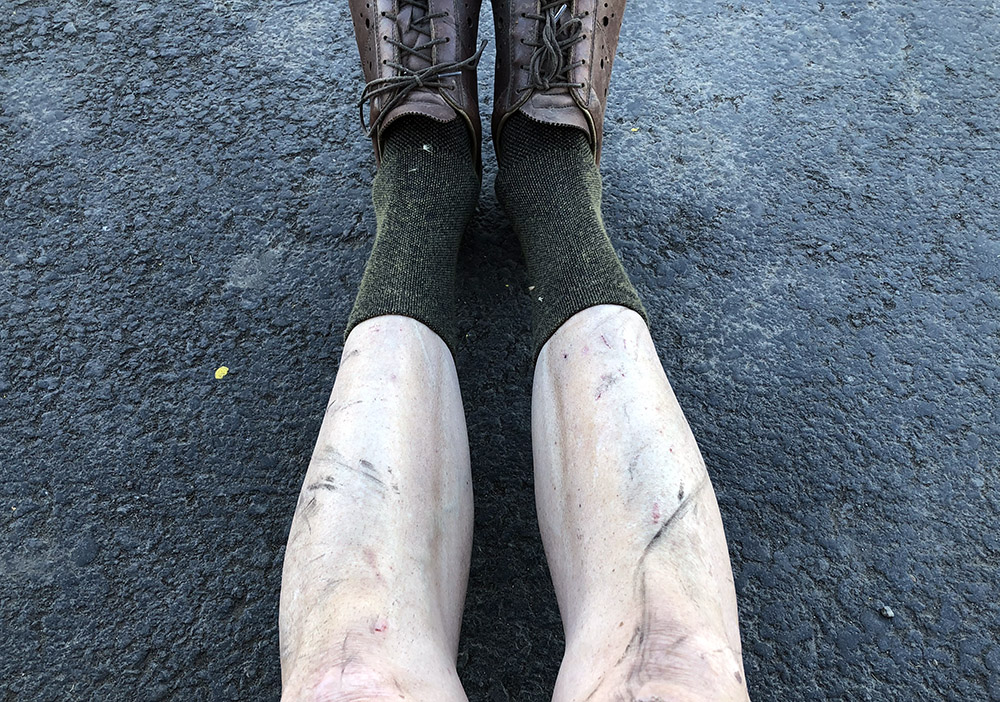
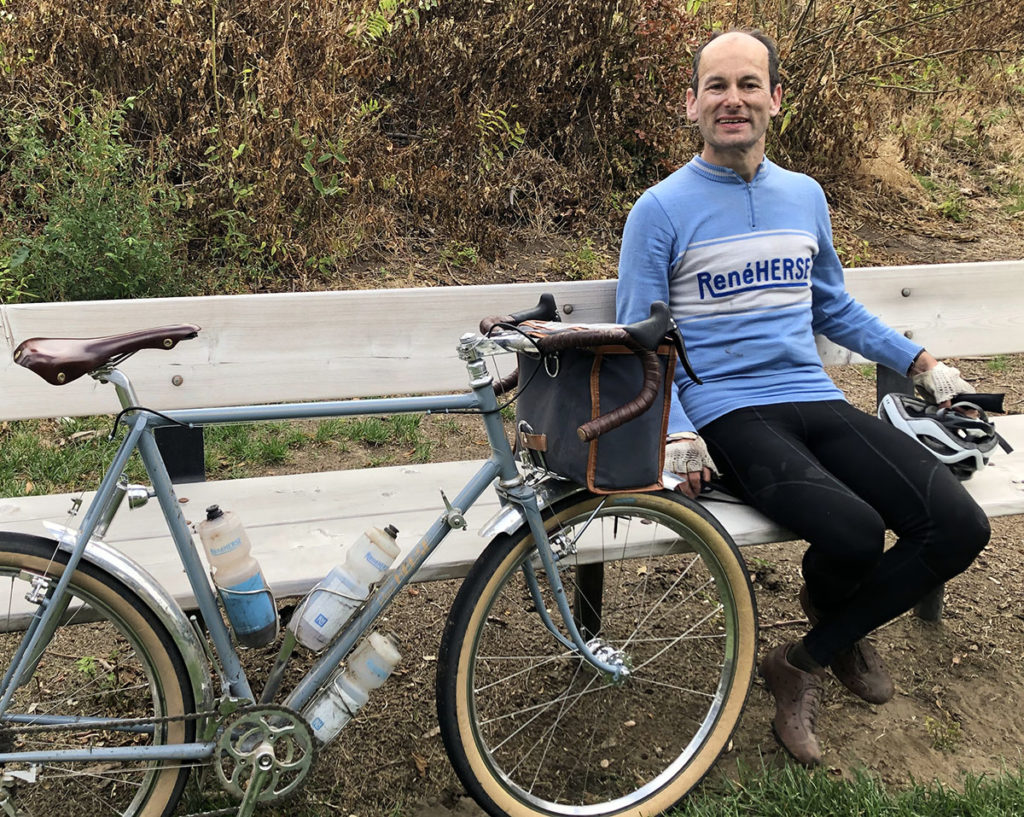
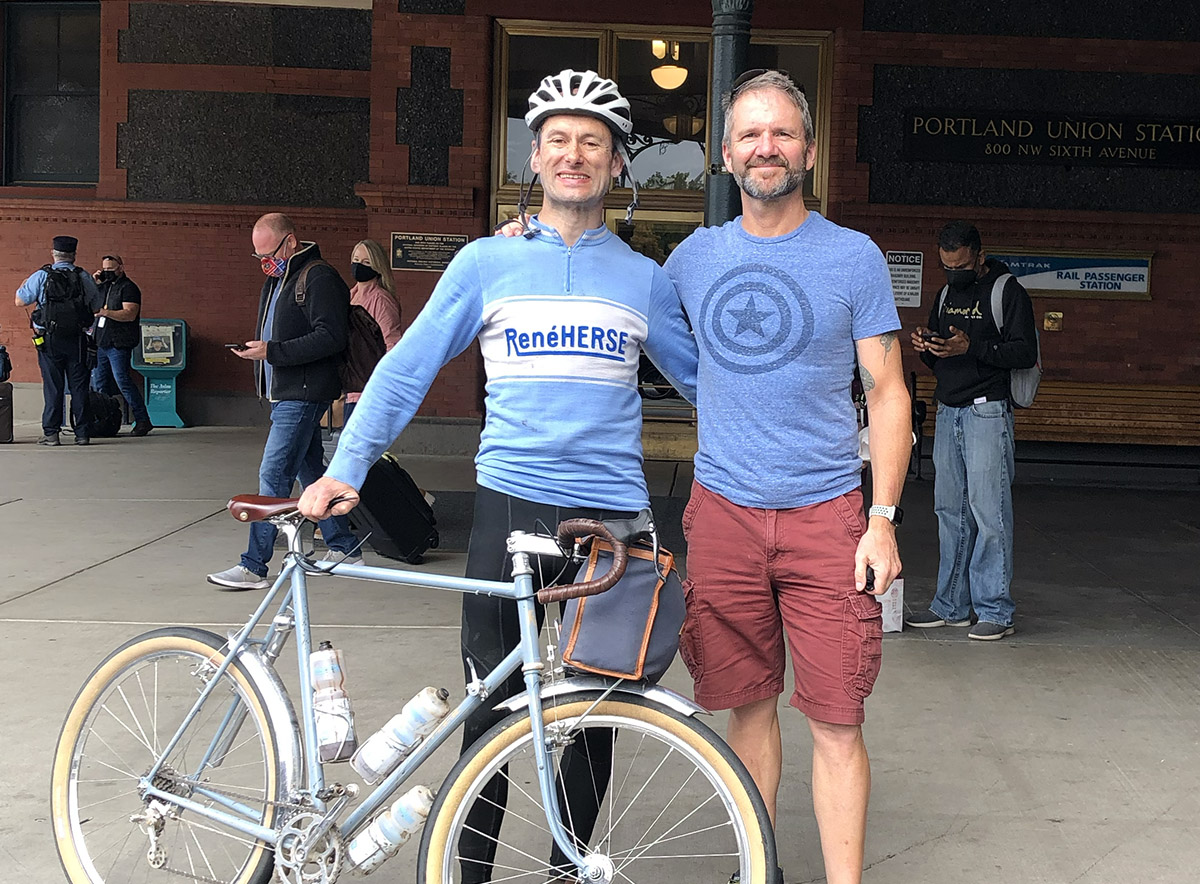


 After a short hiatus, the Curve Kevin of Steel is back with increased tire clearance, updated geometry, and even more size options. Take a closer look at the new Curve Kevin of Steel 4 here...

/uploads/napster-ai.png)
 Today's edition of Weekend Snapshot finds a few more folks from our worldwide bikepacking community out riding and camping around Alaska, Norway, and British Columbia. See how fellow readers spent their recent Saturday and Sunday and share a shot from one of your getaways on two wheels here...
 Dan Camp's 40th video documenting his ride across the Americas picks up at the southern edge of Bolivia's iconic Salar de Uyuni and follows him as he pedals southward toward Chile on La Ruta de las Lagunas. Watch the 30-minute episode here...
 Do simple bike rides sometimes feel like they're not enough? In his latest video, Dom Richard reflects on how chasing bigger bikepacking adventures made smaller rides feel less worthwhile. He heads out on a wet afternoon to test a theory about just getting on a bike and going somewhere...
 Deep in the Aosta Valley, part of the Graian Alps, lies a small circuit around the Rutor Massif, with every pocket of mountains and valleys holding local traditions, culture, and […]
 Tailfin's latest video is a deep dive into the recent colorful changes to their bags. To explain the "why" behind the launch of the Colours Collection, their designers take viewers through the challenges of bringing these unique bags to market. Watch the full video below...




 Inspired by the unmistakable horizontal silhouette of the classic 110 camera, the Camp Snap 110 D is a screen-free digital camera with five built-in filters and a vintage look. Learn more about today's pre-order here...
 This week’s Debrief features a simple poll (chamois or no?), a teaser for the new Trek 32" bike, sustainable zip ties, how to etch bike parts, a saddle bag rack from Memento, several events to follow live, and much more. Find it all here…